
Many Gaggia Classic Pro owners have had the same small moment of confusion. The first shot of the session is decent, but the second one suddenly feels sweeter, calmer, or more balanced. Nothing dramatic changed. The grinder stayed in the same place. The dose stayed close. The coffee was the same. But the cup improved.
That experience is so common that it is worth taking seriously. In many cases, it is not random luck. It is the machine telling you that the full brew path was not yet as settled as it looked at the start.
This does not mean the first shot is always bad, and it does not mean every second shot will be excellent. It simply means that small single-boiler machines often become easier to read after they have already moved a little heat and water through the system.
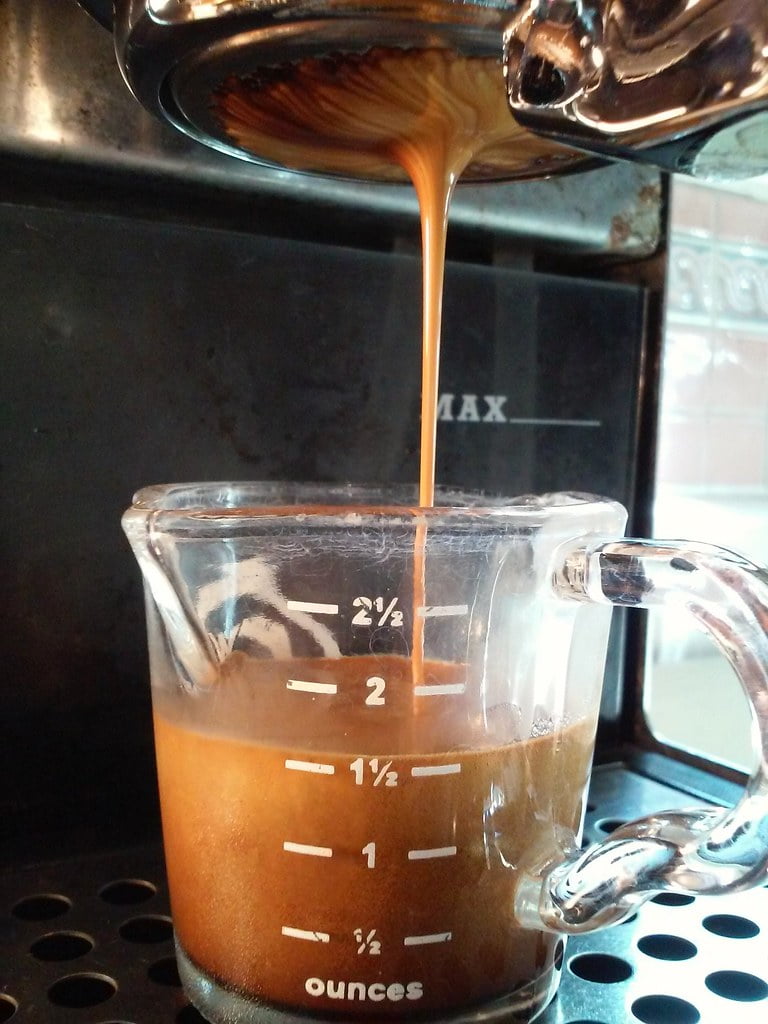
Photo credit: “An espresso pull – homecafe, homebarista” by Flickr user Aludra, licensed under CC BY 2.0.
Table of Contents
- What people are usually tasting
- Why the first shot can feel less settled
- What the second shot is often telling you
- A practical way to test this at home
- How to make the first shot more reliable
- When the problem is not temperature
- Preguntas frecuentes
What people are usually tasting
When people say the second shot tastes better, they usually do not mean it becomes a completely different coffee. The change is often more subtle than that. The second shot may taste a little rounder. It may feel less sharp at the edges. It may hold together better through the middle of the cup.
That kind of improvement matters because it changes how trustworthy the session feels. If the second shot is easier to like than the first, the machine may still be settling into a more stable condition while you are already brewing.
For home baristas, this is important because it changes how you interpret feedback. A weak first shot can tempt you to move the grinder too quickly, when the more useful answer may be to look at heat, warm-up, and routine first.
Why the first shot can feel less settled
The Gaggia Classic Pro is a capable machine, but it is still a compact single-boiler design. That means the boiler, group area, portafilter, and metal around the brew path do not all warm in exactly the same way or at the same speed.
The machine may look ready because the switch lights are on and the waiting time feels long enough. But inside the routine, the first real shot often does more than make coffee. It also moves heat through parts of the machine that were only partly stabilized before the shot began.
That is why the second shot can feel calmer. The system is no longer waking up. It is already working.
Sometimes the first shot is not only a drink. It is also part of the machine’s final warm-up.
What the second shot is often telling you
If the second shot is better in a consistent way, it usually points to one useful idea. Your workflow may be close, but not fully settled before the first extraction starts.
That does not automatically mean you need a PID, and it does not prove that temperature is the only issue. But it does suggest that thermal stability deserves more attention than many people first give it.
| If the second shot feels better because… | It may suggest… |
|---|---|
| The flavor is sweeter and less sharp | The brew path may be more thermally stable by the second shot |
| The body feels more complete | The extraction conditions may be settling into a more repeatable range |
| The shot is easier to judge | The machine is giving cleaner feedback after the first cycle |
This is one reason so many Gaggia owners eventually look at temperature control more seriously. Once your grinder and basic prep become more stable, the machine’s thermal behavior becomes easier to notice.
A practical way to test this at home
If you want to test whether this pattern is real in your own setup, keep the routine as calm as possible for a few sessions. Use the same coffee, the same dose, the same yield target, and the same warm-up timing. Then compare the first and second shots without rushing to change the grinder after the first cup.
The goal is not to run a laboratory experiment in your kitchen. The goal is simply to observe whether the second shot keeps becoming easier to like under similar conditions.
If it does, that is useful information. It means the machine may be asking for a more stable starting routine, not only a different recipe.
A good home test
If the second shot keeps winning even when grind and dose stay close, do not blame the grinder too quickly. Look at machine readiness first.
How to make the first shot more reliable
The good news is that this issue is often manageable. In many home setups, the first shot improves when the warm-up routine becomes a little more deliberate and a little more repeatable.
| Adjustment | Why it can help |
|---|---|
| Give the machine more time before the first shot | More of the brew path has time to settle |
| Keep the portafilter locked in while warming up | The metal around the basket is less cold at the start |
| Use a repeatable pre-shot routine | The first shot becomes easier to compare from day to day |
| Consider better temperature control later | The machine may become easier to read and easier to repeat |
If this problem appears again and again, that is also where a Kit de Control de Temperatura PID starts to make sense for many owners. Not because it makes the machine magical, but because it can reduce one large source of guesswork.
When the problem is not temperature
Not every weak first shot is a heat problem. Sometimes the first shot is worse because the grinder is drifting, the puck prep is inconsistent, or the user is still waking up and moving too quickly. That is why it helps to stay honest.
If both the first and second shots are unstable, or if the flavor swings wildly in ways that do not form a pattern, the issue may still be somewhere else. Temperature matters, but it is not the only thing that matters.
This is also why good upgrade advice should be calm. The goal is not to turn every small problem into a reason to buy parts. The goal is to understand what the machine is actually telling you.
Quick checklist
- If the second shot is better again and again, check warm-up before changing grind.
- If both shots are unstable, check prep and grinder consistency too.
- If the machine feels close but not trustworthy, better temperature control may be the next useful step.
If you want to keep building from this topic, the next useful pages are the PID temperature reference page, the broader article on why temperature stability matters, and the HomeBaristaMods reference library.
Preguntas frecuentes
Is it normal for the second shot to taste better on a Gaggia Classic Pro?
Yes, it can be. Many owners notice this pattern when the machine is good but not fully settled before the first extraction.
Does this always mean I need a PID?
No. It means you should pay more attention to thermal stability and warm-up routine. A PID may help later, but it is not the only possible answer.
Should I change grind after one weak first shot?
Usually not right away. First ask whether the second shot improves in a repeatable way.
Can a longer warm-up really change the cup that much?
Yes. On small single-boiler machines, a calmer and more repeatable start can make the cup easier to judge.
What should I read next?
Read the temperature stability guide for the larger explanation, or use the PID temperature reference page if you want a bookmarkable practical tool.
References
 English
  Italiano
  Deutsch
  Español
  Français
  العربية
  日本語
日本語  한국어
한국어  香港中文
香港中文  Nederlands
  Português