更清晰的因果關係.
If the same recipe tastes sweet once and then sharp or flat the next time, temperature stability may now matter more than another small grind change.
30-second answer
A PID matters because it makes the Gaggia Classic Pro easier to learn from. It reduces one large source of uncertainty, so grind, dose, and recipe changes become easier to judge.
Table of Contents
- Quick symptom check
- Why temperature stability changes the learning speed
- Roast-level starting points
- Stock thermostat vs PID control
- What a PID fixes and what it does not
- When a PID is worth buying first
- 常見問題
Quick symptom check
Before you change three variables at once, use this short check. It helps separate temperature instability from other common problems.
| What you notice | What may be happening | What to check first |
|---|---|---|
| The shot runs fast every time | Grind size or puck prep is likely the main issue | Adjust grind and prep before blaming temperature |
| The same recipe tastes different from one shot to the next | Temperature variation may be distorting the feedback | Warm-up, timing, and brew stability |
| Milk drinks taste fine but straight shots feel unstable | Small extraction shifts are becoming easier to taste | Re-check brew temperature behavior before buying random accessories |
If one shot teaches a different lesson every time, your machine is harder to learn from.
Why temperature stability changes the learning speed
Many beginners focus first on grind size, dose, and yield. That makes sense. These variables are visible and easy to adjust. Temperature is different. It quietly changes extraction behavior, but it is harder to see.
That is why the Gaggia Classic Pro can feel confusing. A user may think the problem is distribution, tamp pressure, or beans, when one of the real issues is that brew conditions are not repeating closely enough.
Once temperature behavior becomes more stable, the machine gives cleaner feedback. A grind change becomes more meaningful. A recipe adjustment becomes easier to trust. That is the practical reason many owners treat a Gaggia Classic Pro PID Temperature Control Kit as a workflow upgrade, not only an electronics upgrade.
Why people bookmark this topic
Temperature is not only theory. It affects what users do every time they open a new bag of coffee, re-check a recipe, or wonder whether the machine or the grinder is causing the problem.
Roast-level starting points
These are practical PID starting ranges for a Gaggia Classic Pro. They are not universal truths. They are meant to reduce guesswork when you switch roast levels.
| 烘焙程度 | Suggested PID starting range | Practical reading note |
|---|---|---|
| Light roast | 95 to 97 C | Useful when the cup feels thin or sharp and extraction is otherwise close |
| Medium roast | 93 to 95 C | Often the easiest range for balanced daily espresso |
| Dark roast | 90 to 92 C | Can help keep bitterness and roast harshness under better control |
For a fuller lookup version, open the PID temperature reference page. That page is designed to be revisited, not only read once.
Stock thermostat vs PID control
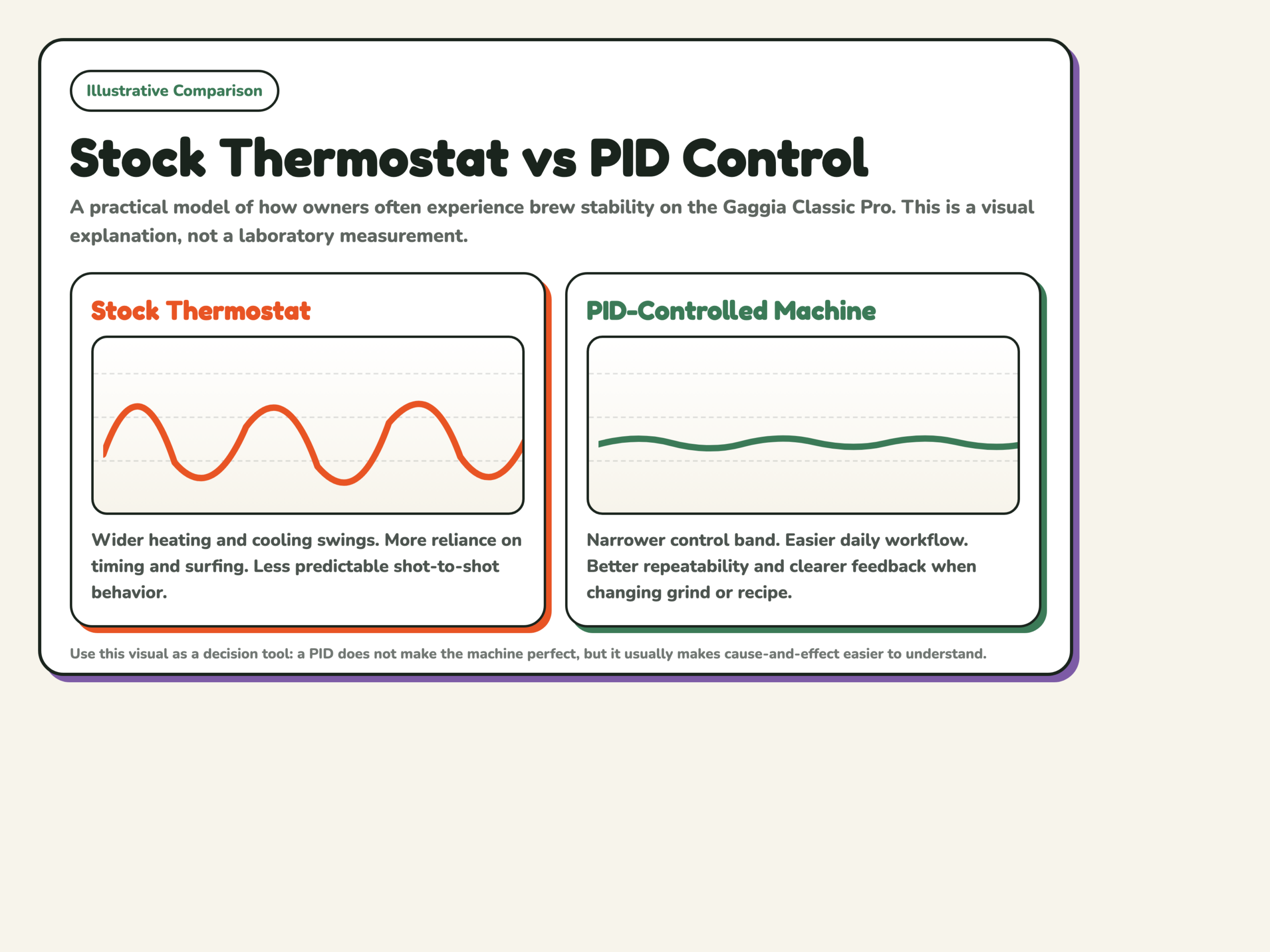
The chart below is a simplified explanatory visual, not a laboratory claim. It exists to show the practical difference most users are trying to solve: a wider stock swing versus a narrower and easier-to-repeat PID-controlled target.
| Area | Stock thermostat workflow | PID-controlled workflow |
|---|---|---|
| Temperature behavior | Wider heating and cooling cycle | Narrower and easier to target |
| Shot preparation | More timing sensitivity | More repeatable routine |
| Learning speed | More mixed signals in the cup | Cleaner cause and effect |
| 為何溫度穩定性對Gaggia Classic Pro而言,比許多初學者預期的更為重要 | More guesswork | More trust in the process |
Reading note
The value of a PID is not only better numbers. The bigger value is cleaner feedback from the cup.
What a PID fixes and what it does not
A strong article on this topic should say both sides clearly. A PID is useful, but it is not magic.
| What a PID usually improves | What a PID does not remove |
|---|---|
| Shot-to-shot repeatability | The limits of a small single-boiler machine |
| A clearer and calmer daily workflow | The need for a capable grinder |
| More useful feedback when changing recipes | The need for sensible puck prep |
| Less dependence on rough temperature surfing | The need for full warm-up and good routine |
Checklist
- Keep the machine fully warmed through before judging taste changes.
- Do not use temperature as the excuse for every grinder or prep mistake.
- Use one temperature target long enough to learn what the coffee is doing.
When a PID is worth buying first
A PID often makes the most sense when the grinder is already capable enough to reveal machine inconsistency and the owner now wants repeatability more than random shot luck.
If your shots occasionally taste excellent but are hard to repeat, temperature control deserves serious attention. In that situation, the HomeBaristaMods shop should be read as a path, not a random parts list. Performance control comes first because it improves the meaning of every later upgrade.
Next step: turn theory into a working setup
Save these pages for later.
If this article clarified why temperature control matters, these pages will help you use that idea in daily brewing. They are built as practical references, not one-time reading.
常見問題
Is a PID more important than a grinder on the Gaggia Classic Pro?
Not always. If the grinder is still the main weak point, grinder quality may matter more first. But once the grinder is already capable, a PID often becomes one of the clearest machine upgrades for repeatability.
Does a PID remove the need for temperature surfing?
In most cases, it reduces the need for rough temperature surfing a lot. It does not remove the need to understand warm-up and shot sequence, but it usually makes the workflow much easier.
Will a PID make the machine taste like a very expensive dual boiler?
No. It improves control and repeatability, but it does not change the fact that the Gaggia Classic Pro remains a small single-boiler machine with its own limits.
Why do some owners still talk about offsets after installing a PID?
Because the displayed boiler temperature is not exactly the same thing as brew water temperature at the puck. A PID improves control, but the machine still needs sensible setup and workflow.
Should I buy cosmetic parts before a PID?
If your machine still feels inconsistent in daily use, performance control usually creates more value first. Cosmetic parts make more sense after the core workflow feels stable.
References
 English
  Italiano
  Deutsch
  Español
  Français
  العربية
  日本語
日本語  한국어
한국어  香港中文
香港中文  Nederlands
  Português