
Dedica vs Gaggia Classic: cheap starter or real platform?
A €200 compact thermoblock vs a €450 aluminum-boiler mod platform. One is the cheapest real-espresso on-ramp; the other is a machine you can grow into for a decade. Compared by someone who's wrenched on both.
The Dedica EC685 is the cheapest real-espresso on-ramp once modded; the Gaggia Classic is the platform you keep for a decade. I have owned both, wrenched on both, and the answer depends on whether you want to spend two hundred or four hundred fifty euro up front.
Budget entry, tiny kitchen, partner-acceptance-factor: buy the Dedica EC685, swap the basket, transplant a Rancilio wand, wire a dimmer. You spend two hundred euro plus one hundred fifty in parts and get eighty percent of a specialty shot. Geek path, long-term platform, commercial-grade parts: buy the Gaggia Classic, drop the OPV to nine bar, add a PID, then decide whether Gaggiuino belongs in your future.
Both machines ship broken from the factory in different ways. The Dedica kneecaps every shot with a pressurized basket and a Panarello wand. The Gaggia ships at fifteen bar with a seventeen-degree thermostat swing. Every mod in this guide attacks one of those factory compromises.
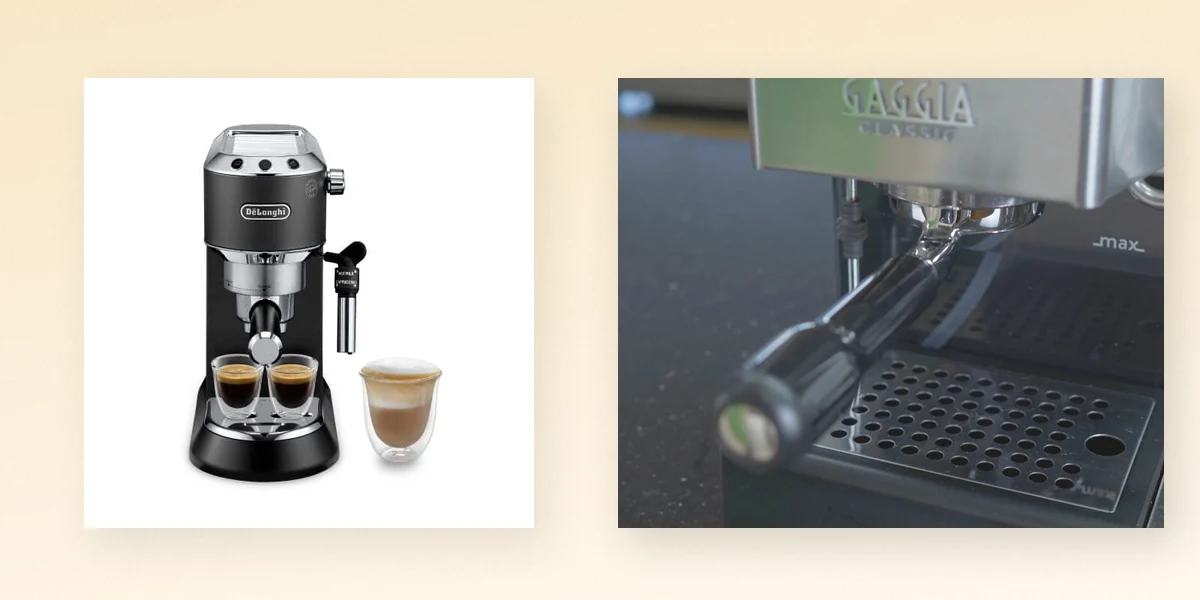
STOCK FLAWS Is the Dedica a real espresso machine?
Out of the box, no. The factory ships three parts that kneecap every shot: a dual-wall pressurized basket with a single pinhole exit, a Panarello steam sleeve running on the Venturi effect, and a fifteen bar Ulka vibration pump with no over-pressure valve. Each one trades cup quality for forgiveness. That pressurized basket traps water between two metal walls and forces it through one tiny hole, whipping air into a brown foam that looks like crema but carries almost no aroma. The Panarello dumps coarse soap-bubble froth into your milk. Run the pump against a fine puck and pressure spikes past fifteen bar because nothing bleeds it off, so the bed channels and the shot blondes early. Once you ditch that pressurized basket for a 51mm IMS non-pressurized basket and a bottomless portafilter, transplant a Rancilio Silvia V1 steam wand, and wire a dimmer into the pump line for nine-bar pressure control, the Dedica punches above its weight. The fifteen-centimeter chassis earns a huge install base and a high Partner Acceptance Factor on kitchen counters, but none of that fixes the cup until you mod it. Read the full Dedica EC685 modding guide for every screw, clip, and failure mode.
Key takeaway: Stock Dedica trades flavor for forgiveness; the pressurized basket, Panarello wand, and OPV-less fifteen bar pump all hold it back.
CEILING Can the Dedica match a Gaggia after mods?
Close, but not equal. A modded Dedica with basket, dimmer, gauge, and Rancilio wand pulls genuine specialty shots with real crema, real microfoam, and real pressure control. I have served guests cortados from mine and watched them not guess the machine. The wall you hit is thermal: the Thermablock heats instantly but holds almost no mass, so back-to-back shots drift, and steam energy runs out halfway through a four-hundred-milliliter pitcher. A modded Gaggia with OPV clamped to nine bar, a PID holding a third of a degree, and a single-hole steam tip clears that wall. The hundred-milliliter aluminum boiler is small, but a PID-fed SSR turns it into a stable brew cylinder, and the 58mm commercial group shares baskets and screens with multi-thousand-dollar machines. The Dedica gets you to eighty percent of specialty; the Gaggia gets you to ninety-five percent and keeps climbing toward Gaggiuino territory. The full Gaggia Classic modding guide walks every mod in order.
Key takeaway: A modded Dedica reaches real specialty territory; a modded Gaggia reaches commercial territory and keeps climbing.
COST MATH Which is cheaper to upgrade?
The Dedica, by a wide margin, but the math surprises people. The machine itself runs roughly two hundred euro. The high-impact mod path costs another one hundred fifty: a 51mm IMS basket and bottomless portafilter, a Rancilio Silvia V1 steam wand, an AC phase-cut dimmer, a zero-to-three-hundred-PSI gauge, a brass T-fitting, and PTFE tape. Add an espresso-grade grinder like a Baratza Encore ESP or Kingrinder K6, budget at least as much as you spent on the machine. The Gaggia Classic starts near four hundred fifty euro, and the minimum mod path costs two hundred more: a nine bar stainless OPV spring, or a brass adjustable OPV on pre-2015 models, a Shades of Coffee or Auber PID kit with an SSR-40DA, and a single-hole steam tip. A dimmer with a 3.3 kilo-ohm bleed resistor adds thirty euro. By the time you reach parity on shots, you have spent three hundred fifty on the Dedica path and six hundred eighty on the Gaggia path. The Gaggia costs roughly double, and it is worth every euro if you plan to keep it.
Key takeaway: Dedica mod path lands near three hundred fifty euro all-in; Gaggia mod path lands near six hundred eighty — the Gaggia is double the money and double the ceiling.
GROUP HEAD Is 51mm a dead end?
No, but it is a narrower road. The Dedica 51mm three-lug bayonet is shared across EC680, EC685, EC785, and EC885, and IMS manufactures precision baskets for the whole family. You will never run out of parts. The catch is that a smaller diameter means an equal dose produces a thicker puck, so dosing ceilings run sixteen to eighteen grams, and dark roasts top out at fourteen to fifteen grams before the puck touches the dispersion screen. Your grind window is narrower than a Gaggia Classic demands, and any overdose destroys bed structure the moment the pump hits pressure. The 58mm commercial group on the Dedica's bigger rivals shares baskets, tampers, and screens with cafe machines. A VST eighteen-gram basket, a Pullman Big Step tamper, a 58mm puck screen — all drop straight into a Gaggia. If you ever want to graduate to a Lelit Anna, a Rancilio Silvia, or a Flair 58, your 58mm tooling travels with you. Your 51mm tooling stays on the Dedica.
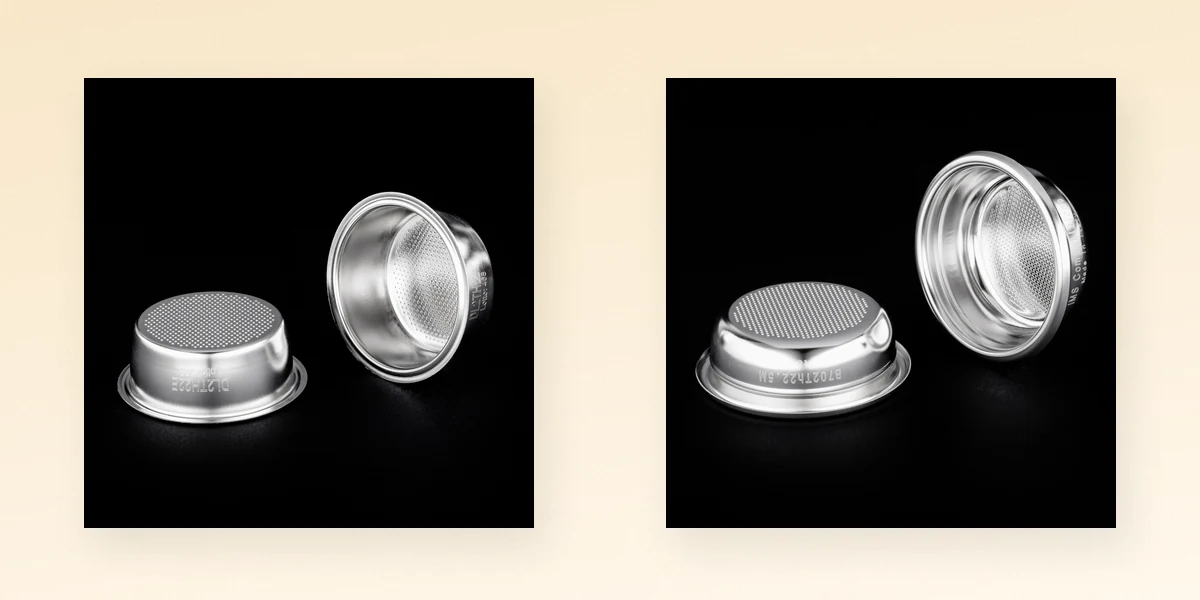
Key takeaway: 51mm is not a dead end, but it is a cul-de-sac; 58mm is the commercial standard your tooling outlives the machine with.
BUYER PROFILE Which is better for a beginner?
Depends on who you are. If you have never pulled a shot, never owned an espresso grinder, and you are not sure this hobby sticks, buy the Dedica. The pressurized basket forgives blade-grinder coffee and zero tamping effort. The fifteen-centimeter footprint fits a studio apartment. Partner Acceptance Factor on the kitchen counter is off the charts. When you outgrow it, the mod path teaches you pressure, temperature, and puck prep without drowning you in boiler thermodynamics. If you already own a capable grinder, you have been making pour-over, and you want a machine that grows with you for ten years, buy the Gaggia. The 58mm group means your existing tools fit. The three-way solenoid dumps pressure after each shot and keeps your puck dry, which is a workflow upgrade you feel every morning. Factory fifteen bar and seventeen-degree thermostat swing need fixing on day one, but once OPV and PID land, the machine disappears and you just pull shots. The Dedica guide covers the beginner path in detail.
Key takeaway: Starter machine, no grinder, tiny kitchen: Dedica. True platform, grinder ready, ten-year horizon: Gaggia.
STEAM SYSTEM Does the Dedica steam wand swap close the gap?
Partially. The Rancilio Silvia V1 or V2 single-hole steam wand, six millimeters outer diameter, one hundred eighty millimeters length, is the definitive Dedica steam mod. Pull the factory Panarello sleeve, remove nine T20 Torx screws from the bottom plate, disconnect the high-pressure hose linking the steam knob to the pump, remove the circlip on the factory ball joint, and force the Rancilio ball in from the bottom. Lubricate the rubber sleeve with dish soap, apply repeated torsion and axial force until the ball clears the bend, and you have a real single-hole tip producing a concentrated, penetrating jet. You can microfoam latte-art milk. The gap that remains is energy: the Dedica Thermablock gives you maybe twenty seconds of useful steam before temperature drops, and a four-hundred-milliliter pitcher drains it dry. The Gaggia hundred-milliliter aluminum boiler is also small, but a single-hole tip like Shades of Coffee "The One" matches steam mass flow to the boiler recharge rate. The heater stays on continuously, the jet stays fast, and the microfoam window stretches to a full pitcher. See the Gaggia Classic guide for the donor wand details.
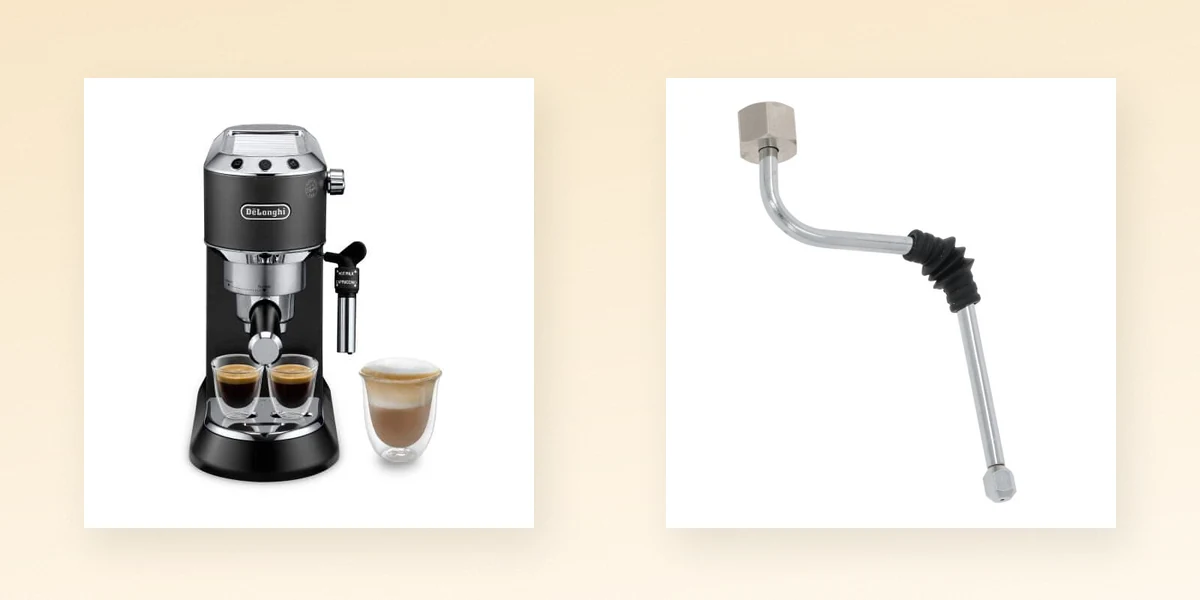
Key takeaway: The Rancilio wand transplant gives the Dedica real microfoam; the Gaggia matched single-hole tip gives it sustained microfoam.
THERMODYNAMICS Which machine holds temperature better?
The Gaggia, by a wide margin, and not even close. The Dedica Thermablock heats in seconds, which is wonderful for boot time, but the block holds almost no thermal mass. Cold water from the tank hits the block, the block cools, the thermistor reacts, and shot temperature drifts several degrees across a thirty-second pull. Back-to-back shots drift further. There is no factory PID, and the Arduino PID build is a weekend of soldering, tapping an M4 thread into the aluminum, splicing a T-fitting, and running a zero-point-nine-six-inch OLED — a build that eats time and rewards tinkerers more than it rewards drinkers. The Gaggia hundred-milliliter aluminum boiler is also low mass, but the factory bimetal thermostat swings seventeen degrees, and the community has spent twenty years perfecting PID kits. An Auber or Shades of Coffee PID with an SSR-40DA replaces the bimetal thermostat with a Pt100 thermocouple, and the heater holds brew temperature inside a third-of-a-degree band. Temperature surfing ends. Shot consistency jumps immediately. The Gaggia PID install guide walks the full thirty-three-step path.
Key takeaway: Dedica temperature is fast but unstable; a PID-fed Gaggia holds a third of a degree and ends temperature surfing.
PRESSURE Can you pull turbo shots on both?
Yes, but the paths look completely different. A turbo shot runs at six-point-five bar dynamic pressure, allowing a finer grind, shorter time, and higher extraction yield with fewer bitter large molecules. On the Gaggia, you swap the OPV spring for a six-point-five bar stainless spring. Drop it into the black plastic Pro/Evo valve body, reassemble, grind finer for a twenty-five-to-thirty-second flow, and you are pulling turbos. No electronics needed. On the Dedica, there is no OPV to swap. You wire a phase-cut dimmer into the brown pump wire, mount a potentiometer on the chassis, watch a pressure gauge, and hold the knob at six-point-five bar by eye for the entire shot. It works, and I have pulled excellent turbos this way, but you are the closed-loop controller. Your hand drifts, the pressure drifts. The Dedica turbo path is analog and rewarding; the Gaggia turbo path is mechanical and repeatable. Compare with the Silvia vs Gaggia breakdown for how a factory OPV changes the story.
Key takeaway: Gaggia turbos need a fifteen-euro spring; Dedica turbos need a dimmer, a gauge, and your steady hand.
LONGEVITY Which one still makes sense in five years?
The Gaggia, without hesitation. I have rebuilt Classics built in 1995 that still pull shots after a new boiler gasket and a descale. The 58mm commercial group is a standard. The solid metal chassis gives real metal for grounding and mounting. The three-way solenoid is a serviceable part with a known orifice and a known O-ring. When the Evo Pro Boilergate coating crisis hit in late 2023, the community response was a brass boiler upgrade — heavyweight, corrosion-proof, larger thermal mass — that turns a defective machine into a commercial-grade brewer. The Dedica has a different five-year story. Soft tubing and plastic diverters embrittle under repeated heat cycling. Steam volume drops not from scale but from a snapped plastic diverter inside the milk-frothing unit. The PTFE line ages. The mainboard dies. Machines several years old lose steam volume, and parts availability shrinks because the platform is treated as disposable by its manufacturer. You keep a Dedica running because you love it, not because the platform rewards you.
Key takeaway: A five-year Gaggia is midlife; a five-year Dedica is end-of-life, kept alive by stubborn owners.
LIMITS Where does each machine hit a wall?
The Dedica hits its wall at thermal stability and steam energy. Once you have added the basket, the dimmer, the gauge, and the Rancilio wand, the next upgrade is an Arduino PID build, and the build eats a weekend for diminishing returns. You cannot add boiler mass. You cannot add a three-way solenoid. You cannot widen the 51mm group. The Dedica ceiling is a budget pressure-profiling rig that pulls real specialty shots and dies in five years. The Gaggia wall is further out, and the wall keeps moving. OPV, PID, dimmer, single-hole tip — these are entry-level mods. Gaggiuino replaces four scattered modules with one closed-loop MCU running on an STM32 or ESP32, reading an electronic pressure transducer at millisecond scale, driving a zero-cross AC dimmer for stepless variable pressure, and reading a load cell under the drip tray for stop-on-weight dosing accurate to a tenth of a gram. A fully modded Classic pulls shots next to machines costing ten times more. The Gaggia ceiling is a Decent DE1 rival for under a thousand euro all-in. The Dedica ceiling is a great espresso machine for under four hundred. The Gaggia guide maps the full Gaggiuino path.
Key takeaway: Dedica ceiling is a great budget espresso rig; Gaggia ceiling is a commercial-grade pressure profiler rivaling a Decent DE1.
SPEC TABLE Core specs: Dedica vs Gaggia
| Spec | Dedica EC685 | Gaggia Classic |
|---|---|---|
| Street price | ~€200 | ~€450 |
| Group head | 51mm three-lug bayonet | 58mm commercial |
| Boiler / heater | Thermablock (instant, low mass) | 100ml aluminum (fast, low mass) |
| Pump | Ulka vibration, 15 bar | Ulka vibration, 15 bar |
| OPV (factory) | None | Brass adjustable (pre-2015) / fixed plastic (Pro/Evo) |
| Stock basket | Dual-wall pressurized | Single-wall commercial |
| Steam wand (factory) | Panarello (Venturi) | Panarello (older) / two-hole (Pro/Evo) |
| Thermostat | Thermistor, hidden menu | Bimetal, 17°C swing |
| PID option | DIY Arduino (~€40 parts) | Auber / Shades of Coffee kits (~€150) |
| 3-way solenoid | No | Yes |
| Mod ceiling | Basket + dimmer + gauge + Arduino PID | Gaggiuino closed-loop rebuild |
| Footprint | 15 cm chassis | Full-size prosumer |
COST TABLE Upgrade cost: Dedica path vs Gaggia path
| Mod | Dedica | Gaggia |
|---|---|---|
| Precision basket + bottomless portafilter | €70 (51mm IMS) | €90 (58mm VST) |
| OPV spring swap | N/A — no OPV | €15–€40 |
| Dimmer + pressure gauge + T-fitting | €50 | €30 (dimmer only) |
| Steam wand upgrade | €40 (Rancilio V1 transplant) | €35 (single-hole tip) |
| PID | €40 (Arduino DIY) | €150 (Auber kit) |
| Gaggiuino MCU rebuild | N/A | €250+ |
| Brass boiler upgrade | N/A | €0–€300 |
| Espresso grinder (Baratza Encore ESP) | €180 | €180 |
| Total to specialty-grade | ~€350 | ~€680 |
FIT TABLE Which machine fits you?
| Your situation | Recommendation |
|---|---|
| Absolute budget under €400 all-in | Dedica + basket + Rancilio wand + dimmer |
| Studio apartment, 15 cm counter | Dedica (stock until you outgrow it) |
| No grinder yet, not sure hobby sticks | Dedica + Encore ESP |
| Geek path, ten-year platform | Gaggia Classic + OPV + PID |
| Want a Decent DE1 rival under €1000 | Gaggia Classic + Gaggiuino |
| Gift for a non-hobbyist coffee drinker | Dedica stock (forgiving pressurized basket) |
| Light-roast turbo shot enthusiast | Gaggia Classic + 6.5 bar OPV spring |
| Latte art on a budget | Dedica + Rancilio wand transplant |
FAQ Dedica vs Gaggia Classic quick answers
Can I use a 58mm basket in my Dedica?
No. The Dedica group head uses a 51mm three-lug bayonet shared across EC680, EC685, EC785, and EC885. A 58mm commercial basket will not seat, seal, or lock into the portafilter. You need a 51mm precision basket from IMS. Anyone selling a 58mm basket for a Dedica does not know the machine. The smaller diameter means an equal dose produces a thicker puck, so dosing ceilings run sixteen to eighteen grams and dark roasts top out at fourteen to fifteen grams.
What is the best grinder for both machines?
Community consensus lands on three: Baratza Encore ESP, Kingrinder K6, and DF54. All three hit espresso-fine particle distribution without blade-grinder dust. The same three grinders serve the Gaggia. Budget at least as much for the grinder as you spent on the machine. Blade and pour-over grinders produce particles too coarse for a non-pressurized basket; water runs through in ten seconds with no crema. The Encore ESP is the cheapest reliable entry, the Kingrinder K6 is the hand-grinder pick, and the DF54 is the flat-burr choice.
How do I know if my Dedica needs descaling?
The steam button turns orange or red and blinks steadily or goes solid. The mainboard integrates flowmeter volume against your water hardness setting, and when cumulative volume crosses the threshold it flags scale risk in the fine heating tubes. Fill the tank with DeLonghi EcoDecalk descaler and run the full program. Many users report the light keeps blinking because they interrupted the cycle; after the chemical wash, run at least two fresh-water rinse cycles with the tank filled to MAX to trigger the float sensor. Skipping descaling calcifies the aluminum Thermablock and shortens machine life.
Can I pull a turbo shot on a Dedica without Gaggiuino?
Yes, but you become the closed-loop controller. Wire a dimmer into the brown pump wire, mount a pressure gauge, and hold six-point-five bar by eye for the entire shot. The Gaggia path is simpler: swap the OPV spring for a six-point-five bar stainless spring and grind finer. No electronics needed. The Dedica turbo path is analog and rewarding; the Gaggia turbo path is mechanical and repeatable. A pressure gauge makes the Dedica diagnosis trivial.
How do I know if I should skip the Dedica and go straight to a Gaggia?
If you already own an espresso-grade grinder, you have been making pour-over, and you know you want a ten-year platform, skip the Dedica. The Gaggia 58mm commercial group shares baskets and tampers with cafe machines, the three-way solenoid keeps your puck dry, and the mod ceiling runs all the way to Gaggiuino. If you are not sure the hobby sticks, start on the Dedica and upgrade later. The mod path teaches you pressure, temperature, and puck prep without a large up-front commitment.
Still stuck on which machine fits your kitchen, your budget, or your shot goals? Talk to us — we rebuild these every week and will point you at the right platform.
Pick your entry point.
The Dedica is a starter that punches above its weight; the Gaggia is a platform. If you're not sure which fits your budget and ambition, talk to us.
 English English
  Italiano
 Deutsch
 Español
 Français
 العربية
 日本語
日本語
 한국어
한국어
 香港中文
香港中文
 Nederlands
 Português