

Black flecks in a white cup look dramatic. You want espresso, not black dots. First, identify the source path.
Black flakes can come from an Evo lined boiler, aluminum oxide, scale, gasket debris, coffee residue, or startup debris. Test steam-wand water and group water separately, note your model year, and contact support if flakes repeat after flushing.
This is not a panic article. It is a sorting article. The machine may need a simple clean, a support ticket, or a boiler inspection. The cup is giving evidence. Let it speak before you buy parts.
Table of Contents
- What should you do first when you see black flakes?
- How do model year and boiler type change the diagnosis?
- How can you tell coating flakes from scale or coffee debris?
- Why does the steam wand test matter so much?
- When should you stop flushing and contact support?
- Can water and descaling make black particles worse?
- What repair or upgrade path makes sense?
- 자주 묻는 질문
What should you do first when you see black flakes?
You see black dots. Your brain jumps to the worst case. The machine may still be diagnosable.
Stop pulling drinks, flush into a white cup, and test the steam wand and group head separately. Write down where the flakes appear, how often they appear, and whether they reduce after flushing.
Start with a clean test. Remove the portafilter. Use a white cup or white bowl. Run water from the steam wand first. Then run water from the group head. Do not use coffee during this test. Coffee grounds can create a false diagnosis, and that small mistake can waste a lot of time.
The goal is not to identify the material by color alone. Color is weak evidence. A black speck can be coating, oxide, gasket material, old coffee residue, or debris loosened by cleaning. The stronger evidence is the pattern.
Use this first log:
If flakes appear once and then stop after a careful flush, the problem may be loose manufacturing residue or debris from a recent service. If flakes continue after repeated flushing, treat it as a real fault. The machine is no longer just being quirky. It is asking for a support ticket, very clearly.
For flow problems that happen together with debris, keep the Gaggia Classic Pro no-water diagnostic guide nearby. Flakes and low flow can share the same root cause when scale or debris blocks the water path.
How do model year and boiler type change the diagnosis?
The same black dot can mean different things on different machines. The badge is not enough.
A 2023 Classic Evo Pro with a lined aluminum boiler raises coating questions. A 2019-2022 Classic Pro points more toward aluminum oxide, scale, gasket debris, or water chemistry. An E24 uses a brass boiler, so the diagnosis changes again.
This model split matters because owners often search one scary phrase and then apply it to every Gaggia Classic. That creates bad decisions. The 2023 Evo conversation is real, but it does not make every black particle a lined-boiler coating failure.
Whole Latte Love states that Gaggia started replacing lined Evo boilers with unlined boilers on machines from a later serial range. Gaggia North America also lists a 2024 brass boiler for the Classic E24, and says that part is compatible with the Classic, Classic Pro, and Classic Evo Pro. Those two details matter because they show that the boiler story has changed over time.
Use this model map:
Forum posts show why this split is useful. Evo owners often describe black flakes from the steam wand and then worry about the lined boiler. Older-machine owners describe black specks too, but those cases can involve aluminum oxide, scale, soft water, stale storage, or worn seals.
So do not diagnose by internet fear level. Diagnose by model, source path, and repeat pattern. Even the coffee dog wants the serial number before blaming the boiler.
How can you tell coating flakes from scale or coffee debris?
The cup shows particles. It does not print a lab report. You need a simple decision map.
Coating flakes are more suspicious on a 2023 Evo when dark flakes repeat from the steam wand or both paths. White or pale flakes usually point to scale. Dark specks from the group only may be coffee debris.
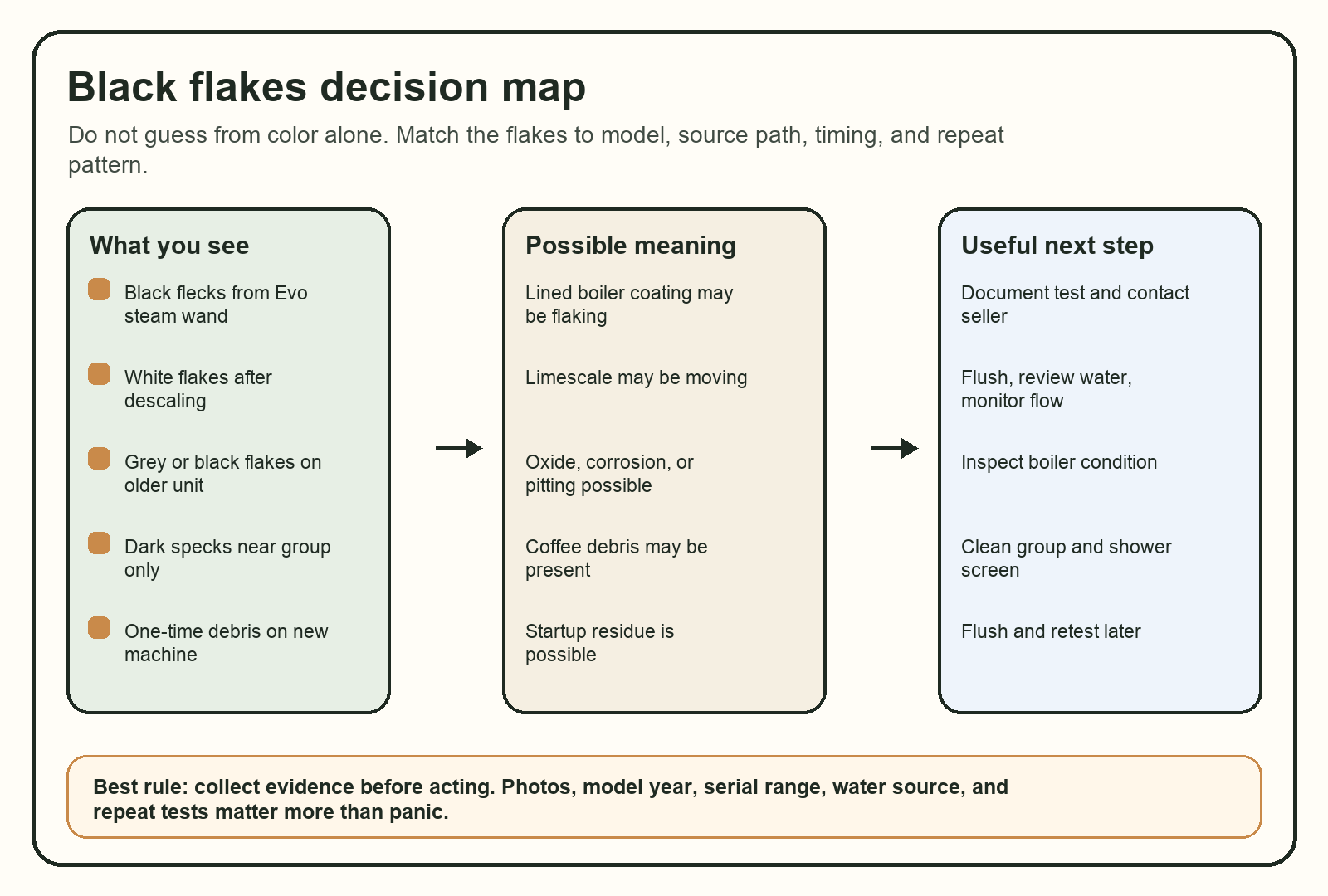
The useful question is more specific than “what color is it?” Ask where it came from, and whether it kept coming. A one-time speck after a new setup is different from recurring black flakes after several flushes. A few grounds from the group are different from flakes that appear from the steam wand with no coffee involved.
Use this table before you open the machine:
Coating flakes usually concern owners because they do not behave like normal scale. They can look like flexible or dark fragments, and they may keep appearing after flushing. Scale is often pale, hard, and chalk-like. Coffee residue usually smells like coffee and appears around the group path, basket, or shower screen.
Still, do not pretend the kitchen counter is a laboratory. If the flakes are persistent, visible, and unknown, the practical move is to stop making drinks and contact support. That is not dramatic. That is clean risk control.
Why does the steam wand test matter so much?
The steam wand bypasses the coffee puck. That makes it a good witness.
If flakes appear from the steam wand, the source is likely upstream of the wand, not coffee grounds in the portafilter. This helps separate boiler-path debris from puck-prep debris.
Many owner reports start the same way. The user thinks the black dots are coffee grounds. Then they flush hot water from the steam wand into a white cup and still see particles. That test changes the diagnosis. Coffee never touched that path, so the puck cannot be blamed.
The steam wand test also exposes patterns that the group can hide. A portafilter, puck screen, basket, and coffee bed can trap particles. The cup from the steam wand is more direct. It is not perfect, but it is cleaner evidence.
Run the test like this:
- Let the machine heat normally.
- Remove the steam tip if the manual and your comfort level allow it.
- Place a white cup or bowl under the wand.
- Dispense hot water from the wand.
- Let the particles settle for a minute.
- Take a photo in good light.
- Repeat and compare whether the count falls or stays similar.
Do the same with the group head, but remove coffee from the test. If the group water is clean and the steam wand shows flakes, the wand and boiler path deserve attention. If both paths show flakes, the boiler path becomes a stronger suspect. If only the group shows dark specks, start with the shower screen, basket, and old coffee oils.
This is the same thinking behind good upgrade planning. Test the machine before you mod it. If you are deciding whether to tune pressure, temperature, or workflow after this problem is solved, use A Practical Upgrade Order for the Gaggia Classic Pro.
When should you stop flushing and contact support?
Flushing is a test. It is not a daily routine. Nobody bought a machine to fill the sink.
최선의 첫 수.
There is a reasonable first step. You can flush and retest. Some sources discuss cases where flakes reduce and stop. That pattern may suggest loose residue rather than an active failure. But if the flakes keep returning, the test has already answered your question. More flushing may only delay the correct action.
Collect simple evidence:
If your machine is under warranty, do not open the boiler first unless support tells you to do so. Opening the machine may complicate the claim. If your machine is used, out of warranty, or already modified, a careful inspection may be more realistic, but keep safety first.
Use the Gaggia Classic Pro mod safety matrix before internal work. Unplug the machine. Let it cool. Depressurize it. Water and electricity should not meet inside your machine.
Can water and descaling make black particles worse?
Water can prevent scale. Water can also create new problems. Annoying, but true.
Hard water can build scale that later breaks loose. Very soft, low-buffer water may increase corrosion risk in some metal systems. Repeated aggressive descaling can also loosen debris and move it into small passages.
Owners often ask whether they should simply descale more. Sometimes that is the wrong question. If flakes are scale, a correct descaling plan helps. If flakes are coating, worn gasket material, or aluminum oxide, more acid may not fix the source. It may even reveal more material by disturbing old buildup.
This is why water chemistry deserves a boring but serious place in the article. Water affects flavor, scale, corrosion, and service life. A machine with hard water may create white or pale flakes. A machine with poorly buffered water may face different metal stress. A machine that receives random descaling products on a random schedule may become an uncontrolled cleaning test.
Use this water logic:
If you want the deeper water side, the Brewing & Water Chemistry page is the better next stop. Water should make coffee taste cleaner, not create loose mineral debris.
What repair or upgrade path makes sense?
Do not jump from black flecks to a shopping cart. Make the machine safe first.
If flakes are persistent on a lined Evo, contact support before modifying. If an older aluminum boiler shows oxide, corrosion, or heavy scale, inspect and service the boiler path. If the boiler is damaged, replacement can be more sensible than heroic cleaning.
The best path depends on warranty status:
If a boiler replacement becomes the answer, choose the part based on your exact model and region. Gaggia North America lists a 2024 brass boiler assembly as compatible with the Classic, Classic Pro, and Classic Evo Pro, but seals and hardware may be separate. That is a parts-planning detail, not a casual “add to cart” moment.
After the fault is fixed, think about upgrades only in order. Temperature stability, pressure tuning, and workflow mods all work better on a healthy machine. A PID cannot make boiler debris disappear. A pressure gauge cannot stop flakes. Start with clean water paths, then tune performance.
For the bigger picture, the 참고 도서관 keeps the troubleshooting and upgrade pages together. If you are comparing service work with future performance mods, also read What a PID Controller Changes in Daily Brewing.
자주 묻는 질문
Are black flakes from a Gaggia Classic Pro always boiler coating?
No. They can be coating, aluminum oxide, scale, gasket debris, coffee residue, filter dust, or service debris. Model year and source path matter.
Should I keep drinking espresso if I see black flakes?
No. Stop making drinks until you identify the source. Flush into a white cup, document the particles, and contact support if they continue.
Do black flakes mean my pump is failing?
Usually no. Black flakes point more toward debris in the water path. A pump issue is more likely when water flow is weak from both the wand and group.
Can descaling remove black flakes?
Only sometimes. Descaling can help with scale. It will not solve a failing coating, damaged gasket, or damaged boiler surface.
Is the Gaggia Classic E24 affected by the Evo coating issue?
The E24 uses a brass boiler, so the Evo lined-boiler coating diagnosis does not apply in the same way. Still test for scale, filter dust, and service debris.
Black flakes need evidence, not panic. Test both water paths, match the result to your model, and choose support or service before upgrades.
References
- Whole Latte Love: Gaggia Classic Pro Lined Boilers vs. Un-lined Boiler
- Gaggia North America: 2024 Brass Boiler for Gaggia Classic E24
- Coffee Blog: BoilerGate Gaggia Classic Pro Evo Boiler Problems
- Reddit: Another confirmation of flaking Evo Pro boiler
- Reddit: Black specs from steam wand on a non-boilergate model
- Coffee Forums: Descaling GC 2019 Pro black water and particulates
If flakes keep returning, pause the drinks and collect evidence. A calm diagnosis protects the machine, the warranty, and your future morning coffee.
 English
  Italiano
  Deutsch
  Español
  Français
  العربية
  日本語
日本語  한국어
한국어  香港中文
香港中文  Nederlands
  Português