Gaggia Classic Pro PID offset: what the display does and does not mean
This page is built for one of the most repeated Gaggia PID questions: what does the display number really mean, and how far is it from what the coffee actually feels like in the cup?
mostruário de configuraçãoOlhe aqui primeiro
Offset is one of those subjects that sounds simple until people start comparing notes. One owner says the machine runs best at one displayed number. Another says the same number tastes too hot or too sour. Then someone else says the real group temperature is several degrees lower than the boiler number anyway.
All of those people may be partly right. The problem is not only the number. The problem is what the number stands in for.
mostruário de configuraçãoThink in three layers
This is the most useful way to stop getting confused by PID offset conversations.
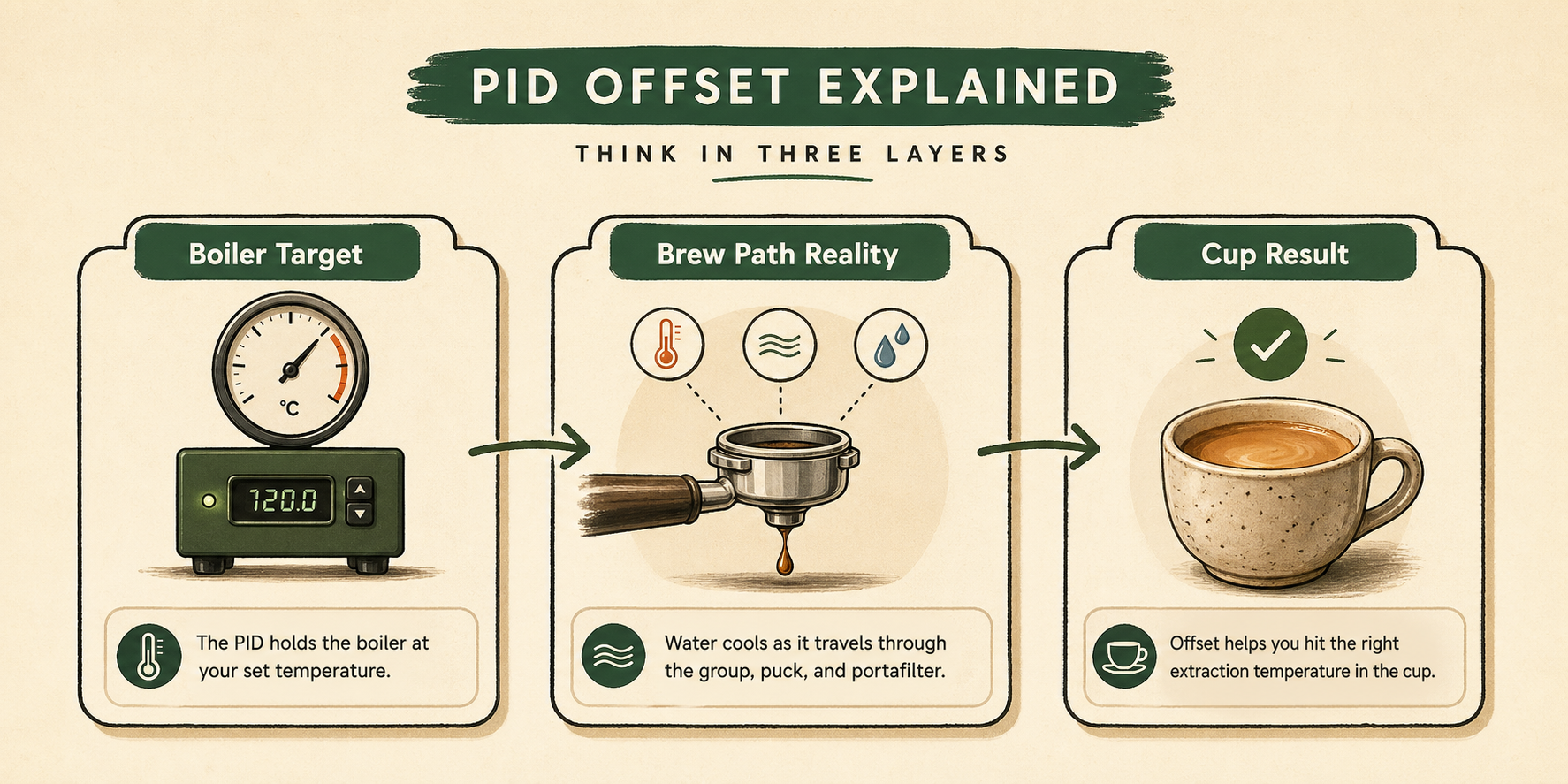
This is what the PID mainly controls and displays.
What you can set
Heat is lost between boiler, metal, water path, and puck.
What the machine is doing
This is what you actually taste.
What you must judge
What offset usually means in practice
When people talk about offset on a Gaggia Classic Pro PID, they usually mean the difference between a boiler reading and the temperature that seems more relevant at the group or in the shot. In real discussion, values around several degrees lower than the boiler number appear often. But the exact number is not universal.
| Question | Practical answer | Why it matters |
|---|---|---|
| Is the PID display the same as puck temperature? | No. It is closer to a controlled boiler reference than a direct cup number. | It prevents false confidence in one displayed value. |
| Do all Gaggia Classic Pro machines share one exact offset? | No. Sensor placement, tuning, warm-up, and routine can shift the effective behavior. | It keeps you from copying another person’s number too literally. |
| Can two people use the same displayed number and get different cups? | Yes. The workflow around that number still matters a lot. | It reminds you that offset is only one part of the system. |
Where confusion usually starts
Most offset frustration starts when the display looks stable but the shot still tastes wrong in a repeatable way.
| If this happens | Look here first | Do not assume too quickly |
|---|---|---|
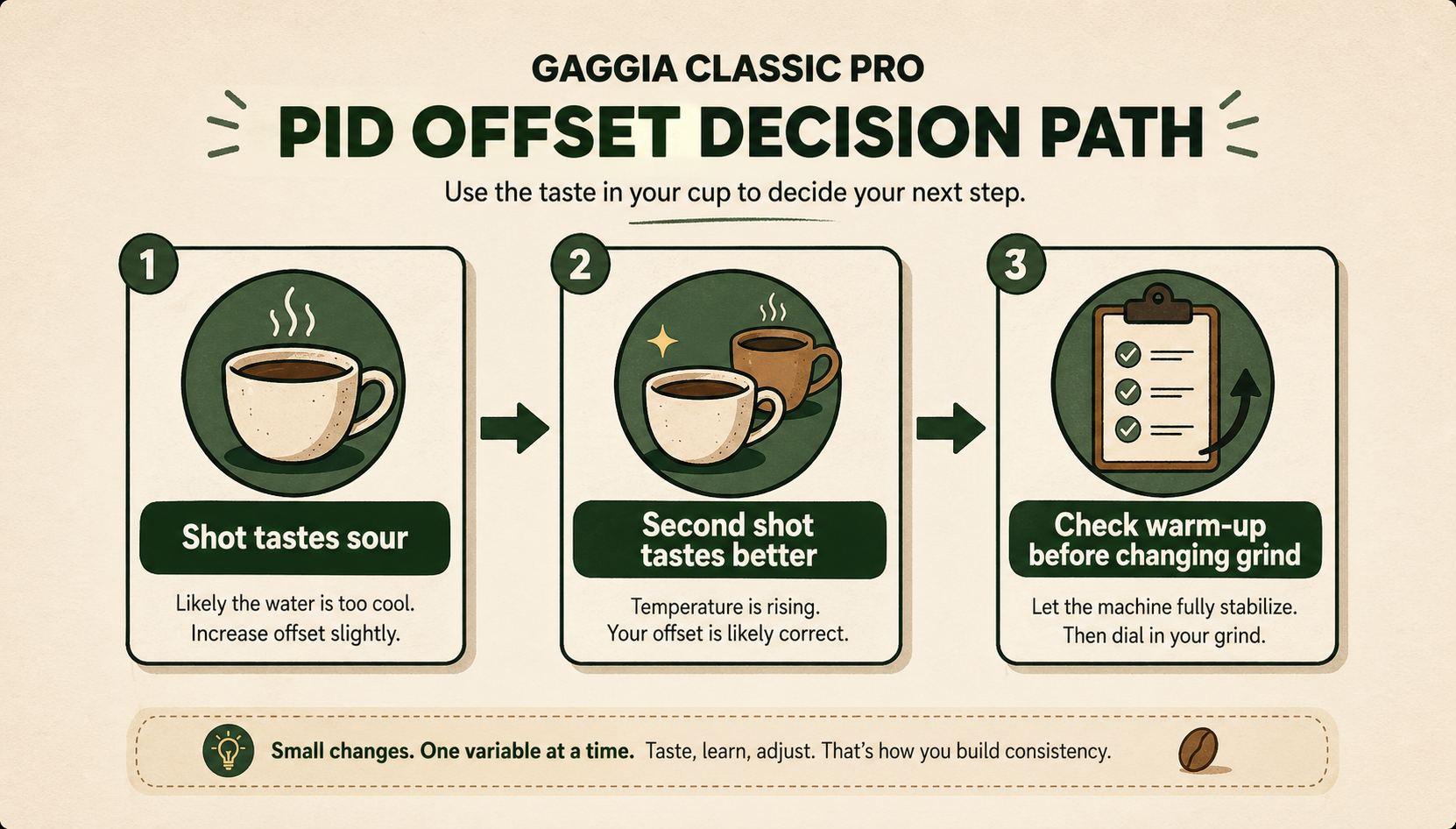
| The shot still tastes sour at a common shared setpoint | Extraction, dose, grind, and full warm-up | That the displayed number alone is wrong |
| The first shot behaves worse than the second | Machine readiness and group stability | That your offset setting is automatically bad |
| The same display setting behaves differently on different days | Workflow sequence and warm-up consistency | That the PID suddenly became inaccurate |
A useful working rule
Treat the displayed PID number as a repeatable starting reference, not as a final truth. That mindset is usually more helpful than chasing a perfect theoretical conversion from boiler number to brew number.
In other words, you do not need one magical offset answer before you can make better espresso. You need a stable routine, a reasonable starting point, and enough consistency to taste what changes are actually doing.
mostruário de configuraçãoWhat to change first when the display looks right but the cup does not
| Situation | Best first move | Second move if needed |
|---|---|---|
| You changed beans and the cup suddenly feels too sharp | Check roast level and use a practical temperature starting range | Then test a small temperature change |
| The first shot is unstable, the second is calmer | Improve warm-up and pre-shot routine | Then reconsider your PID target |
| The grinder and prep are still inconsistent | Stabilize those first | Then judge whether offset is still the real issue |
Next step: use the number more intelligently
This page works best as part of a wider reference path. Use these pages together instead of trying to solve everything with one displayed temperature.
- Reference page: roast-level PID starting points
- Compre isto quando o problema estiver claro.
- Article: why temperature stability matters
- Open the wider HomeBaristaMods reference library
Representative references: Coffee Forums UK PID reference discussion, Reddit offset and temperature-surfing threads.
mostruário de configuração English
  Italiano
  Deutsch
  Español
  Français
  العربية
  日本語
日本語  한국어
한국어  香港中文
香港中文  Nederlands
  Português