El E24 tiene un caldero de latón. Tus shots aún divagan. Antes de comprar un PID, separa la estabilidad del control.
The E24 does not automatically need a PID. Its brass boiler improves temperature stability and steam behavior, so many users can brew well with warm-up and a repeatable routine. PID is still useful if you want target temperature control, light-roast testing, or repeatable back-to-back shots.
The short answer is not “yes” or “no.” The useful answer is “for whom, and for what problem?”
Table of Contents
- What changed with the E24 brass boiler?
- Does better stability mean PID is unnecessary?
- Who can skip the PID on the E24?
- Who still benefits from PID on the E24?
- Does a PID shorten warm-up time?
- What should you fix before installing PID?
- How should E24 owners decide the upgrade order?
- Preguntas frecuentes
What changed with the E24 brass boiler?
The E24 changed one important part. That part changes the conversation, but not every answer.
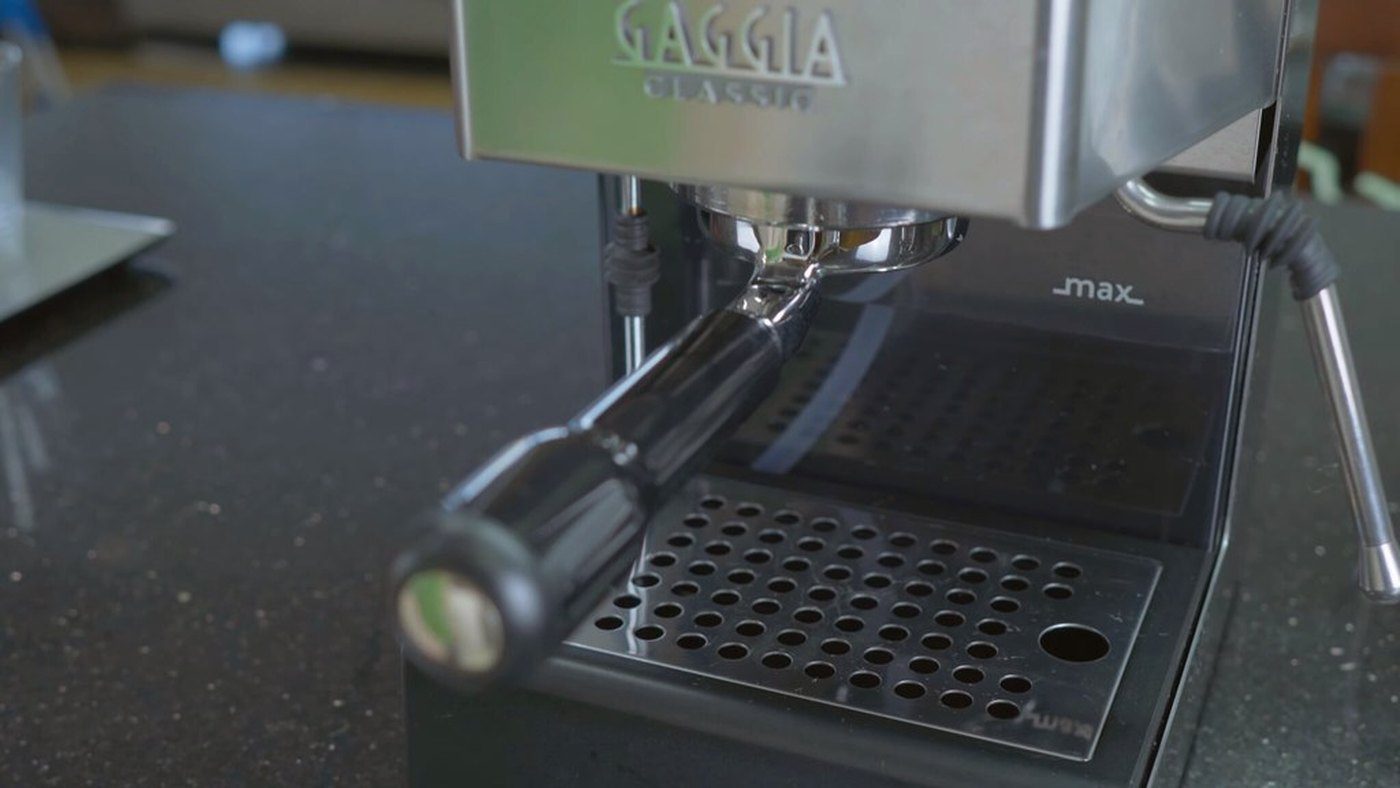
The Gaggia Classic E24 uses a lead-free brass boiler instead of the older aluminum boiler. The larger thermal mass improves temperature stability, improves heat retention, and can make steam behavior more stable.
Gaggia North America describes the E24 as using a solid brass boiler and 9 bar brew pressure. Whole Latte Love measured the brass boiler as larger and much heavier than the older aluminum boiler, and they reported improved temperature stability even without PID control. That is real progress.
The practical reason is simple. More boiler mass stores heat better. More water capacity means each ounce of incoming cold water changes the boiler temperature less. The machine still has a small single-boiler design, but the boiler is more stable than before. Good. A stable boiler is easier to live with.
Here is the useful model change:
This is why the E24 feels like a better starting point than older versions. It reduces one major weakness. It does not become a dual boiler, and it does not become a PID machine. The brass boiler is a stronger foundation, not a full control system.
If your main confusion is pressure instead of temperature, read ¿La Gaggia Classic Pro necesita un resorte OPV de 9 bares? first. Pressure and temperature are different levers.
Does better stability mean PID is unnecessary?
Stability and control sound similar. They are not the same thing.
The E24’s brass boiler can reduce temperature swings, but a stock E24 still uses thermostat-based control. A PID remains useful when you want to choose and repeat a specific brew temperature.
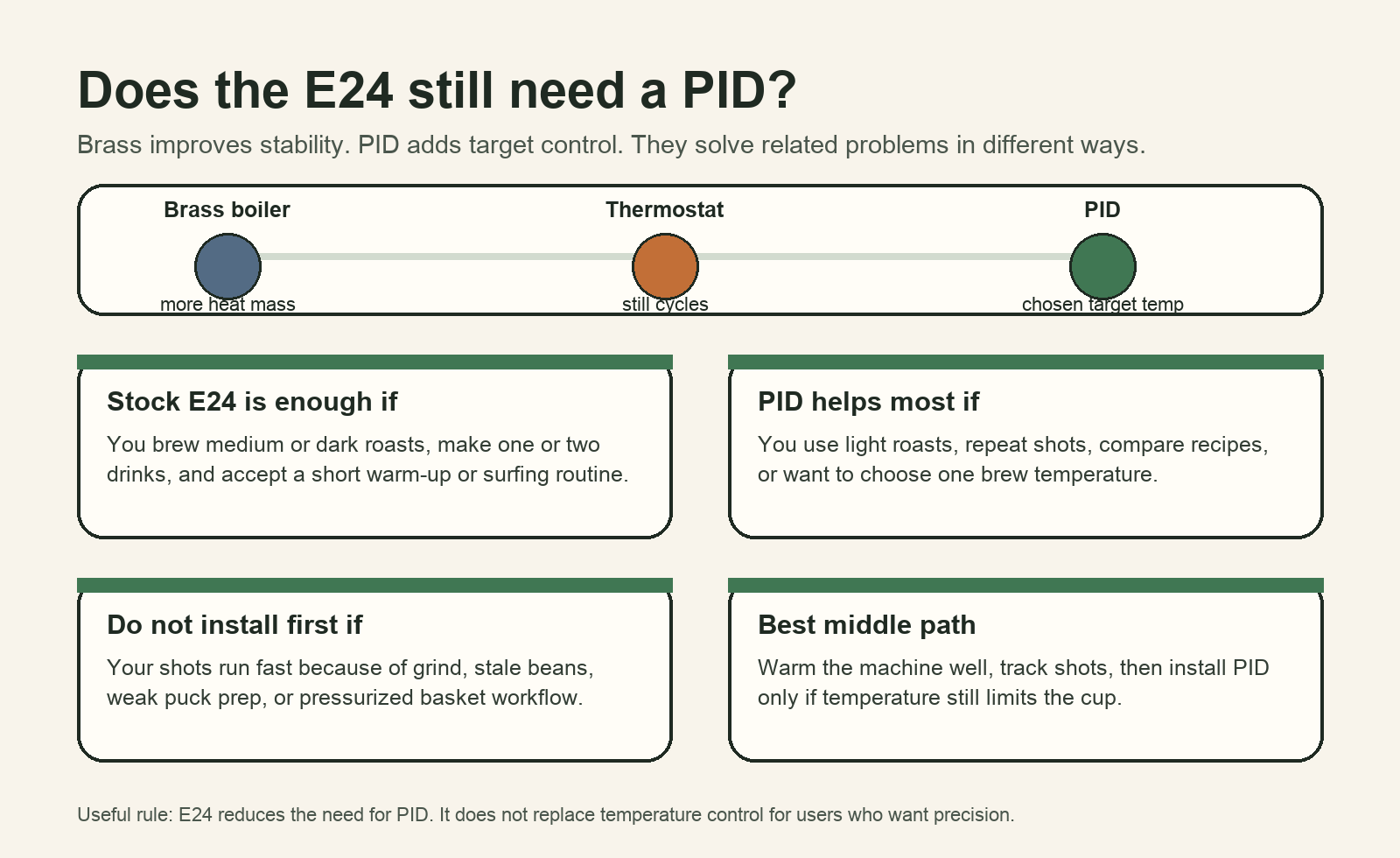
A thermostat turns heating on and off around a range. It does not let you select 92 C, 94 C, or 96 C as a direct brew target. A PID controller measures temperature and controls the heater more precisely around a chosen setpoint. That difference matters most when you are comparing recipes, using lighter roasts, or trying to remove one variable from testing.
Forum discussions about the E24 often circle this exact point. One side says the brass boiler is stable enough. The other side says PID lets you choose the temperature instead of learning a surfing routine. Both sides can be right because they are answering different use cases.
Use this split:
So the E24 makes PID less urgent. It does not make PID meaningless. The brass boiler improves stock behavior. It does not add direct temperature selection.
For the basic concept, Lo que un controlador PID cambia en la elaboración diaria de cerveza explains the daily workflow difference without turning it into a parts advertisement.
Who can skip the PID on the E24?
Some owners should spend the money elsewhere. That is not a downgrade. That is good order.
You can skip PID on the E24 if you brew mostly medium or dark roasts, make one or two drinks at a time, accept a warm-up routine, and already get balanced shots.
The E24 can be very capable in stock form. Whole Latte Love’s review argues that the stability improvement is significant even without a PID. Tom’s Guide also noted better temperature stability than older Classics, while still saying the machine may require some temperature surfing. That is the middle ground.
If you drink milk drinks with medium roasts, the stock E24 may be enough. Milk hides small temperature differences. Medium and dark roasts are often more forgiving. If your grinder is good and your recipe is stable, the machine may not be the problem. Start with coffee and workflow before tools.
This user profile can usually wait:
The best “skip” test is simple. Pull the same recipe for a week. Use the same dose, yield, grind range, warm-up time, and basket. If the results are enjoyable and repeatable, do not install PID only because many owners install one.
If the machine already gives you good cups, your next better purchase may be beans, grinder burrs, a basket, a scale, or cleaning tools. Small boring things win many mornings.
Who still benefits from PID on the E24?
PID is not dead on the E24. It just has a more specific job.
PID benefits E24 owners who use light roasts, compare recipes, pull repeated shots, dislike temperature surfing, or want one visible number for brew and steam control.
Light roasts are the easy example. They often need higher and more controlled brew temperatures to extract well. If you are changing temperature as part of recipe testing, the stock thermostat gives you less direct control. A PID gives you a number to set, repeat, and adjust.
Back-to-back shots are another case. The E24 brass boiler helps recovery, but it is still a compact single boiler. If you pull several shots and care about consistency, a PID can reduce guesswork. It does not turn the machine into a commercial multi-boiler machine, but it makes the small machine more readable.
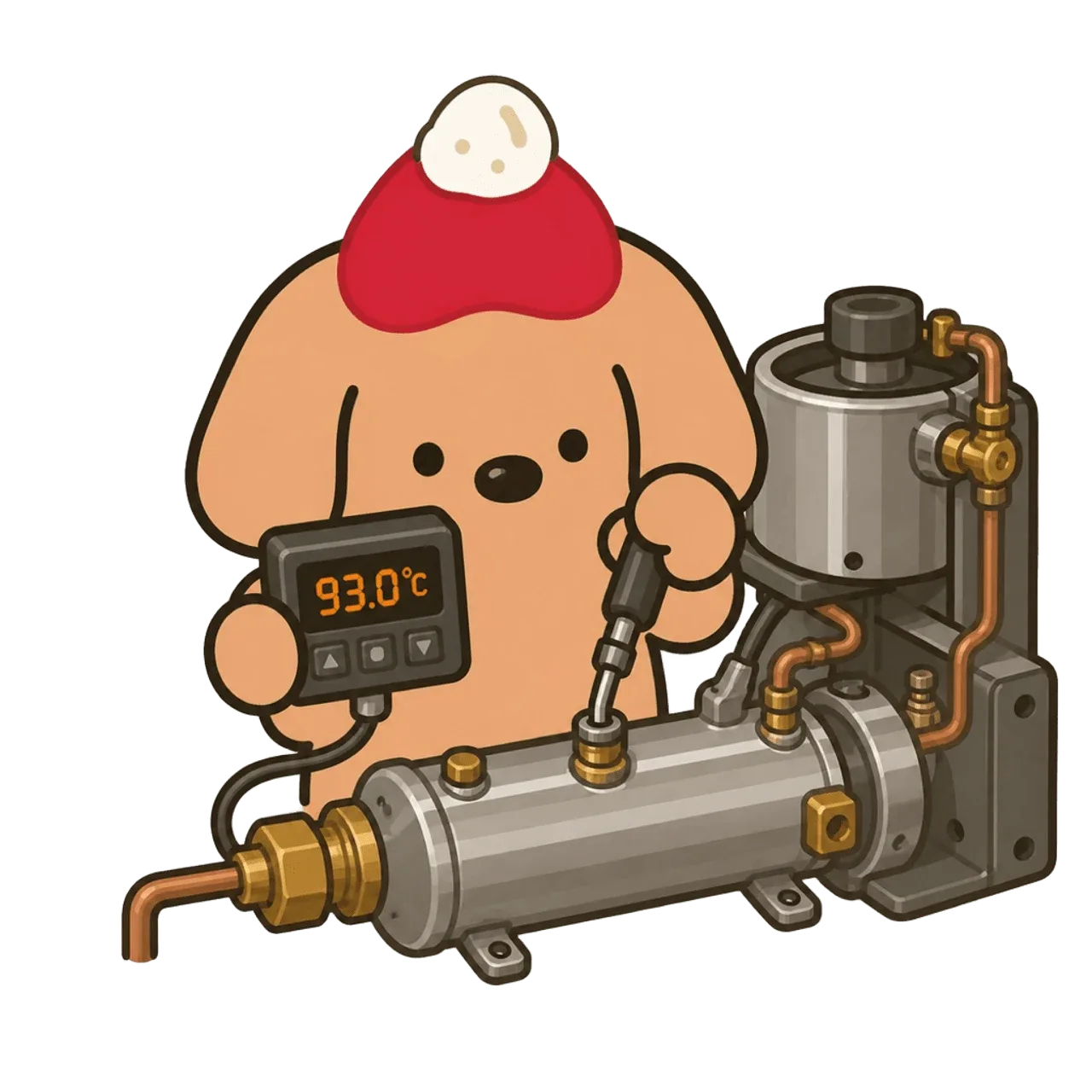
PID also helps users who dislike surfing. Some people enjoy learning the machine’s rhythm. Some people want to press brew at a known setpoint and move on with life. Both preferences are valid. The dog with the controller does not judge. He just wants the number to stop wandering.
PID makes most sense here:
Recent forum posts show E24 users still installing PID kits and testing different settings. That tells us the brass boiler did not end the mod culture. It changed the starting point. The E24 owner now asks a better question: “Do I need control, or just stability?”
If you are trying to decide whether your own workflow is ready, use Cómo saber cuándo tu Gaggia Classic Pro está lista para una actualización PID. It focuses on evidence, not upgrade pressure.
Does a PID shorten warm-up time?
This question appears often because waiting is annoying. Fair complaint. Coffee has a schedule.
A PID does not remove the need to warm the group head, portafilter, and boiler mass. It can show temperature and control the heater, but the machine still needs real heat soak.
Whole Latte Love measured a short time for the brew-ready light on the E24, but they still recommend a longer warm-up for the group and portafilter. That distinction matters. The boiler can reach a thermostat point before the whole brew path is evenly warm. Espresso touches the boiler, metal group, basket, portafilter, and coffee puck.
This is why a PID display can mislead beginners. The number may say the boiler sensor is near target. The portafilter may still be cool. The first shot can still taste different. The problem is not that the PID lied. The problem is that the sensor only sees one place.
Use this warm-up logic:
If you want a simple stock routine, use Un flujo de trabajo simple de calentamiento PID para la Gaggia Classic Pro as a reference idea, even if your E24 is not modified yet. The core principle is the same: repeat the warm-up before judging taste.
What should you fix before installing PID?
PID is useful. It is not a rescue team for every bad shot.
Fix grinder control, bean freshness, dose, basket, puck prep, pressure setup, and water routine before installing PID. Temperature control only helps when other variables are already stable enough to show the difference.
This is the most common mistake in upgrade planning. The owner has fast shots, channeling, old beans, and a plastic tamper. Then they install PID and expect the machine to behave like a trained barista. The machine may improve, but the root problem remains.
Before PID, check this list:
If your shot time changes from 18 seconds to 42 seconds with small grinder adjustments, temperature is probably not your first issue. If your shot tastes good one day and strange the next while your recipe is identical, then temperature becomes more interesting.
The E24 deserves a clean baseline before mods. Pull ten careful shots. Track results. If the pattern says temperature is the missing control, PID becomes a smart upgrade. If the pattern says grind or puck prep is unstable, fix that first.
For a broader diagnostic view, Por qué la estabilidad de la temperatura es importante en la Gaggia Classic Pro explains how taste symptoms can look like grind problems when the machine temperature is moving.
How should E24 owners decide the upgrade order?
The E24 changes the upgrade order slightly. It does not erase the order.
For E24 owners, confirm pressure and workflow first, then judge temperature. PID should come after grinder, basket, recipe, and warm-up routine unless you already know temperature control is the limiting factor.
A practical E24 order looks like this:
- Buy fresh coffee and use a scale.
- Use an espresso-capable grinder.
- Use an unpressurized basket and repeatable puck prep.
- Confirm the machine’s 9 bar OPV setup for your region.
- Build a consistent warm-up routine.
- Track taste across several shots.
- Add PID if target temperature control still matters.
- Add workflow or steam mods only when daily use asks for them.
This order keeps the E24’s strengths in mind. The brass boiler means you may not need PID immediately. The lack of direct temperature selection means PID may still be valuable later. Both statements can be true.
If you are planning a full build, use Un orden práctico de actualización para la Gaggia Classic Pro. The E24 starts ahead in boiler stability and pressure, but the same logic still applies: prove the bottleneck before buying the part.
Preguntas frecuentes
Does the Gaggia Classic E24 need a PID for good espresso?
No. The E24 can make good espresso without PID. Its brass boiler improves stability, especially with a repeatable warm-up routine.
What does PID add to the E24?
PID adds target temperature control and better repeatability. It helps when you want to choose and test brew temperatures.
Is the brass boiler better than PID?
No. Brass boiler mass and PID control do different jobs. Brass improves heat behavior. PID controls the heater around a target.
Should light roast users install PID on the E24?
Light roast users benefit more from PID because temperature choice matters more. Still fix grinder, dose, and puck prep first.
Does PID make the E24 warm up instantly?
No. A PID can show and control boiler temperature, but the group head and portafilter still need warm-up time.
The E24 reduces the need for PID, but it does not replace PID. Skip it if the cup is already stable. Add it when temperature control is the proven limit.
References
- Gaggia North America: Gaggia Classic Pro E24
- Whole Latte Love: Gaggia Classic Pro E24 Review
- Reddit: Does the new Gaggia Classic Pro E24 model need a PID?
- Reddit: Gaggia Classic Pro E24 PID temperature stability test results
- Tom’s Guide: Gaggia Classic E24 Evo Pro review
- Kaffeemacher: Gaggia Classic E24 test
If your E24 already tastes stable, enjoy the coffee. If you keep chasing temperature, PID gives the chase a number.
 English
  Italiano
  Deutsch
  Español
  Français
  العربية
  日本語
日本語  한국어
한국어  香港中文
香港中文  Nederlands
  Português