How Long Do Coffee Beans Last? Check the Bag, Not Just the Date
The National Coffee Association gives opened roasted beans at room temperature a freshness guide of about 1-3 weeks when the coffee is kept in an airtight container. Treat that as a quality range, not an expiration alarm. The package, moisture, aroma and brewed cup still matter.
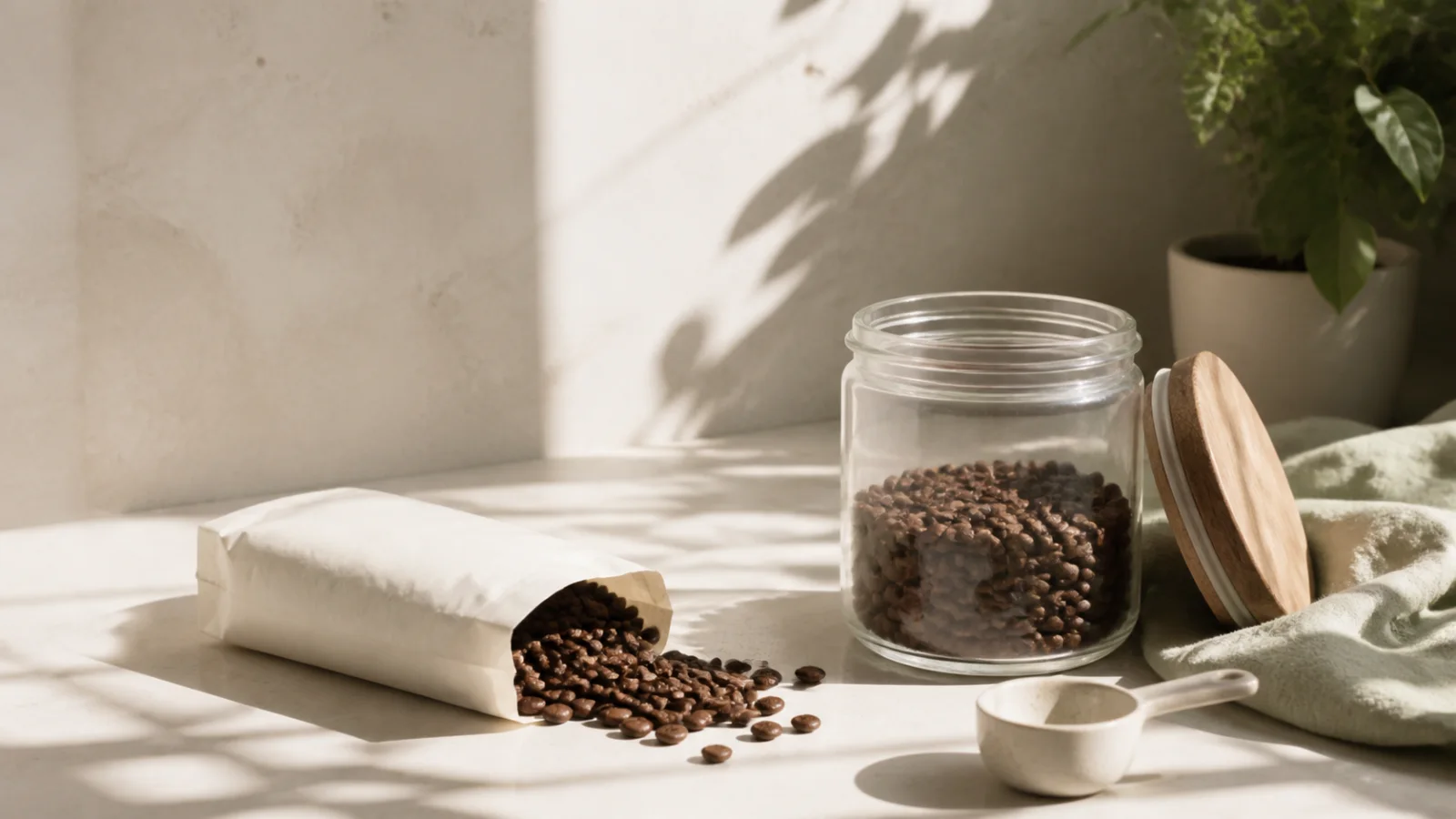
Opened roasted beans: about 1-3 weeks in the NCA guide.
That range assumes room-temperature storage in an airtight container. It describes retained freshness. It does not declare every coffee perfect on day 20 or unsafe on day 22.
Read the package, then inspect and brew.
A dry, intact bag with fading aroma is a different problem from beans exposed to moisture or mold. The first may simply taste stale. The second belongs in the bin.
Which date should you use: roast, opened or best-by?
Each date answers a different question. Writing the opening date on the bag removes one common guess, but none of these dates can prove that a damaged package is fine.
Roast date
Useful for knowing when roasted coffee began changing. It is not a universal discard date.
Date opened
Marks the start of regular opening and closing. Add it yourself if the package does not.
Best-by date
A maker's quality guide for the unopened package, not permission to ignore a wet or damaged bag.
Brewed cup
When the beans are dry and clean, a small brew tells you more about remaining aroma and flavor.
Simple habit: write the opened date on the bag. You will still need to look, smell and brew, but you will stop trying to remember whether the seal was broken last Tuesday or last month.
How long do roasted coffee beans stay fresh after opening?
The range changes with form and package condition. The figures below come from the National Coffee Association's quick guide and should stay attached to its assumptions.
| Coffee condition | NCA freshness guide | How to read it | What to check next |
|---|---|---|---|
| Opened roasted beans at room temperature | 1-3 weeks | Assumes opened coffee has been moved to an airtight container | Seal, moisture, aroma and a small brewed cup |
| Unopened roasted beans or ground coffee | Through the best-by date | Applies to an unopened package; the package still needs to be intact | Damage, swelling, moisture or mold |
| Opened ground coffee at room temperature | 1-2 weeks | Ground coffee loses aroma faster because grinding exposes more surface area | Closure, aroma and brewed flavor |
Repeating “1-3 weeks” without “opened roasted beans, room temperature, airtight container” turns a useful guide into a false guarantee.
Do coffee beans go bad, or do they mostly go stale?
Most roasted beans lose aroma and flavor as they age. A flat or dull cup is disappointing, but stale flavor alone is not the same as visible contamination.
Moisture changes the answer because mold can develop. Do not brew a taste test from beans that look wet, moldy or contaminated.
Weak aroma usually means quality loss
The bag smells less vivid than it did when opened.
Flat flavor usually means quality loss
The cup is dull, woody or empty even after a reasonable dial-in.
Visible mold means discard
Do not grind or taste coffee with visible mold growth.
Moisture damage means discard
Wet beans, damp clumps or moisture inside the bag stop the test.
How can you tell whether old coffee beans are still worth brewing?
Start with contamination, not taste. Only move on to aroma and a small brew when the package and beans are dry, intact and free of visible mold.
Check the package
Look for a broken seal, puncture, moisture or other damage.
- Is the bag dry?
- Is the closure intact?
- Is the storage history known?
Check the beans and aroma
Look before smelling. Stop if the beans are damp or moldy.
- No visible mold
- No damp clumping
- Some recognizable coffee aroma remains
Grind and brew a small dose
If the first checks pass, grind a small dose and brew a small cup.
- Note aroma after grinding
- Taste a small test brew
- Decide before using the rest
A different recipe cannot repair contamination. Discard the coffee instead of using a small brew as a safety test.
Can you use coffee beans that are two years old?
Two-year-old roasted beans are unlikely to deliver the aroma and flavor people expect from fresh coffee. An unopened, intact, dry package is a different case from an opened or damaged bag, but age alone cannot certify the coffee.
Check the best-by date, package condition, moisture and aroma before considering a small brew.
Expect major quality loss. If history is unclear, discarding it is the cautious choice.
Discard it. Do not use the old date as a reason to taste-test contamination.
A novelty question is not a useful freshness standard for the coffee you plan to drink.
Why does one bag fade faster than another?
A range is only a starting point because the beans, package and daily routine are not identical from one kitchen to the next.
Whole bean or ground
Ground coffee has far more exposed surface area, so its aroma usually changes faster.
Package closure
A zipper closed carefully after each dose is different from a bag left folded open.
Opening frequency
A large bag opened many times meets more room air than smaller sealed portions.
Heat, light and moisture
A bright, warm or damp location makes the calendar a poor stand-in for actual condition.
Roast and package
Different coffees and packaging systems do not age on one identical schedule.
Your flavor threshold
One drinker notices a faded aroma before another, even when both cups are clean.
What can you do with coffee beans that taste stale?
These options apply only to dry coffee with no mold or contamination signs. None of them can restore aroma that has already disappeared.
Do not commit a full dose until one small cup shows what remains.
A milk drink may make a merely flat coffee easier to finish when the beans are otherwise clean.
Clean stale beans can help with grinder retention checks or workflow practice when the drink itself is not the goal.
If the cup is unpleasant or the bag history is doubtful, discarding it is cheaper than forcing it.
How should the next bag be stored?
Seal the daily-use coffee, keep it cool, dark and dry, and freeze only properly sealed portions meant for later. The full storage guide covers the original bag, containers, kitchen location and freezer routine without turning storage into a shopping list.
Where the freshness ranges come from
Coffee bean freshness questions
How long do coffee beans last after opening?
Coffee beans can retain freshness for about 1-3 weeks at room temperature after opening when transferred to an airtight container, according to the National Coffee Association. Coffee beans do not follow one exact timer, so also check the package, moisture, aroma and the flavor of a small brewed cup.
Do coffee beans expire if the bag is unopened?
Coffee beans in an unopened, intact package can be checked against the printed best-by date; the National Coffee Association lists unopened roasted beans or ground coffee through that date. Coffee beans in a damaged, wet or moldy package should not be judged by the date alone and should be discarded.
How can you tell if coffee beans are bad?
Coffee beans that have lost aroma or brew as a flat, dull cup are probably stale in flavor. Coffee beans with visible mold, damp clumps, moisture inside the package or a damaged package have a different problem. Discard coffee beans with moisture or mold instead of brewing a taste test.
Can stale coffee beans make you sick?
Coffee beans usually lose aroma and flavor as they age rather than becoming unsafe simply because they are old, according to the National Coffee Association. Coffee beans exposed to moisture can develop mold, which is a discard condition. Do not taste coffee beans that look damp, moldy or contaminated.
 English
  Italiano
  Deutsch
  Español
  Français
  العربية
  日本語
日本語  한국어
한국어  香港中文
香港中文  Nederlands
  Português