
Key takeaways in audio
If you are asking which gaggia classic to buy, you are not alone. The names are a small espresso maze.
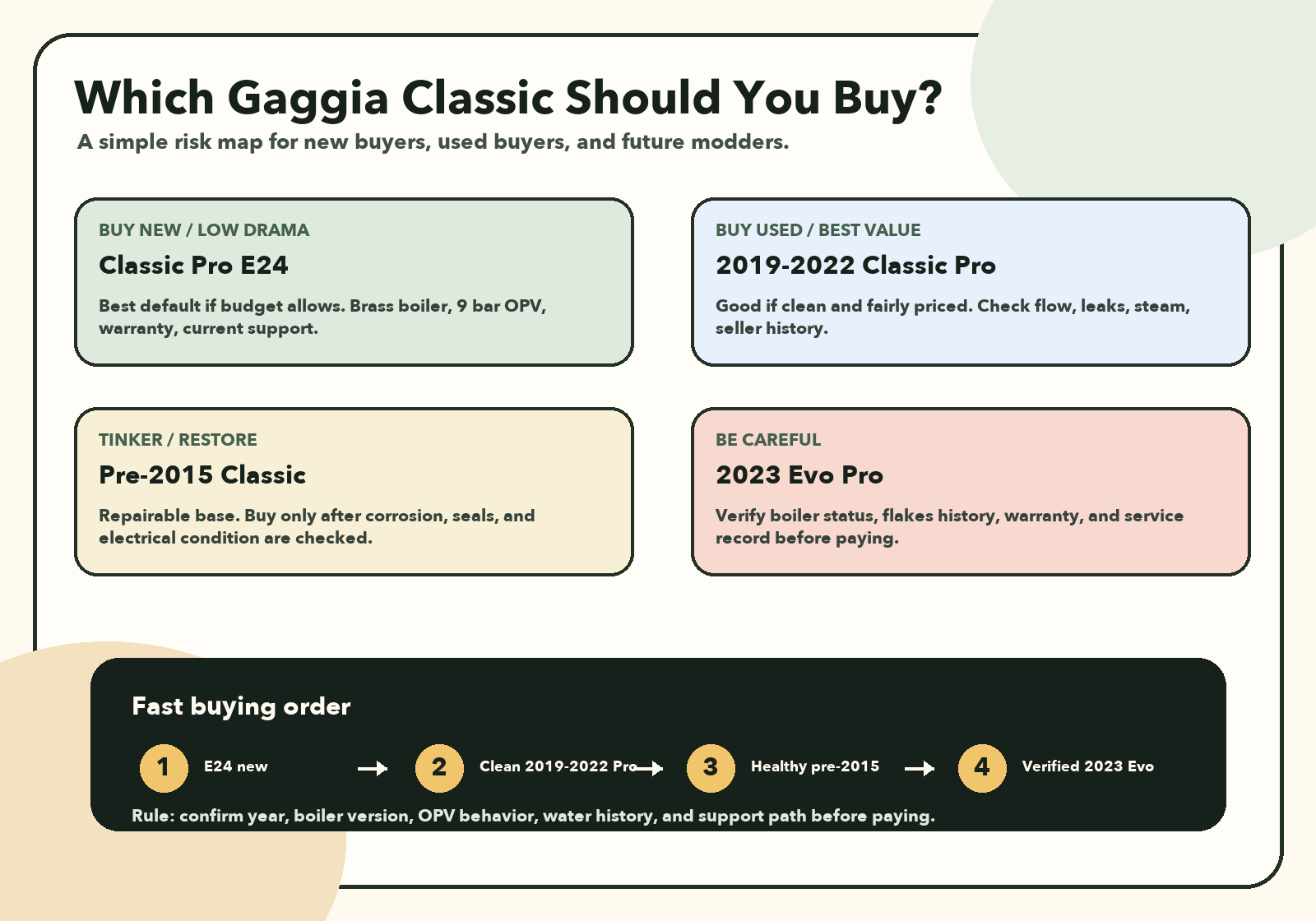
Most buyers should choose the Gaggia Classic Pro E24 if they want a new machine. Used buyers should look first at a clean 2019-2022 Classic Pro or a healthy pre-2015 Classic. Be careful with uncertain 2023 Evo Pro machines unless the boiler history is clear.
That answer sounds simple. The buying process does not feel simple. Gaggia has used names like Classic, New Classic, Classic Pro, Classic Evo Pro, Classic Pro E24, and region-specific versions. Some owners talk about pre-2015 machines. Some warn about 2015-2018 machines. Some mention "boilergate." Some say the E24 fixed the worry. The poor buyer stands in the middle with a shopping tab open and one eyebrow raised.
This guide turns that confusion into a buying order. We will separate model names, real risks, mod value, used-machine checks, and the best match for different buyers.
Which Gaggia Classic should most people buy in 2026?
Most people should buy the Gaggia Classic Pro E24 if they want a new machine, a warranty, and fewer version questions.
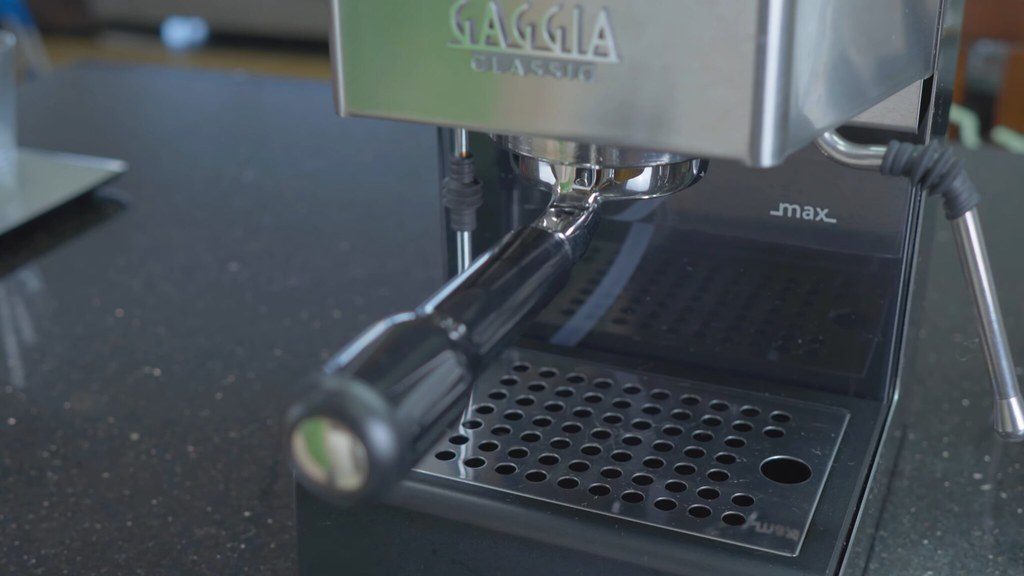
The E24 is the cleanest answer because it is current, easy to identify, and easier to support. Gaggia North America lists the Classic Pro E24 with a lead-free brass boiler, 9 bar OPV calibration, a 58 mm portafilter, and a commercial-style steam wand. That matters because the buyer does not need to decode every older generation before making coffee.
This does not mean the E24 is perfect. It is still a compact single-boiler machine. It still benefits from a good grinder, fresh coffee, a stable warm-up routine, and calm puck preparation. The little coffee dog cannot save a bad grinder with a tiny cape. But the E24 gives a safer starting point than a random used listing with no service history.
Best Match Matrix
If your real goal is future upgrades, read the practical upgrade order for the Gaggia Classic Pro after choosing a safe machine base. Buying the right base comes first. Buying parts comes second.
Why are Gaggia Classic model names so confusing?
The model names are confusing because "Gaggia Classic" covers several generations, and different regions use different labels.
Forum threads show the same pattern again and again. A buyer sees one listing called Classic. Another says Classic Pro. Another says New Classic. A fourth says Evo Pro. Then someone mentions pre-2015, 2019, 2023, or E24. The name alone does not tell the full story. You need the year, region, model number, boiler type, and seller proof.
The rough family tree looks like this:
The Coffee Forums thread behind this topic shows the buyer pain very clearly. People ask which year to buy because advice from old posts, affiliate reviews, and marketplace listings conflicts. The useful answer is not "all old good, all new bad." That is too rough. The better answer is: identify the exact version, then judge condition and risk.

Should you buy the Gaggia Classic Pro E24?
Yes, buy the Gaggia Classic Pro E24 if you want the easiest new-machine recommendation.
The E24 makes sense for a buyer who wants to start brewing instead of reading forum archaeology for three evenings. Its brass boiler improves the buyer story because older debates often circle around boiler material, coating, stability, and long-term service. It also ships with 9 bar OPV calibration in the current North American specification, which removes one common early upgrade question.
The E24 is also the better answer for gift buyers. A used Classic can be a gem, but it can also arrive with scale, leaks, tired seals, or mystery repairs. A new E24 gives a cleaner support path. That matters if the buyer is new to home espresso and does not want to open the case.
Here is the honest caution. The E24 does not remove every limit of the platform. It does not make a weak grinder strong. It does not turn a single boiler into a dual boiler. It does not remove the need to learn dose, yield, grind, and warm-up. If you buy it expecting a small commercial machine with a cute face, you may be disappointed. If you buy it as a strong learning platform, it makes much more sense.
If temperature control is your next question, the E24 PID decision guide explains what the E24 improves and what a PID still changes.
Should you buy a 2019-2022 Gaggia Classic Pro used?
Yes, a clean 2019-2022 Classic Pro is often the best used buy if the price is fair and the machine is tested.
This generation brought back the important Classic idea for many buyers: a small, durable, repairable espresso machine with a real portafilter format and a strong mod community. It also has a better steam wand than many older stock Classics. That is why many owners still see it as a good base for daily use and future upgrades.
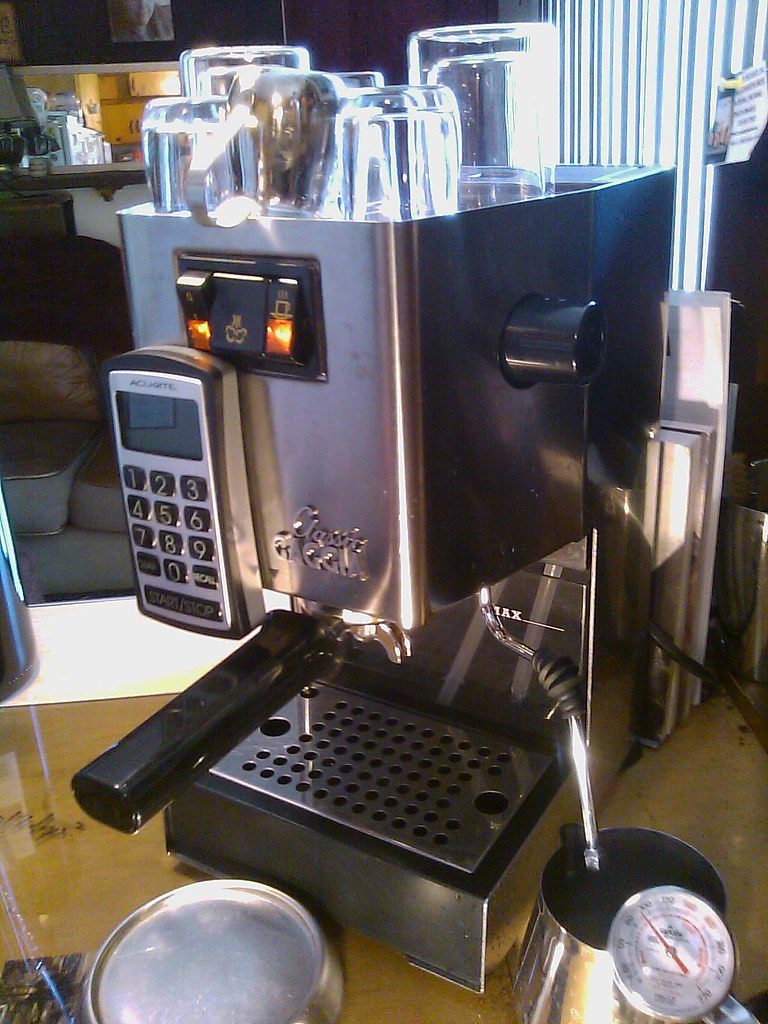
Used value depends on condition. A cheap listing can become expensive if the machine needs a pump, seals, descaling, solenoid cleaning, a new gasket, or a new boiler. A "barely used" listing can still have hard-water scale if the owner used poor water and never cleaned it. This is where buyer discipline matters. Ask for proof before you meet. Ask for a short video of water from the group, water from the steam wand, steam pressure, and the machine heating normally.
Used Listing Check
If the seller reports weak flow, use the no-water diagnosis for group head, solenoid, scale, or pump issues before you assume the fix is easy.
Should you avoid the 2023 Gaggia Classic Evo Pro?
You do not need to avoid every 2023 Evo Pro, but you should not buy an uncertain one blindly.
This is the part that creates the loudest forum energy. The 2023 Evo Pro added useful features on paper, including 9 bar pressure in many markets. But the coated boiler became a concern when owners reported black flakes. That created a trust problem. Once a buyer sees "black flakes," the brain hears tiny horror music.
The practical answer is not panic. It is verification. If you see a 2023 Evo Pro, ask the seller for the purchase date, warranty status, service records, and whether the boiler was replaced or inspected. Ask if black flakes appeared in the tank, cup, portafilter, or after flushing. Ask for photos of flushed water in a clear cup. If the seller gets defensive, let the machine go. There will be another listing.
The 2023 Evo can still make sense if the history is clear and the price reflects the risk. It makes less sense when the seller wants E24 money for a machine with uncertain boiler history. A buyer guide should protect your wallet, not make excuses for a listing.
If you already own one and see particles, use the black flakes diagnosis guide before you run more chemicals through the machine.
Is a pre-2015 Gaggia Classic still worth buying?
Yes, a pre-2015 Gaggia Classic can be worth buying if you want a repairable machine and you can inspect condition.
Older Classics have a strong reputation because they are simple, mod-friendly, and well understood by the community. Many owners like them because parts are available, the layout is familiar, and upgrades are well documented. A good one can run for years with normal maintenance. A neglected one can become a small stainless steel invoice with a portafilter handle.
The important word is condition. Do not buy only because the listing says "pre-2015." Check corrosion, leaks, seals, steam valve condition, pump behavior, boiler condition, and the general cleanliness of the machine. If the seller has no water test, no photos, and no patience for questions, the low price is not always a bargain.
Pre-2015 machines also differ by year and region. Some forum users prefer earlier machines. Some are fine with later pre-2015 machines if they are clean. That split is why this guide does not say "only buy one year." A clean 2012 machine can be better than a crusty 2004 machine. Espresso history is nice. Clean water paths are nicer.
If you plan to modify an older machine, start with the Gaggia Classic family compatibility guide before ordering parts. Model fit can turn a simple weekend job into a small comedy with screws.
Which Gaggia Classic should modders buy?
Modders should buy a clean 2019-2022 Classic Pro, a verified E24, or a healthy older Classic, depending on budget and skill.
The best mod base is not always the cheapest machine. The best mod base is the machine that lets you install parts safely, understand the wiring, and trust the water path. If the machine has unknown electrical work, corrosion, leaks, or a strange repair history, it is a poor mod base even if the price looks friendly.
For a new buyer who wants a modern base, the E24 is attractive. It already solves several stock concerns. For a budget modder, a 2019-2022 Classic Pro can be excellent if it is clean. For a restoration-minded buyer, an older Classic can be rewarding. The work is more hands-on, and the buyer should be comfortable inspecting parts.
Modder Match Table
If a mod involves opening the machine, use the mod safety matrix and multimeter checks first. Cute dog rule: no paws inside a live machine.

Which Gaggia Classic should budget buyers choose?
Budget buyers should choose the cleanest working machine, not the oldest machine with the loudest legend.
This is where buyers lose money. They see an older Classic at a low price and assume it is the clever choice. Sometimes it is. Sometimes it needs seals, a pump, a steam valve, a boiler inspection, a deep clean, and a weekend of troubleshooting. That "deal" can quietly climb toward the price of a better used Classic Pro.
Set a total budget before you contact sellers. Include the machine, cleaning products, a proper basket if needed, a tamper, a grinder if you do not already own one, and maintenance parts. If the machine needs immediate repair, subtract that cost from your offer. Be polite, but let math hold the portafilter.
Budget Reality Table
If scale risk is part of the deal, read the Gaggia Classic water guide. Water quality is not a fancy topic. It is machine insurance in a plain cup.
What should you check before buying a used Gaggia Classic?
Before buying used, check the exact version, water flow, steam behavior, leaks, corrosion, accessories, and seller proof.
Use this message before you meet a seller:
Hi, I am interested. Can you please send a short video of the machine heating, water running from the group head, water from the steam wand, and steam after warm-up? Can you also send a photo of the label or model information? I want to confirm the exact version before buying.
That message is simple. It filters many bad listings. A serious seller usually understands. A careless seller may disappear. That is useful too. The silence just saved you from a countertop mystery box.
Used Buyer Checklist
If the machine passes these checks, it becomes a real candidate. If it fails, do not force the purchase because the price is cute. Cute belongs to the mascot. Machines need proof.
What is the safest buying order?
The safest buying order is E24 new, clean 2019-2022 Classic Pro used, healthy pre-2015 Classic used, then verified 2023 Evo Pro if priced correctly.
This order is not a law. It is a risk ladder. If you want the least version confusion, start with E24. If you want the best used value, look for a clean 2019-2022 Classic Pro. If you enjoy repair and inspection, consider a pre-2015 Classic. If you see a 2023 Evo Pro, slow down and verify boiler history before paying.
The biggest mistake is buying a label instead of a machine. "Classic" does not mean clean. "Pro" does not mean problem-free. "Old" does not mean better. "New" does not mean perfect. The right question is not only which gaggia classic to buy. The sharper question is: which exact machine, in which condition, at which price, with which support path?
Once you answer that, the decision becomes much calmer.
Preguntas frecuentes
What is the best Gaggia Classic to buy in 2026?
For most new buyers, the best Gaggia Classic to buy in 2026 is the Classic Pro E24. It is current, easy to identify, and has a brass boiler with 9 bar OPV calibration in current North American specifications.
Is the Gaggia Classic Pro E24 better than the 2019 Classic Pro?
For most new buyers, yes. The E24 has the cleaner current spec and support path. A 2019-2022 Classic Pro can still be a better value if it is used, clean, tested, and priced well.
Should I avoid the 2015-2018 Gaggia Classic?
Most buyers should be careful with the 2015-2018 version. Many community buyers prefer pre-2015 machines or the 2019-onward Classic Pro design because the 2015-2018 version changed important internals.
Is an old Gaggia Classic better than a new one?
Not always. A healthy old Classic can be excellent. A neglected old Classic can be expensive. Condition, water history, corrosion, and repair needs matter more than age alone.
What should I ask before buying a used Gaggia Classic?
Ask for the exact model label, purchase year, water history, group-flow video, steam video, leak photos, and service history. If the seller cannot show basic function, treat the listing as higher risk.
Final verdict
Buy the safest exact machine, not the loudest model name. For most people, start with the E24. For used buyers, proof beats legend.
References
- Gaggia North America: Gaggia Classic Pro E24 product page
- JonDent: Gaggia Classic list of models 1991 to 2024
- Coffee Forums UK: Gaggia Classic confused which years to buy
- Reddit: I do not understand which model
- Coffee Blog: Gaggia Classic Pro Review. Still The Best in 2026?
- Gaggia North America: Classic Pro, Evo, and E24 manuals
Image Credits
- Featured image adapted from "Gaggia Classic Pro 2019" by coffee-rank, licensed under CC BY 2.0.
- Used-machine image adapted from "My Gaggia Classic after the Silvia steam wand mod" by insidious_plots, licensed under CC BY 2.0.

 English
  Italiano
  Deutsch
  Español
  Français
  العربية
  日本語
日本語  한국어
한국어  香港中文
香港中文  Nederlands
  Português