
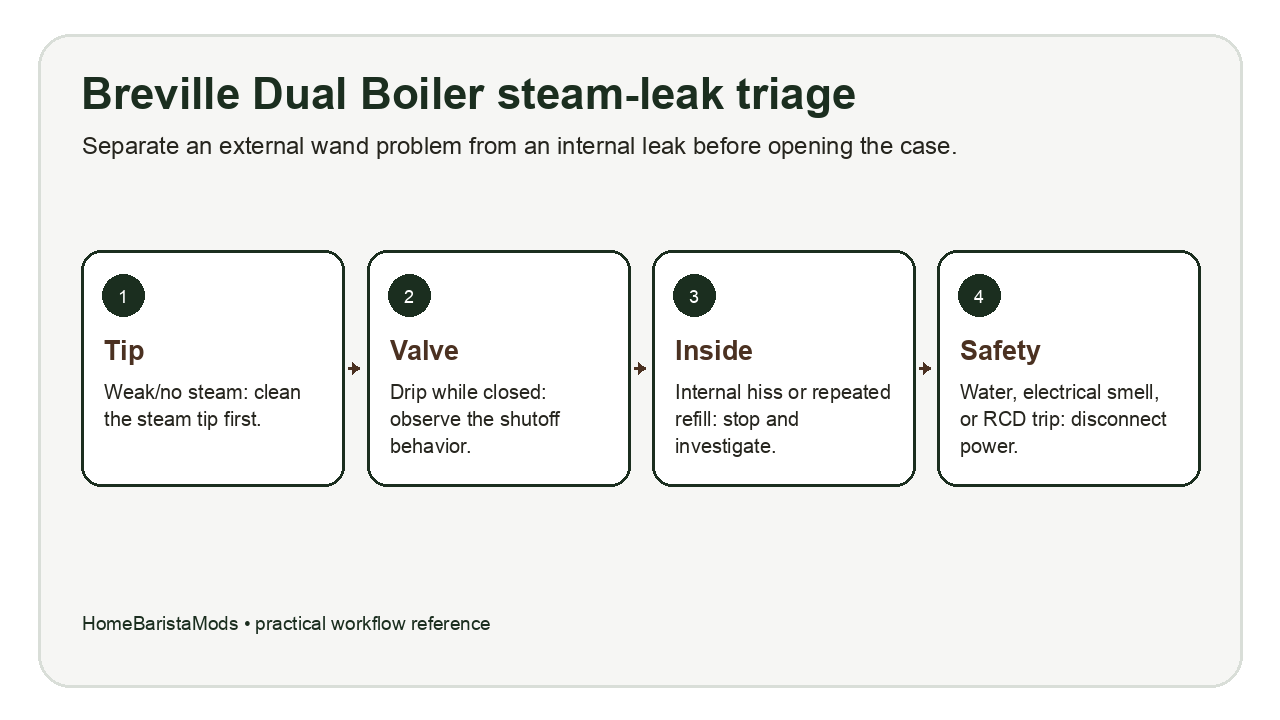
A Breville Dual Boiler that hisses, drips from the steam wand or loses steam pressure does not have one universal failure.
Start by separating three symptoms:
- the steam wand tip is blocked;
- the steam valve does not shut off cleanly;
- steam is leaking somewhere inside the machine.
Breville’s current BES920 troubleshooting guide already gives one safe first check for no steam: clean the blocked steam-wand tip with the supplied cleaning tool, and if necessary remove the tip and soak it in hot water before reinstalling it.
Internal hissing is a different problem. If you also see water under the machine, smell hot electronics, or trip a GFCI/RCD, stop using the machine until the leak is identified.
Is the problem at the wand tip or inside the machine?

Begin with the symptom you can observe without removing the case. If you are still separating machine symptoms, the site-wide espresso-machine diagnosis page is a useful parallel reference.
| Symptom | First check |
|---|---|
| No steam, but no internal hiss | Clean the steam-wand tip |
| Weak or wet steam | Remove and clean the tip, then retest |
| Wand drips while closed | Steam valve / shutoff issue becomes more likely |
| Hiss continues inside the case | Internal steam or water leak needs investigation |
| Machine repeatedly refills steam boiler | Internal leak is possible |
| Water appears under machine | Stop and locate leak before more testing |
| GFCI/RCD trips | Stop using machine and disconnect power |
Do not open a powered Dual Boiler to “listen more closely.” If you are comparing the Dual Boiler with other serviceable platforms, the all-machines page keeps those architectures separate.
The BES920 contains mains-voltage electronics and pressurized hot boilers. A casual live inspection can turn a repairable leak into an electrical hazard.
What does Breville say to check for no steam?

Breville’s BES920 manual lists a blocked steam wand as a cause of no steam.
Its procedure is straightforward:
- use the pin on the supplied cleaning tool;
- if the blockage remains, remove the steam tip with the integrated spanner;
- soak the tip in hot water;
- reinstall the tip.
That is the correct first move when steam output is poor and there is no evidence of an internal leak.
It also gives you a useful diagnostic split.
If removing or cleaning the tip restores normal steam, the problem was downstream at the wand tip.
If the tip is clear and the machine still has no steam, the fault lies elsewhere.
What does a steam-wand drip while closed suggest?
A closed valve should stop steam flow.
A small amount of condensation immediately after steaming is different from a wand that continues to drip or hiss long after the valve is closed.
Owner repair records on Home-Barista repeatedly document leaks around the steam valve, valve stem and nearby seals on older Dual Boilers.
That makes the valve area a reasonable suspect, but not a diagnosis from the outside.
Do not order a specific O-ring because another owner used it. Breville revisions, fittings and previous repairs can change what is inside the machine.
The useful external evidence is:
- how long the dripping continues;
- whether the steam knob or lever feels abnormally stiff;
- whether the leak changes as the valve is opened and closed;
- whether internal hissing is also present.
Why does internal hissing matter?
A pressurized steam system can leak without immediately putting water on the counter.
Community repair threads document older BES920 machines with steam leaks around boiler fittings, steam-valve connections and O-rings. Some owners first noticed the fault as a hiss after heating or after switching the machine off.
Those reports also show why ignoring the symptom can become expensive.
Moisture inside the machine can reach electrical components. Several repair threads describe leak-related damage around the Triac/control area after a steam leak was left unresolved.
That is not proof that every hiss will destroy a board.
It is a reason not to keep operating a machine with a confirmed internal steam leak.
What can you check without removing the top cover?

Use a dry counter and a simple observation sequence.
- Start with the machine cool.
- Check the water tank is seated and filled.
- Power on normally.
- Let the machine reach operating temperature.
- Listen during the final part of warm-up.
- Open the steam valve briefly.
- Close it fully.
- Observe the wand tip.
- Run a short brew cycle.
- Check the counter and underside for water.
- Listen again after the machine sits hot for a few minutes.

Record what happens.
A machine that only drips from the wand is different from one that hisses inside the case and repeatedly tops up the steam boiler.
Why can the fill pump become part of the clue?
If steam or hot water escapes from the steam boiler, the machine may need to replace that lost water.
Older owner reports describe a boiler-fill pump running more often than normal alongside internal hissing and leaks.
That does not make pump cycling a precise leak detector.
Normal boiler management can run the pump too.
The useful signal is a change from the machine’s usual behavior, especially when it appears together with hissing, visible moisture or steam loss.
If the pump suddenly starts refilling much more often and the machine also hisses internally, investigate the leak rather than replacing the pump first.
What if steam becomes weak instead of leaking?

Weak steam can still be a blockage problem.
A recent Home-Barista repair discussion suggests removing the steam tip first. If the tip is clogged, cleaning it may restore flow without opening the machine.
If steam remains weak with a clean tip, the next questions are:
- is the steam boiler heating?
- is the valve opening fully?
- is a thermal protection device open?
- is the machine reporting an error?
Those checks move beyond ordinary owner cleaning.
At that point, use Breville support or a repair procedure grounded in the exact BES920 revision. The Guides Library is the better place to continue when you need a model-specific service path rather than a generic repair guess.
What should make you stop using the machine immediately?
Stop and disconnect power if you see:
- GFCI/RCD tripping;
- water inside or under the electrical side of the machine;
- strong electrical or burnt-plastic smell;
- uncontrolled overheating;
- steam escaping from inside the case;
- repeated error codes combined with abnormal heating;
- visible arcing or damaged wiring.
Do not repeatedly reset a breaker to continue diagnosis.
A steam leak is usually easier to repair before it damages electronics.
Should you remove the top cover yourself?

Only if you are prepared to work around a machine that contains mains-voltage wiring and two heated pressure vessels.
For a basic article, the correct boundary is external diagnosis.
A detailed internal repair guide should be a separate, model-specific procedure with real BES920 photographs, exact parts, power-off verification and a clear cool-down sequence.
HomeBaristaMods should not use an AI-generated internal diagram for boiler fittings, Triac wiring, thermal fuses or steam-valve seals.
Those details have to match the actual machine revision.
What should you document for a repair shop or support case?
A good report speeds up diagnosis.
| Check | What to record | Why it matters |
|---|---|---|
| Exact model / region | Example: BES920XL / US 120 V | Revisions, voltage and parts can differ by market |
| Error code | Full code, or “None” | Separates control/electrical faults from a simple steam-flow problem |
| Steam wand drip when closed | Yes/No; how long it continues | Persistent fresh flow makes valve shutoff more suspicious |
| Internal hiss | When it happens: warm-up, idle, after steaming, after power-off | Helps separate a wand-tip issue from an internal steam/water leak |
| Leak visible under machine | Location, timing and whether it continues | Adds evidence for an internal hydraulic leak |
| Steam tip cleaned | Yes/No; when it was cleaned | Rules out the easiest blockage before deeper diagnosis |
| Steam output with clean tip | Normal / weak / none | Shows whether the restriction remains after the tip is clear |
| Steam boiler appears to heat | Yes / No / Unsure | Separates “no steam” from “boiler not heating” |
| GFCI/RCD trip | Yes / No | A stop-use electrical safety signal |
| Fill pump behavior changed | Normal / more frequent / unusual | More useful when paired with hiss, steam loss or visible moisture |
| Previous repair / descale | Date and what was done | Recent service can change the likely failure path |
A 20-second phone video of the hiss or steam-wand behavior can also be more useful than the sentence “steam is weak.”
Questions about Dual Boiler steam leaks
Is a dripping steam wand normal?
A few drops of condensation after steaming can occur. A wand that continues to drip or hiss while the valve is fully closed deserves inspection.
Can a blocked tip cause weak steam?
Yes. Breville’s BES920 manual specifically tells owners to clean the steam tip when there is no steam.
Does internal hissing mean an O-ring has failed?
It can, and community repair records document failed seals and boiler fittings. But the exact leak point cannot be identified from sound alone.
Can a steam leak damage electronics?
It can if moisture reaches electrical components. Owner repair reports document cases where unresolved leaks were associated with later board damage.
Should I keep using the machine until parts arrive?
Not if there is internal steam leakage, water near electronics, breaker tripping, overheating or electrical smell. Disconnect the machine and repair the fault first. For broader reference material after the fault is identified, use the Reference Library.
References
- Breville — BES920 Dual Boiler instruction manual
- Breville — Dual Boiler support hub
- Home-Barista — Diagnosing Breville Dual Boiler leaks, late 2018 machine
- Home-Barista — Dual Boiler leaks and O-ring replacement
- Home-Barista — BES920XL leaking steam wand valve
Research note: community repair threads identify recurring failure locations but do not replace Breville service documentation or prove which seal has failed on a specific machine.