
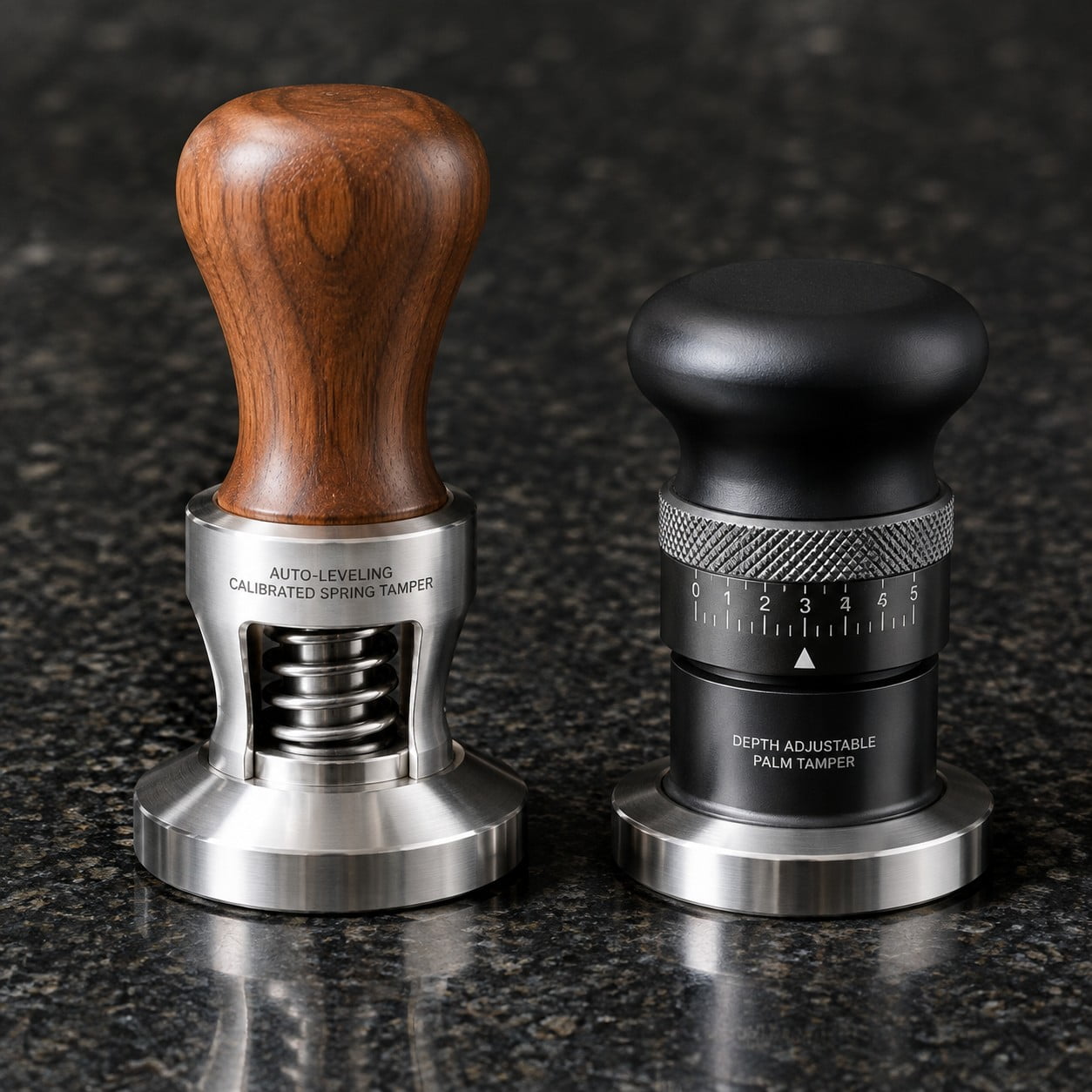
A fixed-depth palm tamper stops at a mechanical collar depth, meaning any slight fluctuation in coffee dose volume or roast density alters the actual compaction force. A calibrated spring-loaded tamper with an auto-leveling flange compresses the bed with a consistent 25 to 30 lb spring load regardless of dose height, preventing angular tilt channeling.

The Flaw in Fixed-Depth Palm Tampers
Palm tampers (also called push tampers) set depth by screwing the tamper base in or out. If you dial in for an 18.0g medium roast, that bed compresses to an exact millimeter depth. But if you switch to a darker roast (which is less dense) or your grinder doses 18.5g, the palm tamper will either bottom out against the basket rim without compressing the coffee, or crush the bed with excessive depth that leaves loose edges. Palm tampers cannot adapt to dose volume variance.
| Feature | Calibrated Spring Tamper | Fixed-Depth Palm Tamper | Impact on Consistency |
|---|---|---|---|
| Compensation for Dose Variance | Dynamically adjusts to bed height | Rigid stop; over or under-compacts | Spring tamper handles ±0.5g variance |
| Leveling Flange Mechanism | Self-leveling rim rests on basket top | Wide collar rests on basket top | Both eliminate human wrist tilt |
| Tamping Pressure Control | Calibrated internal 25–30 lb spring | Depends entirely on mechanical depth setting | Spring tamper delivers full compaction |
| Ease of Dial-In Workflow | Zero depth setup required | Requires micrometer adjustment per bean | Spring tamper is pick-up-and-go |
The Engineering Behind Leveling Spring Tampers
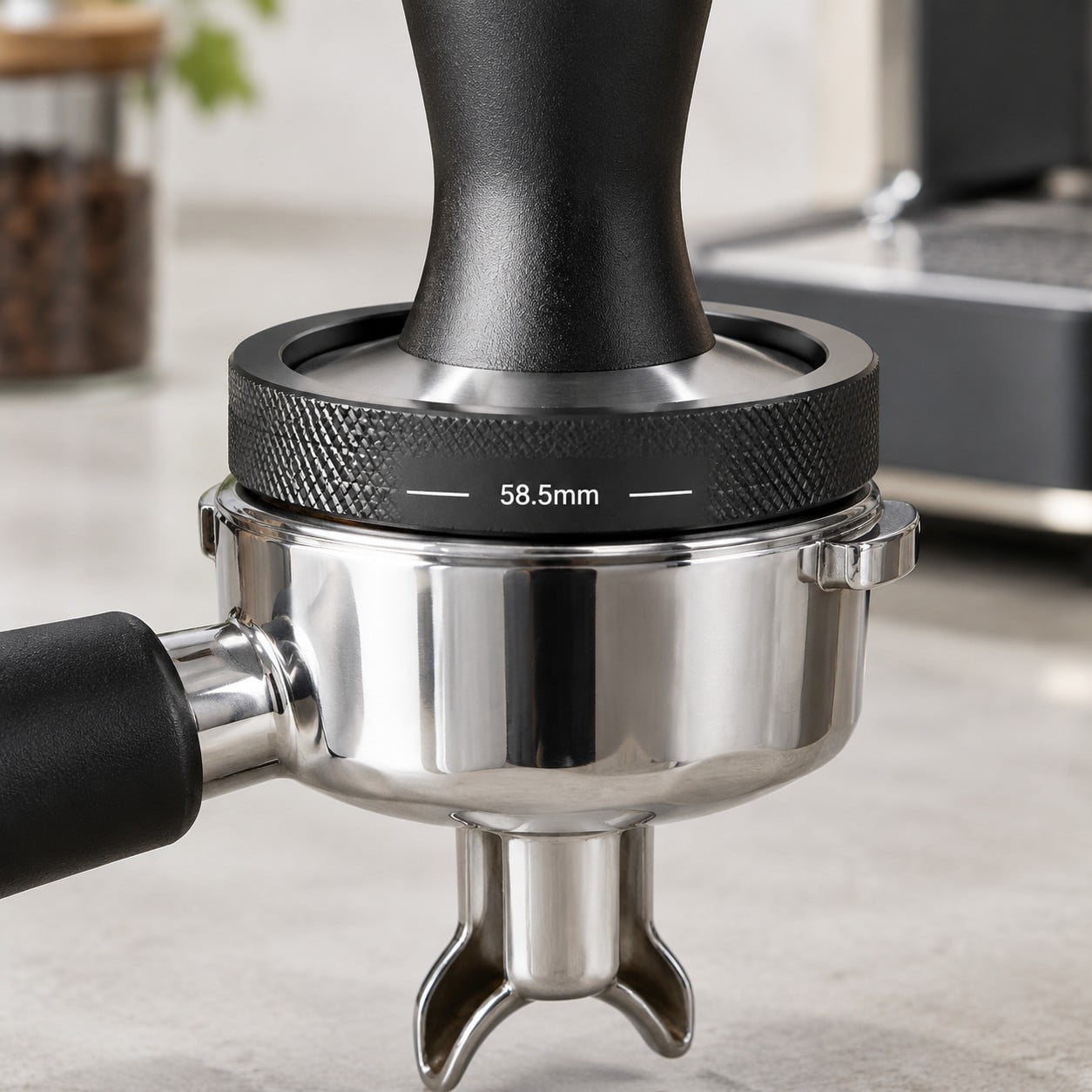
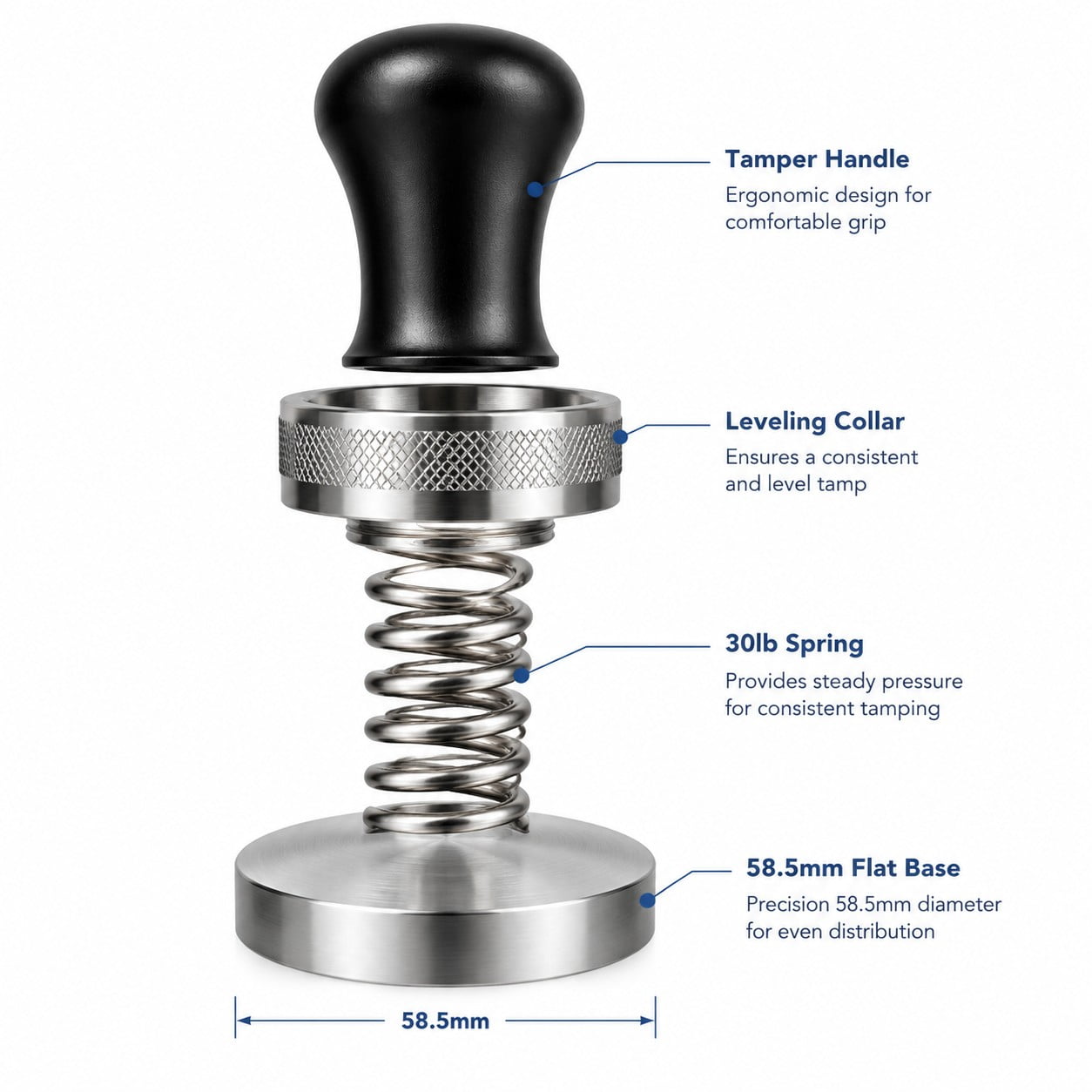
An auto-leveling spring tamper features two independent mechanisms: an outer leveling collar that rests flat on the portafilter rim, and an inner floating piston backed by a calibrated spring. When you press down, the collar ensures a 90-degree perpendicular angle, while the piston pushes downward until the coffee reaches full mechanical compression. The HBM Spring-Loaded Espresso Tamper is available in 51 mm, 53 mm, and 58.5 mm precision diameters, ensuring total edge-to-edge basket coverage.
Why 58.5 mm Fitment Matters for Extraction
Standard factory tampers measure 58.0 mm, leaving a 0.5 mm uncompressed ring of coffee grounds around the basket perimeter. During brewing, pressurized water channels straight down that loose outer ring, creating bitter, uneven extraction. Using a 58.5 mm tamper base eliminates side-wall channeling completely.
Frequently Asked Questions
Does tamping harder than 30 pounds affect espresso extraction?
No. Once coffee particles are fully compacted and air pockets eliminated, applying extra force does not increase bed density or slow down flow.
Why is a leveling flange tamper better than a traditional hand tamper?
Human wrists naturally tilt by 2 to 5 degrees under downward force. A leveling flange ensures the tamper face is reliably perpendicular every single time.
Can you use a 58.5 mm tamper in a standard Gaggia or Silvia basket?
Yes. Precision 58.5 mm tampers fit standard 58 mm commercial baskets (Gaggia, Silvia, E61) and IMS precision baskets precisely.
What tamper size is required for Breville 54 mm portafilters?
Breville 54 mm baskets have an inner diameter of roughly 53.4 mm. Use a 53 mm or 53.3 mm tamper for full coverage.
Do you still need WDT if you use a calibrated spring tamper?
Yes. A tamper compresses the bed vertically; it cannot break up deep clumps inside the lower layers of the basket. Use WDT before tamping.
Related products: Brewing tools.