
Burr alignment matters when the two burr faces are not sitting parallel to each other, but it is not the first explanation for every bad espresso shot. Before opening a grinder, separate four different problems: calibration, burr alignment, worn burrs and an ordinary dial-in error.
If the grinder produces good coffee, reaches the required grind range and behaves consistently, an alignment project may create more risk than value.
What does burr alignment mean?
In a flat-burr grinder, the cutting faces should sit in a controlled relationship to each other. If one side reaches contact before the rest of the circumference, the burrs may not be co-planar.
Alignment is different from centering and different from zero calibration.
– Calibration establishes a reference point for the grind dial. – Alignment asks whether the burr faces meet evenly. – Centering concerns whether rotating parts run concentrically around the intended axis. – Burr condition concerns wear, damage or contamination on the cutting surfaces.
A grinder can have a misleading zero mark while the burrs are otherwise aligned. It can also be calibrated to zero while still having an alignment problem.
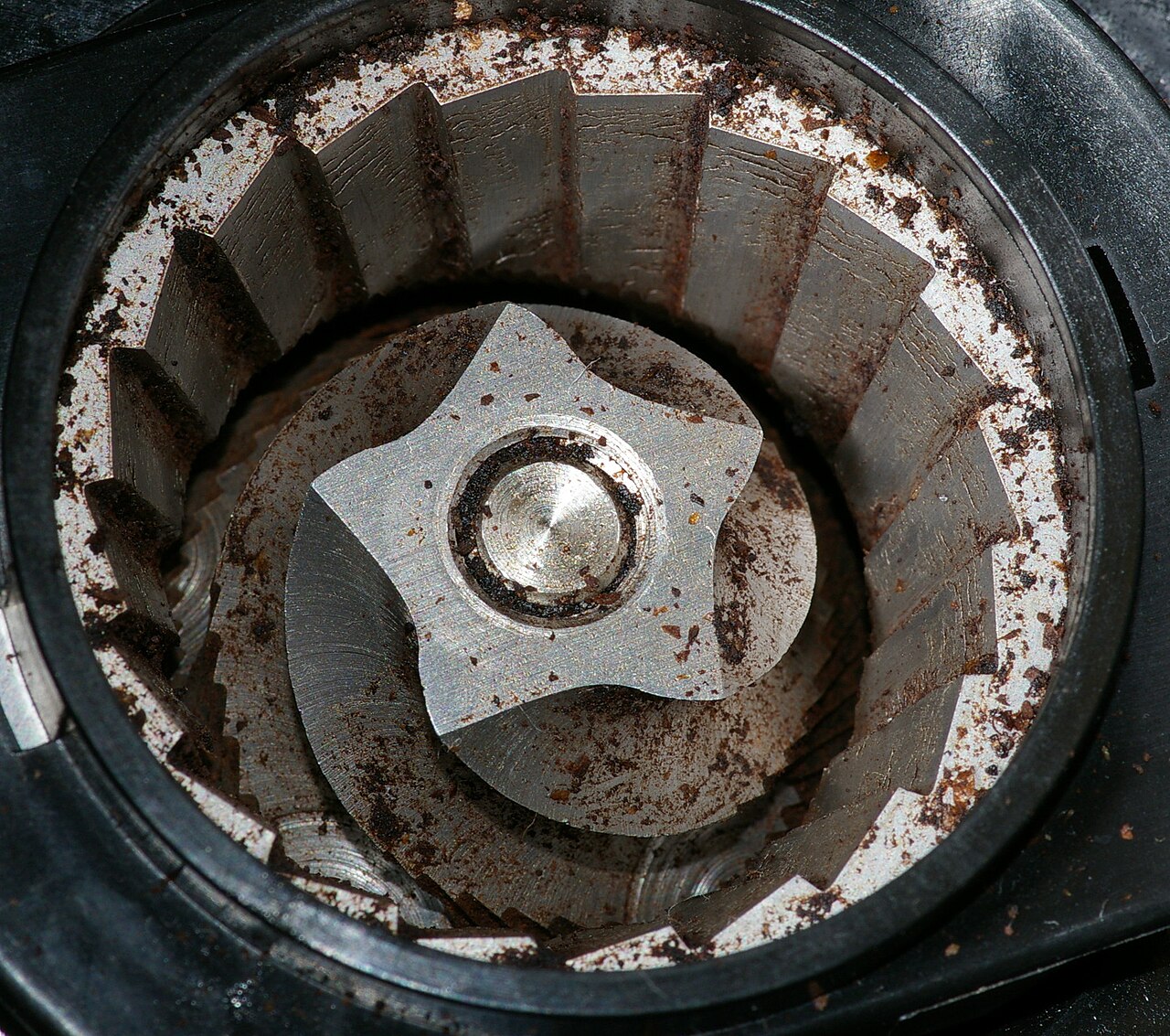
Real burr-grinder hardware for context; this photo does not demonstrate an alignment result or a model-specific service procedure. Photo: Hustvedt / Wikimedia Commons, CC BY-SA 3.0.
Why do people use the marker test?
The marker test is an enthusiast diagnostic concept, not a universal manufacturer procedure.
In community discussions, it is used to infer whether contact appears evenly distributed around a burr face. That can be useful evidence on a known grinder, but the result depends on burr geometry, carrier design, calibration and how contact is created.
HomeBaristaMods does not publish a generic marker-test step sequence here because intentionally bringing burrs into contact can damage a grinder if the model’s procedure is unknown. If the manufacturer or service documentation provides an alignment or calibration method, that exact procedure takes priority. Otherwise, use community contact-pattern reports only as diagnostic context, not as a universal repair instruction.
Which symptoms justify checking alignment?
One weak shot does not.
A more useful reason to investigate is a repeatable mechanical symptom that remains after basic checks. Examples include:
| Symptom | Check before alignment |
|---|---|
| Grinder cannot reach espresso fineness | Calibration, burr installation, wrong burr orientation, clogging |
| Grind setting changed after cleaning | Reassembly and calibration |
| Burr rub starts at one point in rotation | Foreign debris, carrier seating, damage |
| Espresso runs fast at the finest usable setting | Dose, basket, coffee age, calibration, burr installation |
| Grinder became worse immediately after a burr swap | Correct burr set, screw seating, carrier cleanliness, calibration |
| Coffee tastes inconsistent but grinder behaves normally | Recipe, distribution, temperature and coffee before hardware work |
Home-Barista discussions contain many alignment projects, but they also show how quickly owners can spend hours shimming without a clear baseline. That is a reason to diagnose first, not proof that every flat-burr grinder should be opened on day one.
Is calibration the same as alignment?
No.
Niche’s current calibration guide makes the distinction useful even though the Niche Zero is a conical-burr grinder. Its calibration process establishes a known zero reference after cleaning or disassembly. That does not measure whether two flat burrs meet evenly around their circumference.
More generally, moving a grinder’s zero or dial reference only changes the calibration reference. It does not by itself verify that two flat burr faces are parallel.
When troubleshooting, write down which procedure you actually performed. “I aligned it” is not useful if you only recalibrated the dial.
Should a new flat-burr grinder be aligned immediately?
Not by default.
A new grinder should first be checked for normal operation: correct assembly, usable grind range, repeatable dosing, no abnormal noise and the ability to dial in the coffee you brew.
If all of those are working, there may be little practical reason to disturb the burr carrier. Removing burrs can introduce debris under the mounting surface, uneven screw torque or a new calibration problem.
Factory alignment checks are real on at least some grinders: Mazzer says components related to adjustment and grinding receive tolerance checks and that its team performs parallelism checks at the end of the assembly line. That is another reason not to assume a new, normally operating grinder needs immediate owner shimming. A burr removal or burr swap can still change the mechanical state later.
What changes after a burr replacement?
A burr swap resets several assumptions at once.
The new burrs can differ in thickness, cutting geometry and seasoning state. The zero point may move. The screws and mounting faces have been disturbed. Your previous dial number may no longer correspond to the same burr gap.
That makes “my old espresso setting no longer works” a poor alignment diagnosis by itself.
After a burr replacement, confirm the correct parts, clean mounting surfaces, torque according to the model’s instructions where specified, recalibrate and then dial in again. Only investigate alignment further if a repeatable mechanical problem remains.
When should you stop a DIY alignment attempt?
Stop if the procedure requires force, permanent modification or electrical disassembly that the manufacturer does not document.
Also stop if you cannot distinguish a calibration error from an alignment error. Spending another hour adding foil shims is unlikely to help when the burr carrier is not seated correctly.
Do not sand, grind or machine a burr carrier based on a generic forum post. Those changes are difficult to reverse and can affect warranty or future repair options.
If a new grinder shows obvious runout, severe uneven contact or cannot reach its intended grind range after correct calibration, document the symptom and contact the seller before modifying it.
How should you document an alignment problem?
A useful support note is more valuable than “the grinder seems off.”
Record:
| What to record | Why |
|---|---|
| Exact grinder model and version | Burr carriers change between revisions |
| Burr model | Aftermarket burrs can change fit and zero |
| Date and reason for opening grinder | Establishes what changed |
| Calibration procedure used | Separates dial reference from alignment |
| Grind range before and after | Shows whether the problem is functional |
| Sound/video of abnormal contact | Helps support identify runout or interference |
| Photos of clean mounting surfaces | Shows seating condition |
| What you changed | Prevents repeating the same intervention |
If you later adjust anything, change one variable at a time.
Questions about burr alignment
Does every flat-burr grinder need a marker test?
No. The marker test is a diagnostic technique used by enthusiasts. A grinder that performs normally does not need to be opened simply to satisfy a forum checklist.
Can poor alignment cause uneven grinding?
It can contribute to an uneven burr gap, but particle distribution also depends on burr geometry, coffee, RPM and feeding. Do not diagnose cup taste from alignment theory alone.
Does chirping prove the burrs are misaligned?
No. Chirping tells you the burrs are touching somewhere. The contact pattern and the grinder’s calibration procedure determine what that means.
Can I fix alignment with foil shims?
Shimming is a community technique used on some flat-burr carriers, but it is model-specific and easy to overdo. It should not be treated as a universal first repair.
Should I align burrs after every cleaning?
No. Routine cleaning does not necessarily require removing the burrs from their carriers. Follow the manufacturer’s procedure. If the burrs themselves are removed, recalibration may be required; alignment work is a separate question.
Related HomeBaristaMods guides
– When should you replace grinder burrs? – Niche Zero calibration after cleaning – Coffee grinder static decision guide – Maintenance library
References
– Mazzer — Consumer FAQ: factory tolerance and parallelism checks – Home-Barista — Flat-burr alignment discussion and marker-test practice – Home-Barista — Burr alignment and symptoms – Home-Barista — Eureka Mignon Specialita alignment case – Niche Coffee — calibration guide illustrating zero-reference calibration
Research note: PASS — Fact / Solution Gate as a diagnosis/triage article, not a shimming tutorial. The article intentionally avoids universal alignment steps. A repair guide would require the exact grinder revision, manufacturer/service procedure and real model-matched photos.