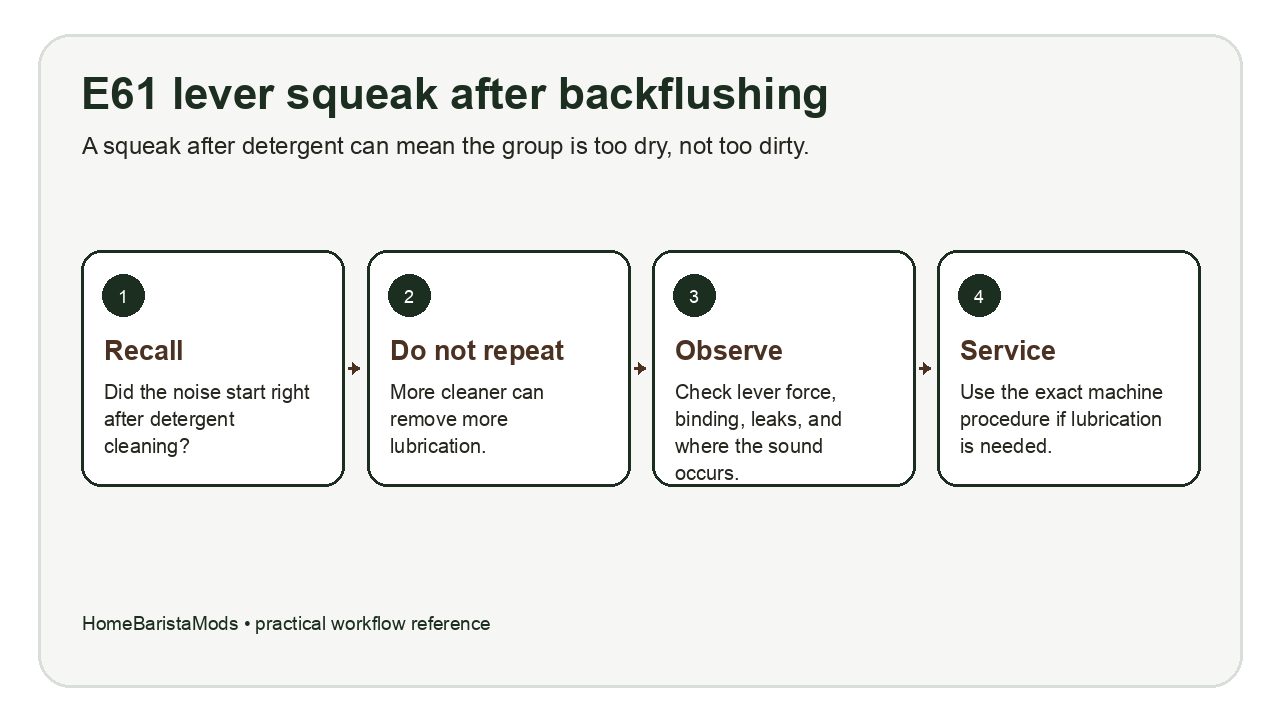
If an E61-style brew lever becomes dry or squeaky soon after detergent backflushing, do not assume the group suddenly needs a major rebuild.
ECM and Profitec both warn in current manuals that cleaning the brew group too often with cleaner can degrease moving parts. Their manuals specifically note that the group can begin squeaking and that excessive detergent cleaning can accelerate wear.
That gives you a much better starting point than “add more cleaner.” If the group actually needs mechanical service, use the model-aware E61 maintenance guide rather than a generic teardown.
Why can detergent backflushing make an E61 lever squeak?

The E61 group contains moving mechanical parts in the lever/cam and valve system.
Coffee detergent is supposed to remove coffee oils.
Used too frequently, it can also remove lubrication from moving surfaces.
ECM’s Puristika manual and Profitec’s Pro 600 manual both warn that overly frequent cleaner use can cause squeaking because moving parts become degreased.
They also recommend cleaning the brew group from time to time without cleaner.
That is a manufacturer-backed mechanism, not just forum folklore.
Does squeaking mean the group is dirty?
Not necessarily.
A group can squeak because it is too dry.
That distinction matters because another detergent cycle may make the symptom worse.
Ask what happened immediately before the noise began:
- Did you just use detergent?
- Did you run several detergent backflush cycles close together?
- Did the lever feel smooth before cleaning?
- Is the noise mainly at one part of the lever travel?
- Is the group still sealing and brewing normally?
If the squeak began directly after aggressive chemical cleaning, loss of lubrication belongs high on the list.
Should you stop backflushing with detergent?
No.
Detergent cleaning still has a purpose: removing coffee oils from the brew path.
The problem is frequency and method, not the existence of detergent.
ECM’s manual, for example, provides a detergent-cleaning procedure and also warns against doing it too often.
A sensible maintenance plan separates these jobs. The broader espresso-machine maintenance guide is useful for keeping routine cleaning separate from repair.
- water-only backflushing / rinsing;
- detergent cleaning;
- mechanical lubrication or service when needed.
Do not make every one of those tasks “chemical backflush.”
What should you check before adding lubricant?

First confirm the noise is actually coming from the brew-group lever.
Listen for whether the sound occurs:
- as the lever first begins to rise;
- near the middle cam position;
- when it reaches the full brew position;
- while lowering the lever;
- only when the machine is hot.
Also check whether the lever suddenly feels heavier.
A squeak with otherwise normal lever force after detergent cleaning is different from binding, grinding or a lever that is becoming difficult to move.
Binding deserves mechanical inspection. If the lever is also leaking, unusually hard to move or no longer holding normal positions, step back to the diagnosis page before treating it as a lubrication-only problem.
Can you lubricate an E61 group yourself?
Many E61 groups are serviceable, but lubrication should be treated as a mechanical-maintenance task, not as “spray something into the lever slot.”
Use a lubricant suitable for espresso-machine food-contact service and follow the exact manufacturer/service procedure for the machine.
Do not use general household oils, penetrating oils or automotive grease around the brew path.
For a detailed HomeBaristaMods lubrication tutorial, the correct standard is:
- exact machine/model;
- real group photos;
- cool and unplugged machine;
- correct access point;
- correct lubricant;
- no invented cam orientation or valve stack.
The current article should explain diagnosis and maintenance logic, not fake a universal teardown.
What if the squeak disappears after water-only backflushing?

That is useful information.
Water-only cycling can redistribute moisture and move the valves without adding more detergent.
ECM and Profitec explicitly recommend periodic brew-group cleaning without cleaner.
If a mild squeak disappears and lever feel returns to normal, you may not need immediate disassembly.
If the noise returns quickly or lever motion becomes rough, inspect the mechanical service state.
Does a squeaking lever mean the cam is worn?
Not automatically.
A dry cam can squeak before it is badly worn.
Excessively frequent detergent cleaning can remove lubrication and increase wear over time, which is exactly why the manuals warn against it.
Wear becomes more plausible when you also have:
- abnormal play;
- rough or notchy lever travel;
- difficulty reaching the normal positions;
- leakage around the group;
- recurring squeak immediately after lubrication/service.
Noise alone is not a wear measurement.
How often should you use detergent?
There is no universal E61 detergent interval that fits every machine and household.
Manufacturers use different reminders and cup-count recommendations.
For example, ECM documents a cleaning interval around a cup count on some machines, while also telling users that overly frequent cleaner use can create squeaking.
Use the manual for your exact machine.
More detergent is not automatically better maintenance.
What if the machine is a Profitec, ECM, Rocket or another E61-type machine?

The broad mechanical principle can be similar, but service instructions are not interchangeable.
ECM and Profitec documentation directly supports the “over-cleaning can degrease moving parts and cause squeaking” mechanism.
That does not mean every E61-family machine uses identical lubrication access, cam hardware or service intervals.
Keep diagnosis generic.
Keep disassembly model-specific.
A better cleaning routine

Use three separate columns in your maintenance log:
| Maintenance | Last done | Trigger |
|---|---|---|
| Water-only backflush | Record date | routine rinse |
| Detergent clean | Record date | machine/manual interval |
| Mechanical group service | Record date | lever feel / scheduled service |
That simple separation prevents a common error: using detergent whenever the lever “feels like it needs cleaning.”
When should you stop using the machine?
A simple squeak is not the same as a dangerous fault.
Stop and inspect before continued use if:
- the lever becomes very hard to move;
- the group leaks significantly;
- parts feel loose;
- the lever does not stay in normal positions;
- you see damaged cam or valve components during service.
Do not force the lever through binding.
Questions E61 owners ask
Why did my lever start squeaking right after Cafiza-type cleaning?
Detergent can remove lubrication from moving group parts. ECM and Profitec both warn that cleaning too often with cleaner can cause squeaking.
Should I run another detergent cycle?
Not as a response to squeaking. First decide whether the group is dirty or simply degreased.
Is water-only backflushing useful?
Yes. ECM and Profitec documentation specifically recommends cleaning the group from time to time without cleaner.
Can I spray lubricant into the lever opening?
Do not improvise. Use the machine-specific service method and an appropriate food-safe lubricant.
Does squeaking mean I need a full rebuild?
No. Squeaking can be an early dry-lubrication symptom. Binding, leaks, play and recurring roughness are stronger reasons for mechanical service. The Guides Library and Reference Library are the next places to continue once you know whether this is routine maintenance or a repair.
References
- ECM — Puristika user manual, group-cleaning warning
- Profitec — Pro 600 user manual, group-cleaning warning
- Clive Coffee — E61 cam lubrication for a sticky or squeaky brew lever
- Whole Latte Love — E61 lever squeaks or is hard to move
Research note: the diagnosis is based on manufacturer statements about detergent, lubrication loss and squeaking. A future step-by-step lubrication article should use the exact machine’s service geometry.