Backflushing cleans coffee oils from the brew-group and three-way-valve path. It does not descale the boiler. Before using a blind basket, confirm that your exact Gaggia Classic version supports pressure release through the drain path.
Can you backflush your Gaggia Classic?
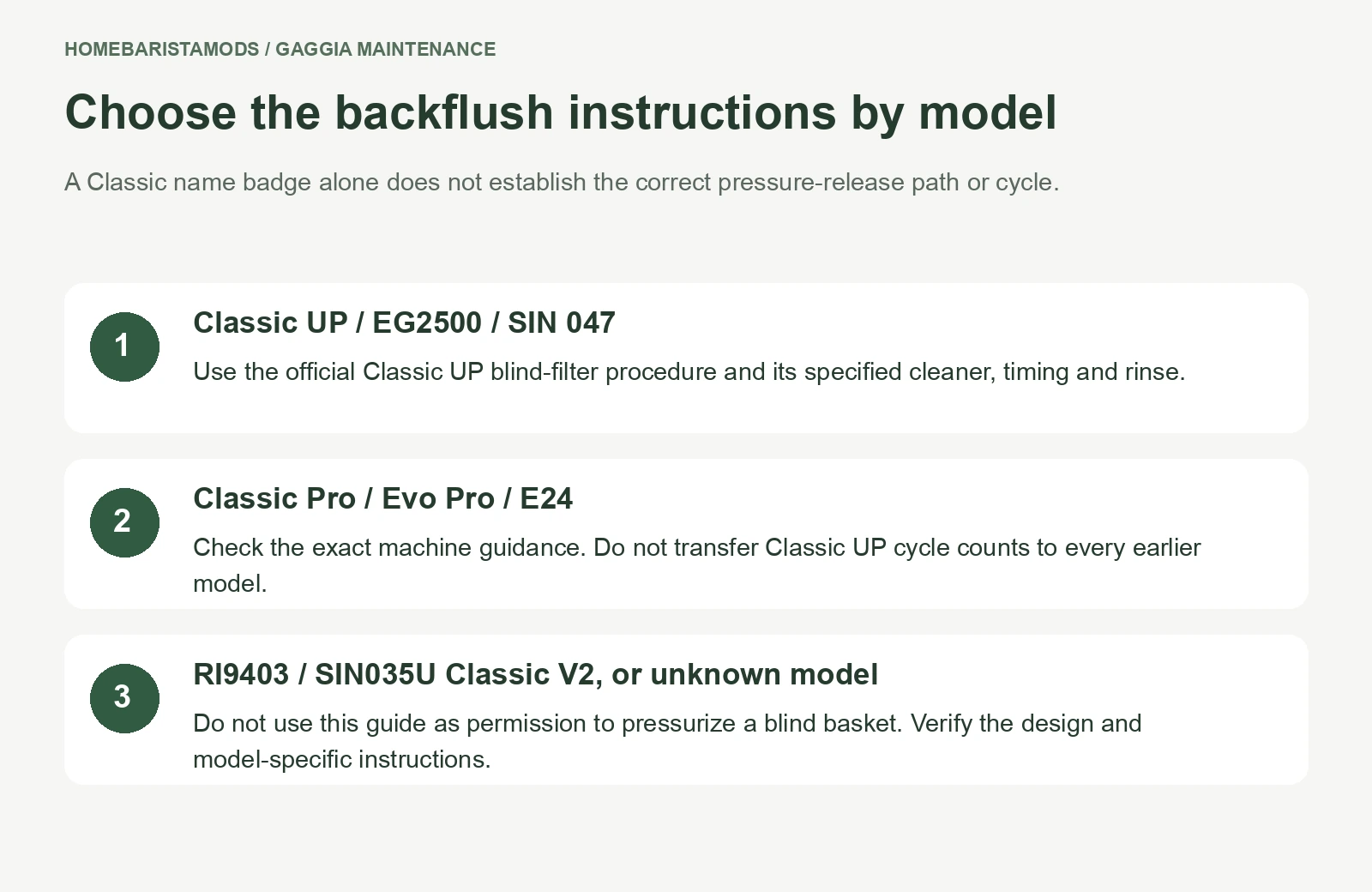
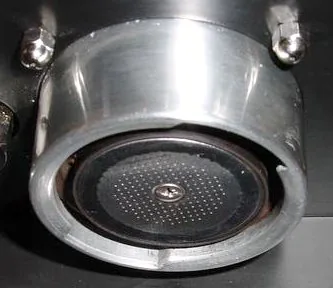
Use a blind-filter backflush only on a machine with the intended drain/three-way-solenoid path and model-appropriate guidance. Classic Pro, Evo Pro and E24 use a three-way solenoid drain path; Gaggia’s current E24 product page explicitly describes the valve releasing pressure into the drip tray after brewing. The 2015-2018 European RI9403 / SIN035U “Classic V2” is a different design and should not be treated as a Pro/E24: its parts documentation does not show the decompression/three-way-solenoid arrangement used for backflushing. If the exact version is uncertain, check the model label and its manual or parts documentation before pressurizing a blind basket.
If group flow is already missing or pressure does not release normally, do not use repeated detergent cycles as a repair attempt. Start with the Gaggia no-water diagnosis.
What do you need to backflush a Gaggia Classic?
You need the correct blind filter or backflush insert, the portafilter, a coffee-oil cleaner intended for espresso equipment, fresh water and access to the drip tray. Do not put coffee-oil cleaner into the water tank. Descaler and backflush detergent solve different problems.

| Item | Purpose |
|---|---|
| Blind filter / approved insert | Builds pressure so the cleaning cycle can discharge through the drain path. |
| Coffee-oil cleaner | Removes coffee residue and oils from the group path. Use the dose for the product and machine. |
| Fresh water | Used for the full rinse phase after chemical cleaning. |
| Group brush | Removes loose grounds around the screen and gasket area. |
Urnex’s Cafiza instructions for traditional machines use a blind filter and alternating brew/rest cycles, but product instructions are not a substitute for the machine manufacturer’s sequence. If you use Gaggia’s current Classic UP procedure, follow its Gaggia-tablet dose and timing rather than combining two different recipes.
What backflush timing should you use?
Classic UP (EG2500 / SIN 047)
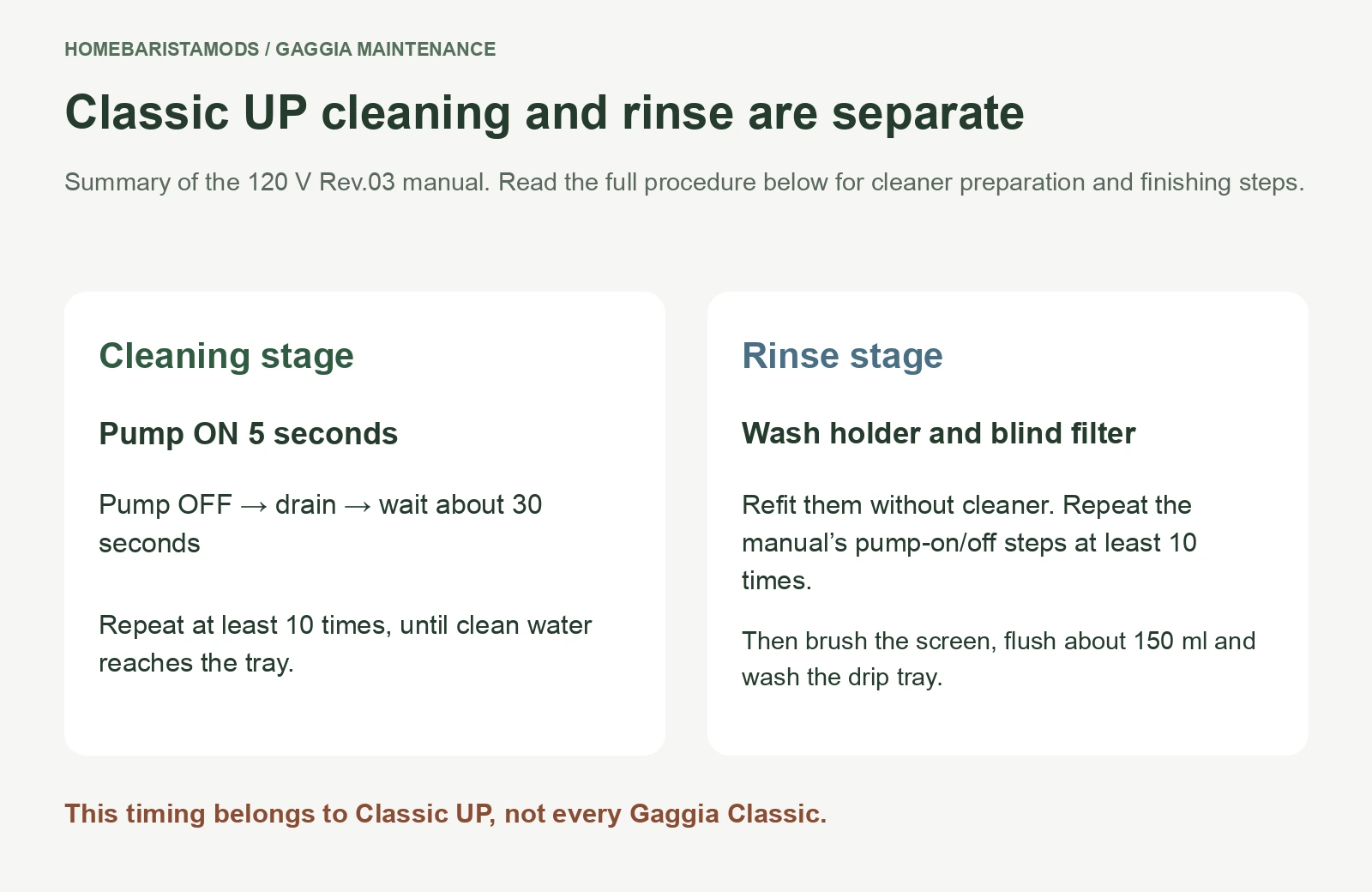
Gaggia’s current Classic UP manual gives an exact machine-specific sequence: insert the blind filter, place one quarter of a Gaggia Coffee Oil Remover tablet in it, lock in the portafilter, run the pump for 5 seconds, stop it, and let the detergent water drain into the tray. Wait about 30 seconds. Repeat the cleaning cycle at least 10 times until clean water appears at the drain, then wash the filter holder and blind filter, run at least 10 cleaner-free rinse cycles, brush the screen, flush about 150 ml of hot water through the brew group, and wash the drip tray.
Classic / Classic Pro / Evo Pro / E24
Do not automatically copy the Classic UP cycle count to earlier Classic-family machines. Gaggia Direct’s Classic-specific backflush note says to activate the brew cycle for about 3-5 seconds, stop, repeat a few times, rinse the portafilter, and then repeat with clean water. Urnex’s generic Cafiza directions for traditional espresso machines use 10 seconds on and 10 seconds off, repeated five times. Treat the Urnex timing as cleaner-manufacturer guidance, not as a Gaggia model-specific override. When sources differ, follow the procedure tied most closely to your exact machine and use the cleaner only at the dose allowed by that procedure.
| Stage | What to do | Stop if |
|---|---|---|
| Confirm | Verify the machine and drain path support backflushing. | The version is unknown or pressure is not releasing normally. |
| Chemical clean | Use the model/product dose and short pump cycles. | Water leaks around the portafilter or the pump sounds abnormal. |
| Drain/rest | Let the cleaning solution discharge to the drip tray between cycles. | No discharge appears where the machine should release pressure. |
| Rinse | Remove cleaner, rinse the basket and run cleaner-free cycles. | Cleaner residue remains; continue rinsing rather than brewing coffee. |
How often should you backflush, and what should you avoid?
The current Classic UP manual specifies brew-group cleaning monthly. Do not automatically copy that interval to every older Classic, Pro, Evo or E24 in every market. Usage, the exact model and the maintenance guidance for that machine still matter.

- Do not use backflush detergent as descaler.
- Do not put Cafiza or a similar coffee-oil cleaner in the water tank.
- Do not replace short cleaning cycles with one long pressure run.
- Do not continue if the portafilter leaks, the pump sounds distressed or the machine does not discharge through the expected drain path.
- Do not assume brown water proves a mechanical fault; detergent is removing coffee residue.
For mineral scale, use the separate Gaggia Classic descaling guide. Keeping these two jobs separate prevents the most common cleaning mistake.
When is backflushing not enough?
Backflushing is maintenance, not a universal repair. It will not dissolve boiler scale, repair a failed solenoid, fix a weak pump, replace a leaking group gasket or identify dark particles by itself. If normal group flow is weak before cleaning, pressure does not release, particles keep returning, or the machine leaks during a blind-filter cycle, stop and diagnose the specific fault.
If you are seeing particles, use the black-flakes diagnosis. If flow is missing, use the no-water guide before adding more cleaner.
FAQ
Is backflushing the same as descaling?
No. Backflushing targets coffee oils in the brew-group/drain path. Descaling targets mineral deposits in the water path.
Can I use Cafiza in a Gaggia Classic?
Cafiza is designed for espresso-machine groupheads and blind-filter backflushing, but follow the machine and cleaner instructions rather than mixing two dosing procedures. Gaggia’s current Classic UP manual specifies its own Coffee Oil Remover tablet procedure.
Should I backflush if no water comes from the group?
Not as a first response. Diagnose the water path, pump, solenoid and scale condition first. A blocked machine is not a reason to keep adding detergent.
References
- Gaggia Classic UP operating manual, 2026 — cleaning and maintenance
- Gaggia North America — Classic Pro/Evo/E24 manuals
- Gaggia — Classic E24 product page and three-way-solenoid description
- Gaggia Direct — Back Flushing a Gaggia Classic (3-5-second guidance)
- Philips support — Gaggia RI9403/11 model documentation
- RI9403 / SIN035U exploded parts diagram
- Whole Latte Love — Gaggia Classic backflush demonstration
- Urnex Cafiza — manufacturer backflush directions
Image Credits
CC image credits are included directly under each reused photograph. HomeBaristaMods does not use those photographs as proof of an unshown internal Gaggia revision.
 English
 Deutsch