
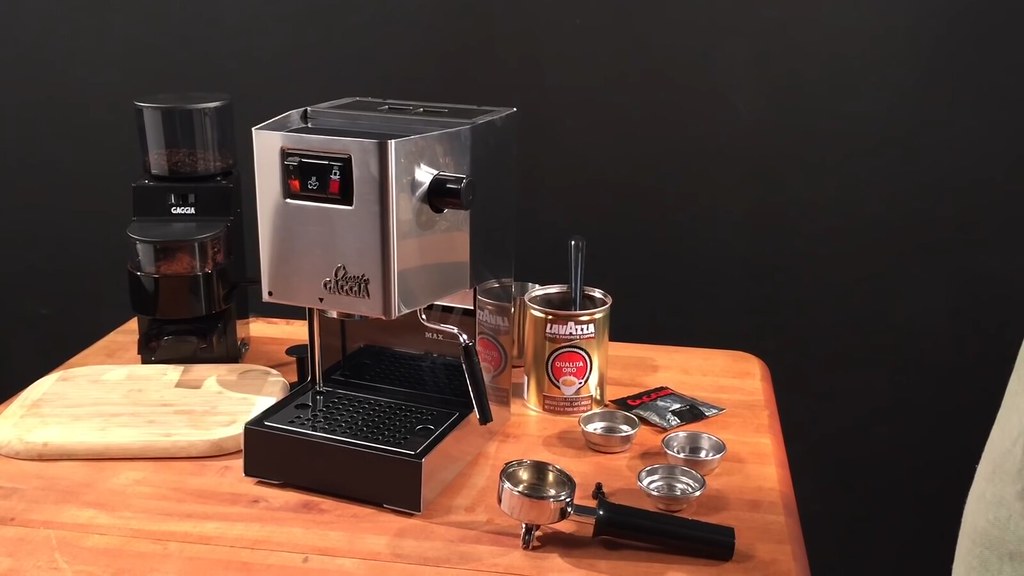
If a Gaggia Classic shower screen is clean before the first shot and packed with grounds immediately afterward, replacing the screen is not automatically the first fix. The screen/holding plate can be dirty, the group can be restricted, or the coffee dose can leave too little headspace.

Why can it clog after one shot?
A recent 2026 owner of a stock 2020 Classic Pro reported that the machine worked normally until one shot, after which grounds appeared between the shower screen and dispersion plate and the next shower became uneven. Backflushing alone did not solve it. That is a useful real symptom, but it does not prove the screen itself is defective.
Coffee can reach the screen when the puck sits very high, expands during brewing or breaks up during pressure release. Scale and old coffee buildup above the screen are separate causes, so diagnose rather than guessing.
First test: bare-group flow
Remove the portafilter and run the group into a measuring cup. Whole Latte Love’s current Classic Pro group-service guidance uses about 6 oz in 20 seconds as a useful flow reference. If flow is materially slower before coffee is installed, the problem is upstream of the puck.
What does Gaggia tell you to clean?
Gaggia North America’s current maintenance procedure removes the shower screen, then the shower holding plate, and cleans buildup from the group head with a stiff brush and suitable descaling solution. Metal parts can be soaked as directed; plastic parts should not be soaked in descaler. Everything must be rinsed thoroughly before reassembly.

Should you clear the tiny holes with a needle?
Not as a default method. Whole Latte Love’s Gaggia group-valve cleaning guidance specifically warns against using a pin to clean the small shower-screen holes because enlarging them can contribute to future problems. Scrub/soak the screen and make sure the holes are visibly clear; replace a damaged screen rather than machining it with a needle.
Could the basket simply be overfilled?
Yes. Keep coffee, grind and puck prep the same and reduce dose modestly for the next shot. If grounds stop packing against the screen, puck height was part of the problem.
Do not treat “18 g” as one universal physical height. Different baskets and coffees occupy different volumes. Home-Barista Gaggia owners commonly use puck-imprint/coin-style checks to explore maximum fill; that is an owner diagnostic, not a Gaggia factory specification. The useful question is whether the dry puck is already contacting the screen/screw strongly before brewing.
If you recently changed baskets, use the Gaggia IMS basket fit guide and return to the known-good basket for the A/B test.
Will a puck screen solve it?
A puck screen can keep coffee away from the machine’s shower screen in some workflows, but it is not a repair for low group flow or scale. It also consumes headspace. Adding a screen to an already overfilled basket can make contact worse.
Establish normal group flow and a sensible dose first. Then treat a puck screen as a workflow accessory, not as a substitute for maintenance.
What if cleaning fixes only one or two shots?
| What returns | Likely branch | Next test |
|---|---|---|
| Coffee grounds above screen | Dose/headspace/puck breakup | Lower dose, same basket/coffee |
| Pale mineral debris | Scale/upstream buildup | Water and group maintenance |
| Flow declines without visible coffee | Group/solenoid restriction | Bare-group + steam-wand comparison |
| Only one basket causes it | Basket fill/geometry | Return to known-good basket |
What if the shower-screen screw is stuck?
Do not keep escalating force while the machine is hot. Whole Latte Love maintains a Gaggia-specific procedure for stuck/stripped shower-screen screws. Gaggia also warns not to damage the ridge where the screen fits while freeing a stuck holding plate.
The screen and screw are inexpensive service parts; the machined group is not. Protect the group surface.
Should you upgrade to an IMS shower screen?
Not because the stock screen got dirty once. Clean the stock assembly, verify normal flow and correct excessive puck height first. An aftermarket screen can be a workflow preference, but it cannot cure a blocked solenoid or an overfilled basket.
The recent owner case that triggered this topic received community suggestions for an IMS screen and puck screen. Those suggestions are useful owner experience, not proof that the stock screen caused the original problem.
Can a bottomless portafilter help?
It can show channeling and spraying below the puck, but it cannot show what is happening above it. Fix group flow and screen cleanliness first. After the machine is healthy, the HomeBaristaMods Gaggia Bottomless Portafilter can be a useful puck-prep learning tool—not the repair for a clogged screen.

A repeatable one-shot test
- Clean the screen/holding plate with the machine cold and unplugged.
- Reassemble and warm normally.
- Measure bare-group flow.
- Use one known basket and coffee.
- Record dose, grind, yield and time.
- Inspect screen contamination after the shot.
- Repeat at a modestly lower dose.
- If flow is slow before coffee, leave the dose experiment and diagnose the group path.
When should you move to solenoid diagnosis?
If bare-group flow is significantly below the current 6 oz/20 sec reference, especially while steam-wand flow remains strong, use the Gaggia solenoid diagnosis. If both steam and group flow are weak, use the pump/priming path.
References
- Gaggia North America — group-head cleaning
- Gaggia — Pro/Evo/E24 manuals and parts diagram
- Whole Latte Love — grouphead service and flow reference
- Whole Latte Love — stuck/stripped shower-screen screw
- Owner case — one-shot shower-screen clogging (2026)
- Home-Barista — Gaggia dose/headspace discussion
Evidence note: Gaggia/service documentation defines cleaning and flow checks. Owner discussions identify real symptoms and useful A/B tests; they are not manufacturer specifications.