
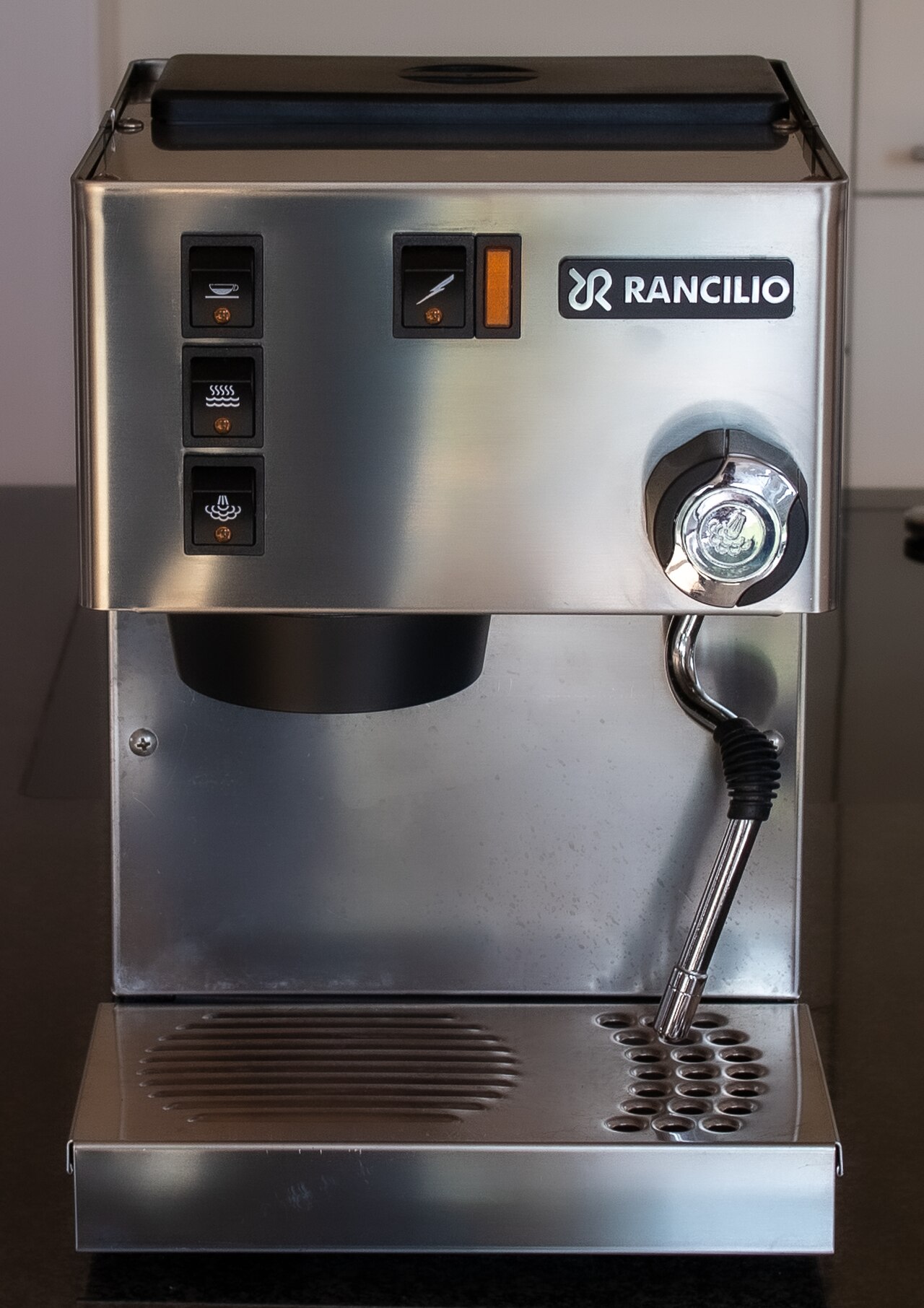
If a Rancilio Silvia leaks around the portafilter even after you installed a new group gasket, do not keep tightening the handle harder. The leak can come from a dirty sealing surface, the wrong gasket fit/orientation, basket interference, or wear on the portafilter locking ears and group bayonet.

What does Rancilio officially tell you to clean?
Rancilio Group North America’s current Silvia manual and weekly-cleaning procedure tell owners to purge the group, brush the portafilter gasket/seal area, backflush with a blind disk/basket and clean the portafilter and filter basket. Coffee grounds and oil on the sealing surfaces therefore belong at the top of the leak checklist.
A new gasket cannot seal reliably against debris trapped between the basket rim and group seal. Clean before deciding the replacement part is wrong.
Why can a new gasket still leak?
A gasket is only one part of the clamping system. The portafilter lugs ride in the group’s bayonet ramps and lift the basket rim into the gasket. If the basket, gasket thickness, portafilter ears or group ramps change that geometry, the seal can be uneven even when the gasket itself is new.
A long-running Home-Barista Silvia repair case documented exactly this: a new OEM gasket was soft and correctly installed, but the machine still leaked unless the portafilter was tightened hard. The troubleshooting moved beyond “replace the gasket” to basket interference, lock-in position and portafilter-lug wear.
First test: how does the portafilter lock with no basket?
Remove the basket and insert the bare portafilter body. Note the lock position and whether it feels smooth and even. This removes basket rim height/shape from the system.
If the bare portafilter behaves normally but one basket makes the seal difficult, investigate that basket. If the bare portafilter itself locks unusually far or feels uneven, gasket thickness, portafilter ears or group wear become more relevant.
Can a VST or IMS basket cause a leak?
It can change the fit. The classic Home-Barista Silvia case began immediately after fitting a 20 g VST basket. Contributors noted that basket height and straight-wall geometry can interfere differently with a portafilter body. The owner later confirmed the old basket leaked too, which is why the diagnosis continued rather than blaming VST forever.
Use the stock basket as a control. If stock seals and the aftermarket basket does not, basket/portafilter fit is evidence. If both leak in exactly the same place, look elsewhere.
Does the gasket have an installation direction?
Follow the replacement gasket’s manufacturer/OEM orientation. In the documented Silvia repair case, experienced repair contributors specifically checked whether the gasket was installed upside down because orientation can change how the bevel/sealing face meets the basket.
Do not assume every aftermarket silicone gasket uses the same markings or bevel as an older OEM rubber gasket. Identify the actual part you bought.
Is 8 mm or 8.5 mm the correct Silvia gasket?
Do not choose thickness from a forum number alone. Gasket thickness changes portafilter lock position and can compensate for wear, but it can also make a healthy machine unnecessarily tight.
Home-Barista repair discussions document both 8 mm aftermarket and 8.5 mm/OEM-style Silvia gaskets. In one case an owner deliberately ordered an 8.5 mm Rancilio gasket because an 8 mm gasket allowed excessive travel. In another recent 2026 case, an owner already had an 8.5 mm silicone gasket and still leaked—showing that thickness is not the only variable.
Confirm the part specification for your Silvia generation and use fit/leak evidence rather than “thicker is always better.”
What if you have to tighten the handle extremely hard?
That is not a good long-term fix. Excessive force can mask an uneven seal and accelerates wear on the portafilter lugs, group ramps and handle assembly. A healthy seal should not require a daily strength test.
If tightening harder stops the leak, record where the handle stops and then perform the empty-portafilter / stock-basket / second-portafilter comparisons.
Can the portafilter ears wear unevenly?
Yes. A September 2026 Home-Barista case is particularly useful: an owner had two portafilters on the same machine. The two-spout portafilter did not leak, while another portafilter did. The owner observed uneven wear on one locking “dog” and linked the leak location to the worn side.
That is strong A/B evidence because the machine, group and gasket stayed constant while the portafilter changed.

Can the group bayonet wear too?
Yes. The locking surfaces are a system: portafilter lugs contact the group ramps. Years of use can change that fit. If multiple known-good portafilters leak similarly even with a correct fresh gasket, inspect the group locking surfaces and seal seat.
Do not try to “fix” worn metal by stacking improvised shims into the sealing path. Home-Barista repair discussions caution that shims themselves can create a leakage path.
What if the leak always comes from the same side?
That is useful evidence. Rotate or swap the basket and see whether the leak location moves. If it stays at the same clock position relative to the machine, the basket becomes less likely. Then compare another portafilter.
The older Silvia case used exactly this reasoning: rotating the basket did not move the leak, which pushed the diagnosis away from a basket defect.
Could too much coffee cause the same symptom?
Yes. An overfilled basket can contact the shower area and make the portafilter difficult to lock. Test the machine empty first, then with an empty basket, before blaming the gasket.
If the portafilter seals empty but becomes extremely tight only after dosing coffee or adding a puck screen, solve headspace/stack height rather than fitting a thicker gasket.
What if the old gasket was hard as a rock?
Replacement is still reasonable. Rubber seals harden with heat and age. But the presence of an obviously old gasket does not guarantee it was the only problem. The Home-Barista case that began with a rock-hard old seal still leaked after the new OEM gasket was installed.
Use the replacement as a new baseline, then continue diagnosis if leakage remains.
Silvia leak decision table
| Test | Result | Next branch |
|---|---|---|
| Clean gasket/basket rim | Leak disappears | Maintenance contamination |
| Empty PF locks normally | Loaded basket leaks/tight | Basket/dose/headspace |
| Stock basket seals | Aftermarket basket leaks | Basket geometry/fit |
| Second PF seals | First PF leaks | Inspect PF ears/lugs |
| All PFs leak same side | Fresh correct gasket | Inspect gasket seat/group bayonet |
| Only extreme handle force seals | Persistent | Do not normalize; inspect geometry/wear |
What should you clean before replacing anything else?
Follow Rancilio’s current Silvia cleaning routine: purge the group, brush around the seal, backflush with the appropriate espresso-machine detergent and blind disk/basket, rinse thoroughly, and clean the portafilter/basket. Rancilio’s current manual specifically instructs owners to brush the seal area and rinse coffee-oil residue from removable parts.
Use suitable espresso-machine detergent and follow the product instructions. Do not attack the sealing surface with abrasive tools.
When should you replace the portafilter?
When a known-good second portafilter seals on the same machine/gasket but the original repeatedly leaks, and visible/measurable wear on the original locking ears supports that difference. That is much stronger evidence than replacing a portafilter because its handle stops at an unfamiliar clock position.
If you want a bottomless portafilter for puck diagnosis, choose one because you want visibility—not because “bottomless” automatically repairs a group leak.
What should you record before buying another gasket?
| Record | Example |
|---|---|
| Silvia generation / voltage | V6 / 120 V |
| Gasket brand / thickness / material | OEM rubber / silicone, measured/spec’d thickness |
| Empty PF lock position | Approximate clock position + feel |
| Stock basket result | Leaks / seals |
| Aftermarket basket result | Leaks / seals |
| Second PF result | Leaks / seals |
| Leak location | Same side / moves with basket / random |
| Visible lug/group wear | Left/right/even/none obvious |

Where should a Silvia owner continue?
Use the Rancilio Silvia machine hub and Silvia upgrade guide for model context. If the machine also has low/no group flow, use the Silvia no-water diagnosis rather than assuming every group symptom is a gasket.
References
- Rancilio — current Silvia 120 V manual
- Rancilio Group North America — Silvia weekly group cleaning
- Home-Barista — new Silvia gasket still leaking repair case
- Home-Barista — Silvia gasket thickness / portafilter wear discussion
- Home-Barista — 2026 uneven portafilter wear A/B case
- Owner discussion — leak despite 8.5 mm silicone gasket (2026)
Evidence note: Rancilio documentation establishes the cleaning/maintenance baseline. Gasket thickness, basket-fit and portafilter-wear branches are supported by first-person repair A/B cases and are presented as diagnostic evidence, not universal Silvia dimensions.