
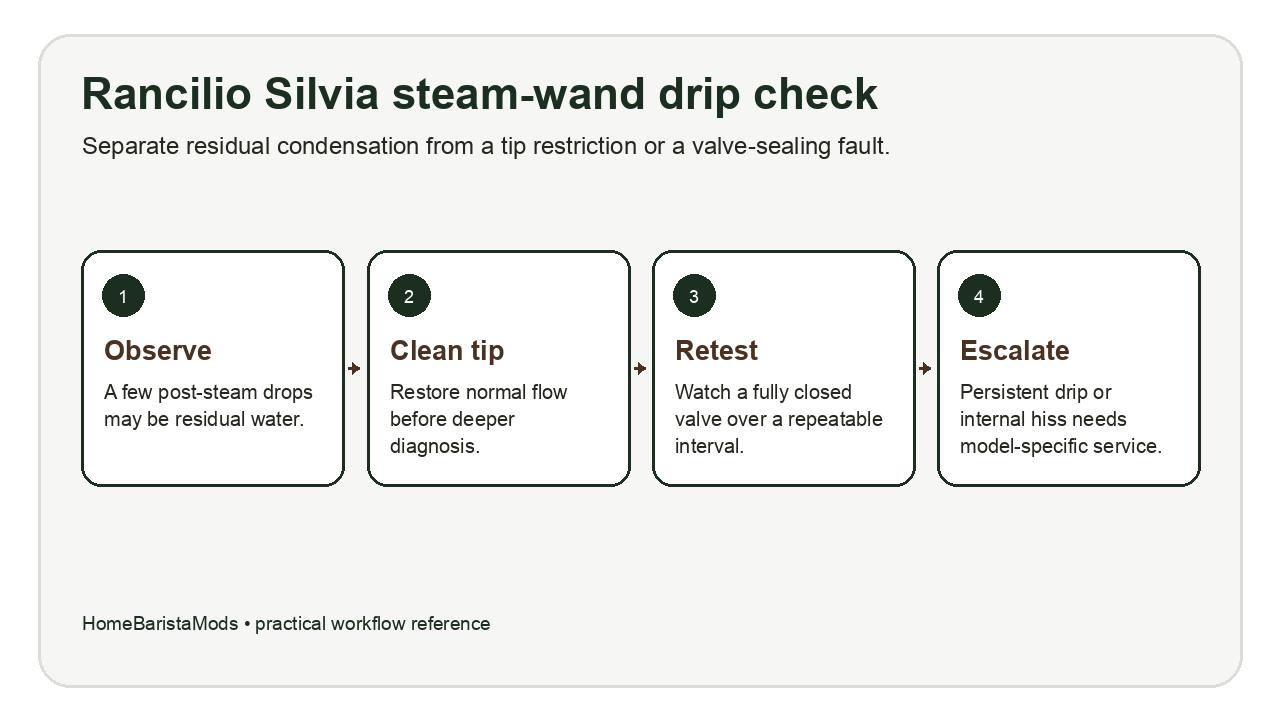
A few drops after steaming are not the same problem as a Silvia that keeps dripping or hissing with the steam knob fully closed. If you need the machine-level context first, start with the Rancilio Silvia hub.
Start by separating three things:
- water left inside the steam wand after use;
- a partially blocked steam tip that is changing flow;
- a steam valve that is no longer sealing cleanly.
Rancilio’s current Silvia workflow tells owners to purge condensation before steaming, close the steam knob when finished, then purge and wipe the wand again. That means some residual water in the wand is expected during normal use. Continuous dripping after the valve should be closed is different.
What does normal condensation look like?

The steam wand contains water and condensed steam after use.
A short drip immediately after steaming can simply be that residual moisture leaving the tip.
A useful baseline is:
- close the steam valve fully without forcing it;
- turn the steam switch off;
- wipe the wand;
- watch the tip for the next minute.
If the dripping slows and stops, you may be looking at ordinary residual water. The broader maintenance guide is useful for keeping cleaning, backflushing and service tasks separate.
If fresh drops continue at a steady rate long after the valve is closed, the valve deserves more attention.

What does Rancilio tell you to do after steaming?

Rancilio’s current Silvia / Silvia E manual dated 2024-03 shows a longer post-steam sequence: switch steam off, purge the wand briefly, wipe it, then switch hot water on and open the tap slowly. Close the tap and switch hot water off as soon as liquid water appears at the hot-water spout.
The refill step is separate from the brief cleaning purge. Older Silvia documentation can show a group-head / brew-switch refill route, so use the procedure that belongs to your exact machine and manual revision. See How to Refill a Rancilio Silvia Boiler After Steaming for the current workflow and revision boundary.
If the valve is fully closed and the machine continues feeding new water or steam through the wand, that is no longer just the purge routine.
Could the steam tip be causing the drip?

A blocked or dirty tip can change the way moisture leaves the wand, but it does not usually explain a valve that continues passing fresh water with the knob closed.
Still, clean the tip before diagnosing deeper.
Use the cleaning method in the current Silvia manual and avoid enlarging the holes with an oversized pin.
After cleaning, repeat the same observation test.
If steam flow improves but the closed-valve drip remains, treat the two symptoms separately.
Why does the steam valve matter?
Rancilio’s own North America parts catalog lists the Silvia steam valve and separate sealing parts in the hydraulic system, including a steam gasket.
That confirms the valve is a serviceable assembly with sealing components rather than a permanently sealed black box.
A worn or damaged sealing surface can allow water or steam to pass even when the knob is in the closed position.
Do not jump directly to “replace the whole valve,” though.
Different Silvia generations use different assemblies, and the correct part should be matched to the exact machine revision.
How can you tell whether the drip is getting worse?
Use a simple test instead of memory.
| Check | Observation |
|---|---|
| Machine generation | Record exact Silvia version / year if known |
| Time since last steam use | Record minutes |
| Steam knob fully closed | yes / no |
| Drops in first 30 sec | Count or describe |
| Drops in next 2 min | Count or describe |
| Hissing while closed | Yes / No; note when it occurs |
| Knob feels unusually stiff | Yes / No |
| Steam power normal | Normal / weak / none |
| Water visible around valve / case | Yes / No; note location |
Repeat the test on two or three separate heat cycles.
A valve that leaks only when very hot may behave differently from one that drips constantly.
What if the knob is hard to turn?
A stiff steam knob can point to the valve mechanism or stem area, especially on an older machine.
Community repair records for older Silvias include cases where owners serviced the valve because of endless dripping, then had to correct seal placement or valve movement afterward.
That is useful evidence that the valve can be rebuilt incorrectly as well as repaired correctly.
It is not a reason to copy another owner’s seal stack blindly.
If the knob became stiff immediately after a rebuild, re-check the exact assembly order for your machine revision.
What if the wand drips but steam power is still strong?

Strong steam does not rule out a sealing problem.
The valve has two jobs:
- open enough to deliver steam when requested;
- close enough to stop flow when requested.
A valve can still deliver good steam and fail the second job.
That is why “steam power feels normal” and “wand keeps dripping when closed” can coexist.
What if the machine hisses from inside the case?

Treat internal hissing separately from a tip drip.
The Silvia contains a heated boiler, electrical wiring and hydraulic fittings. If the sound is clearly inside the chassis, especially with visible moisture, disconnect power and investigate before continued use.
A leak around the boiler or a fitting is not the same repair as a steam-valve seat leak. If the symptom is no longer clearly at the wand, move back to the espresso-machine diagnosis page before ordering parts.
Do not use an AI-generated internal diagram to identify the leak location.
Use the exact Rancilio hydraulic diagram for your machine generation or a real photograph of the machine.
Should you tighten the steam knob harder?
No.
A steam valve should seal through its valve mechanism, not because the user forces the knob beyond its normal closed position.
Over-tightening can damage the valve stem, seat or knob.
Close it normally and diagnose the leak.
If normal closing no longer stops flow, that is information.
When is a valve rebuild reasonable?
A rebuild becomes reasonable when:
- continuous dripping is repeatable;
- the steam tip is clean;
- the leak clearly comes through the wand, not from another fitting;
- the correct valve generation and parts have been identified;
- the machine can be safely cooled and disconnected.
For HomeBaristaMods, the detailed rebuild should be a separate photo-based service guide. The existing Rancilio Silvia mods guide is useful for broader upgrade context, but this page stays focused on diagnosis.
The troubleshooting article should stop at identifying the likely subsystem.
When should you replace the whole steam valve?
Replacement can make more sense when:
- the valve body or stem is damaged;
- sealing surfaces are badly worn or corroded;
- the correct internal service parts are unavailable;
- an earlier rebuild did not restore normal operation;
- the complete correct valve assembly is available for the exact Silvia generation.
Do not use a current Silvia M valve assembly as proof of compatibility with every discontinued Silvia.
Rancilio maintains separate diagrams for current and discontinued models.
Quick decision table
| Symptom | Most useful next step |
|---|---|
| A few drops right after steaming | Observe; likely residual condensation |
| Continuous drip with valve closed | Clean tip, then evaluate valve sealing |
| Strong steam + continuous drip | Valve can still be the problem |
| Weak steam + dirty tip | Clean tip first |
| Knob became stiff after rebuild | Re-check assembly and seals |
| Internal hiss / visible leak | Stop using and locate internal leak |
| Breaker/RCD trips | Disconnect machine; do not continue testing |
For deeper follow-up reading, use the Guides Library and the Reference Library.
References
- Rancilio Group North America — Silvia workflow
- Rancilio Group North America — Silvia current product/manual hub
- Rancilio Group NA Webstore — Silvia M hydraulic system / steam valve and gasket parts
- Rancilio Group NA Webstore — discontinued Silvia hydraulic diagram
- Home-Barista — Silvia V3 steam problems after service
Research note: community repair reports are used to identify realistic failure patterns, not as universal service instructions.