

2:56
The Encore ESP Pro adds stepless grind adjustment, automatic stopping for single dosing, a timer and built-in anti-static technology. The original Encore ESP uses fixed clicks and manual grinding controls. Both belong to Baratza's 40 mm M2 conical-burr platform, so the decision is mainly about adjustment and workflow, rather than buying a completely different burr design. [1–4]
Already own an ESP that gives you repeatable shots? Name the problem you want the Pro to solve before replacing it. Shopping for your first grinder? Choose the controls you will use every morning, rather than treating “Pro” as a requirement for espresso.
This comparison uses manufacturer documentation checked on October 6, 2026. It does not report a side-by-side HBM taste, noise or retention test.
What changes between the two grinders?
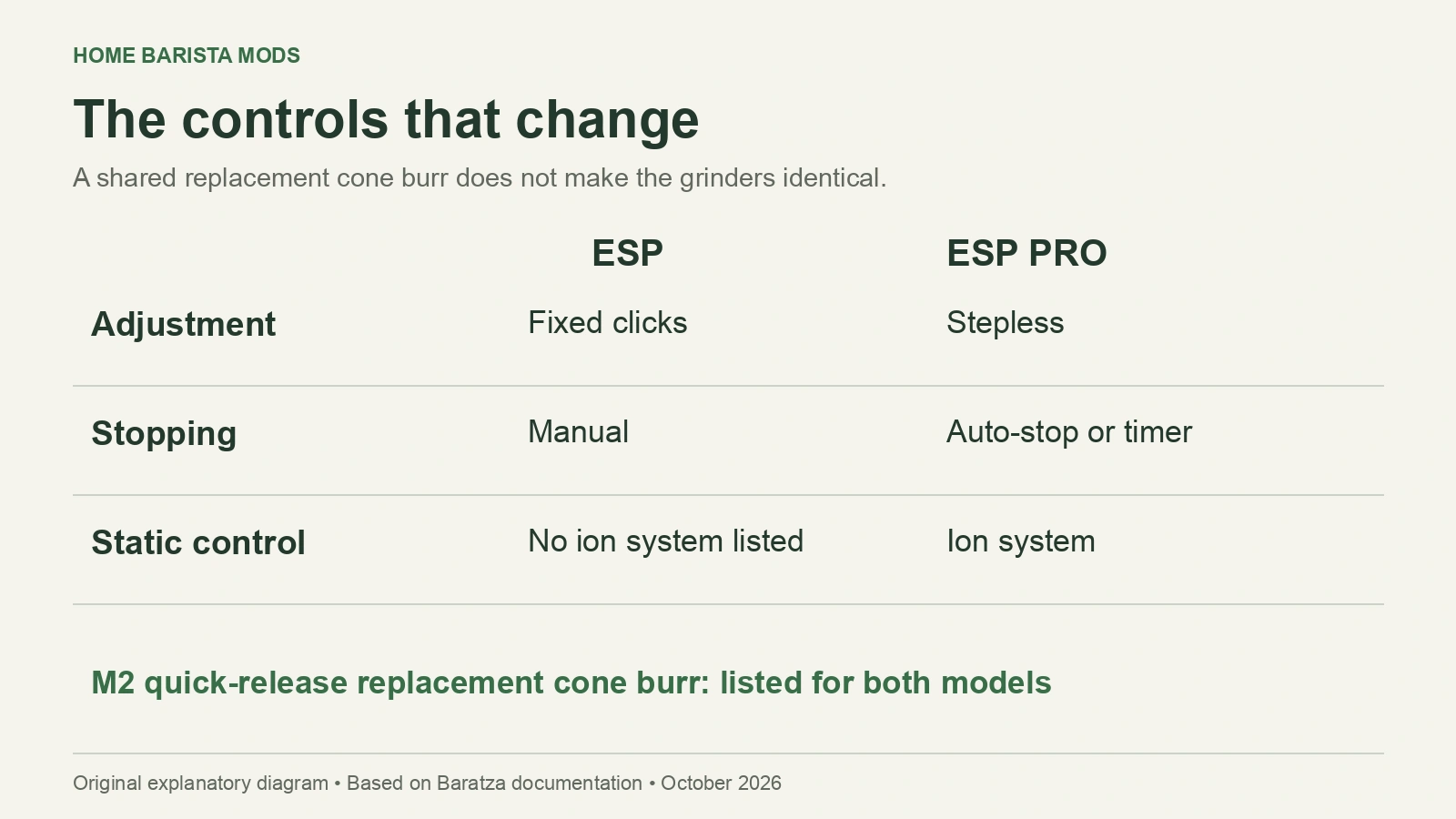
| Decision point | Encore ESP | Encore ESP Pro |
|---|---|---|
| Grind adjustment | Stepped, with a finer-adjustment espresso range | Stepless, with a digital position readout |
| Everyday controls | Pulse button and on/off knob | Single Dose Mode and Timer Mode |
| Single-dose stopping | You control when grinding stops | Automatically stops after the loaded beans have been ground |
| Time-based dosing | Manual control | Timer adjustable in 0.1-second increments |
| Static management | No built-in ion system listed in the cited ESP specification | Integrated anti-static ion technology |
| Burr platform | 40 mm M2 conical steel | Compatible with the same official M2 quick-release replacement cone burr |
The comparison is based on Baratza's product documentation, adjustment guide and replacement-burr listing. A shared replacement cone burr does not establish that every internal part or every performance result is identical. [1–4]
Baratza also lists a flow-control disk on the ESP Pro, intended to help feed the last beans during single dosing. It is a separate hardware feature; sharing a replacement cone burr does not show that an ESP can be converted into a Pro. [2, 5]
When is stepless adjustment useful?
Suppose your dose and target yield are settled, but one ESP setting runs faster than you prefer and the next setting slows the shot too much. A stepless adjustment lets you try a position between those fixed stops without changing the dose just to compensate.
That is a reason to consider the Pro. It is not proof that every espresso made with it will taste better.
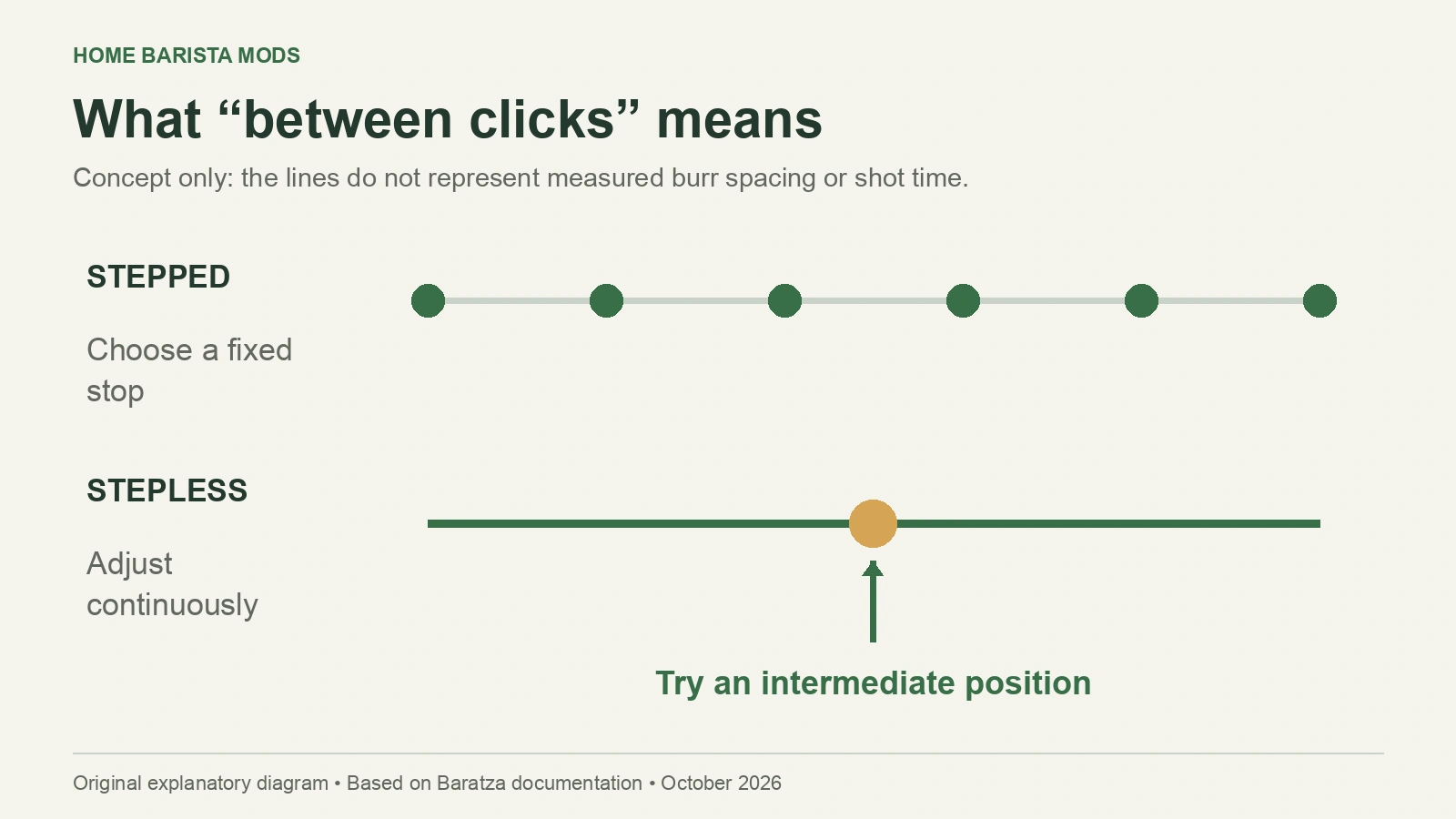
Baratza explains that the ESP uses different adjustment pitches for espresso and coarser brewing. The Pro extends the finer-control idea with a continuous adjustment and a digital readout in 0.5 increments. The displayed increments are reference values; they do not turn the mechanism back into a clicked grinder. [3]
Keep your recipe notes even with a digital display. Write down the coffee, dose, yield and setting together. A remembered number is useful when returning to a brew method, but it cannot account for a different bag of beans or establish that two separate grinders are calibrated identically.
For an existing ESP owner, try to reproduce the apparent between-clicks problem before spending money. Hold the dose and target yield steady, prepare the puck consistently and compare a few ordinary brews. If results vary widely at the same setting, buying a finer adjustment alone may leave that inconsistency unexplained.
Auto-stop, a timer and a scale do different jobs
The Pro's Single Dose Mode starts with beans you have already weighed. Its Timer Mode controls grinding duration. Neither description makes it a grinder that weighs the coffee arriving in the dosing cup. [2, 5]
Consider two hypothetical routines. For single dosing, you weigh an 18 g portion, add it to the grinder and let the grinder stop. For timed dosing, you choose a duration and then check how much coffee that duration produced. These are examples of using the controls, not recommended settings or measured ESP Pro results.
A 0.1-second timer increment is a time-setting specification. It does not mean the output is accurate to 0.1 g. Those units answer different questions.
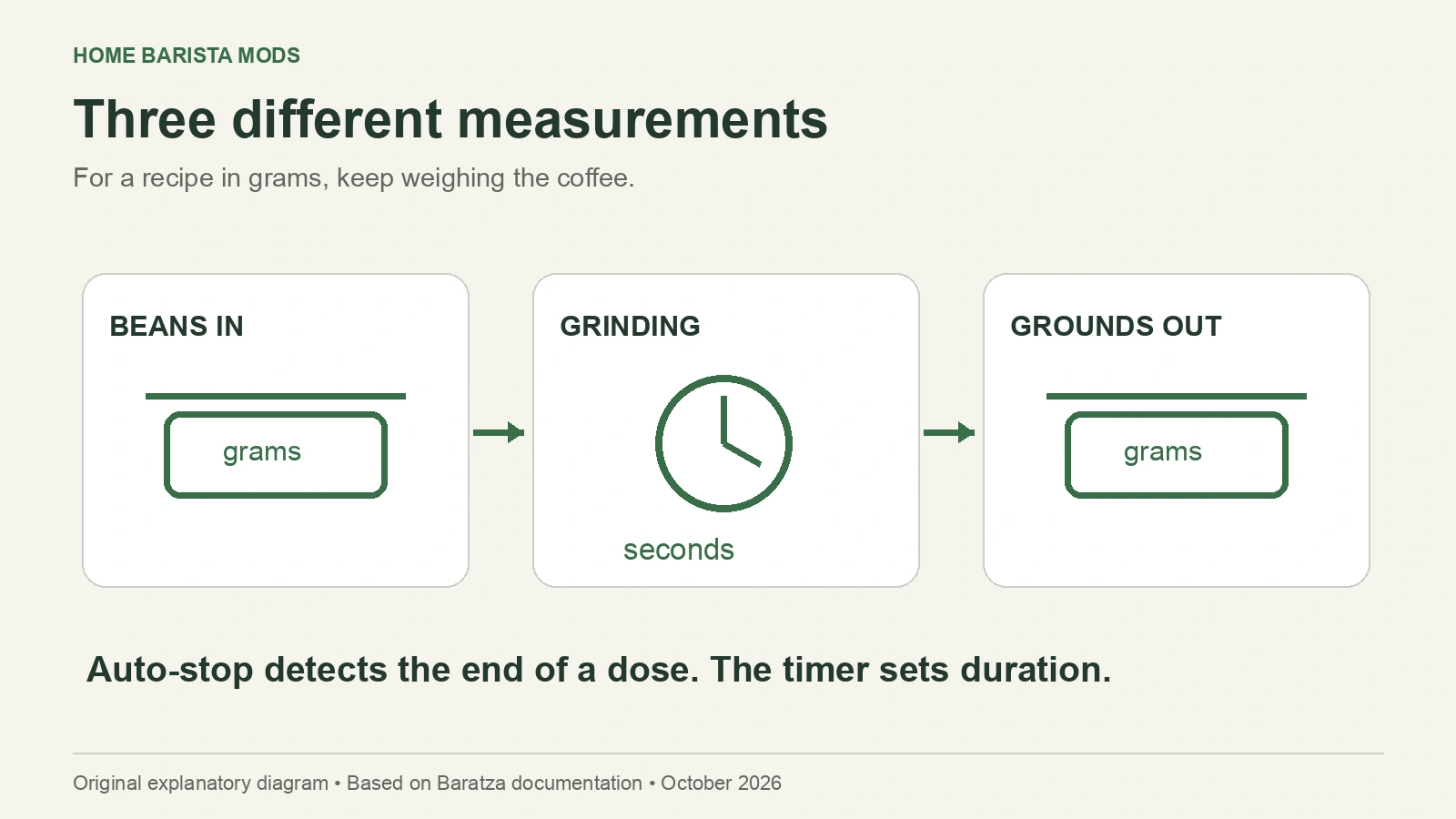
| What you want to know | What answers it |
|---|---|
| How much coffee did I load? | Weigh the beans before grinding |
| How long did the grinder run? | Use the timer or record elapsed time |
| How much ground coffee reached the cup? | Weigh the collected grounds |
| Did coffee from an earlier dose carry over? | A separate exchange measurement; matching weights cannot identify the coffee |
For a buyer who already weighs individual doses, automatic stopping removes one manual action. For a buyer who keeps beans in the hopper, a timer provides a repeatable duration to start from. In either case, retain the scale when the recipe depends on ground-coffee mass.
On the ESP Pro, the clock icon identifies Timer Mode. Baratza's demonstration shows that turning the grind collar displays the grind position, while turning the timer dial displays the duration. Check which value you are reading before recording a setting. [5]
What can you reasonably expect from the anti-static feature?
Baratza describes the Pro's ion system as reducing static on grounds leaving the chute. That supports treating it as a mess-management feature. It does not provide an HBM measurement of retained coffee or establish zero exchange between beans. [5]
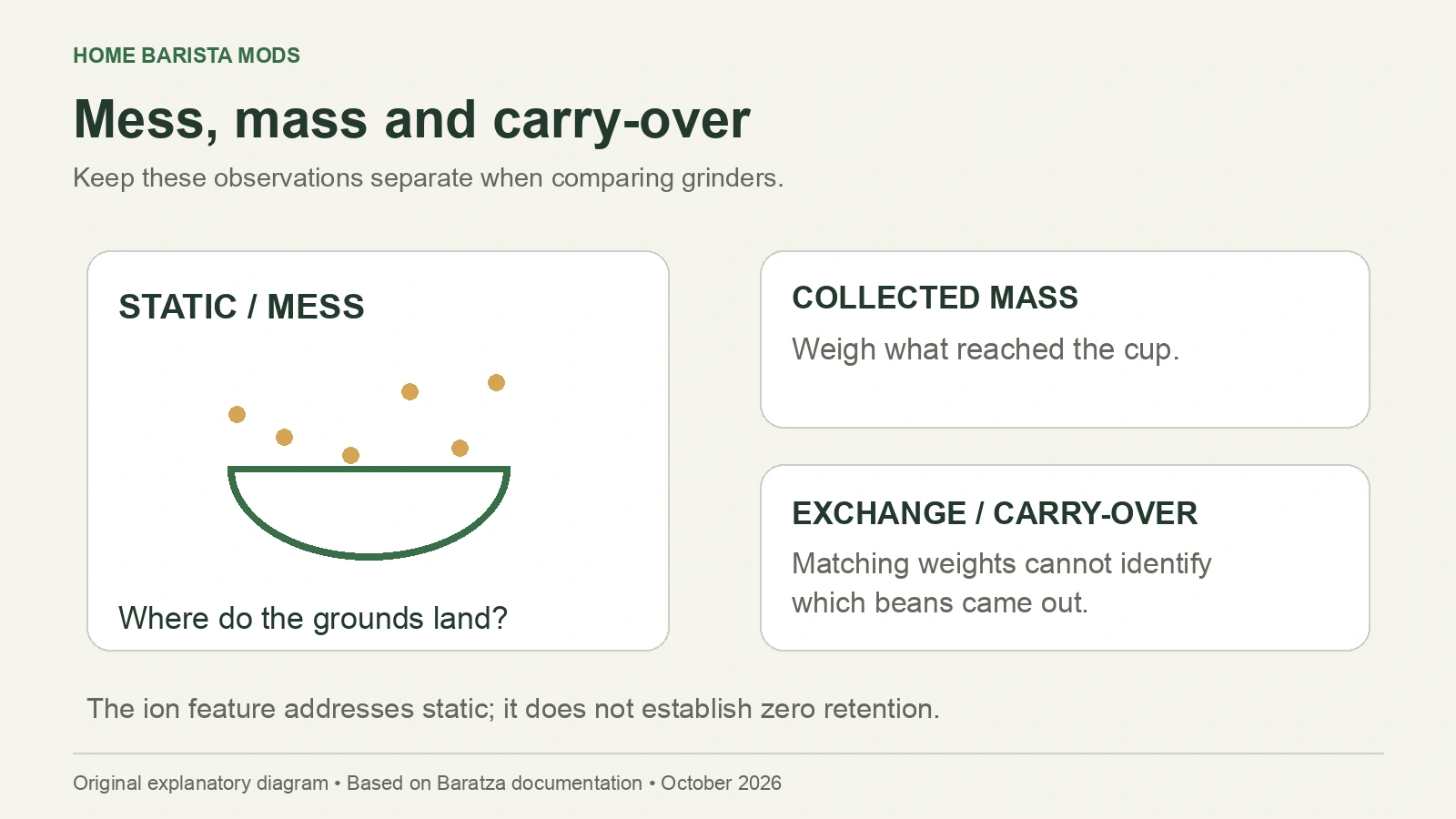
Separate what annoys you before evaluating the feature. Grounds missing the cup, grounds clinging to a surface and an unexpectedly short dose may appear together, but they are not the same observation. Photograph the mess and record the collected dose during your normal routine. You will have a clearer comparison than “this grinder feels cleaner.”
Do not assume a water-spray technique from another grinder is part of Baratza's approved procedure. Use the exact model's instructions, especially around powered equipment and cleaning access.
Should an existing ESP owner upgrade?
Keeping a working ESP is a reasonable editorial choice when its adjustment suits your coffee and its manual controls do not bother you. The Pro becomes more relevant when you can point to a recurring between-clicks limitation, want automatic single-dose stopping, or value its timed workflow.

Use this short decision record before ordering:
| Your situation | What to establish first |
|---|---|
| One setting seems too fast and the next too slow | Confirm dose, yield and preparation were comparable |
| You want to stop watching the grinder finish | Decide whether automatic single-dose stopping is the specific convenience you need |
| You want the same grams without weighing | Do not confuse timed or auto-stop operation with grind-by-weight |
| You mostly brew filter coffee and already like the results | Identify a concrete benefit beyond the model name |
| You expect a large flavor, noise or retention improvement | Look for a relevant controlled test; this document comparison does not establish one |
For a new setup, compare total spending rather than the grinder alone. Leave room for a scale and the basket and tamper that fit your machine. An accessory is not good value when it solves a different problem from the one you have.
Check the exact market version with your retailer as well. A US price does not establish the correct electrical version, local support arrangements or delivered cost elsewhere.
Questions worth settling before checkout
Is the ESP Pro just a new burr set?
No. The cited differences include the adjustment mechanism and operating controls. Baratza's official M2 quick-release cone-burr listing names both the ESP and ESP Pro. That supports a shared replacement cone burr, not a claim that the grinders are identical inside. [4]
Can the original ESP be used for single dosing?
Baratza lists its Single Dose Hopper as a compatible accessory for the ESP. Check the current accessory package and the grinder's instructions. Do not assume the Pro's automatic stopping becomes available simply by fitting a smaller hopper to an ESP. [1]
Does the digital setting guarantee the same shot when I return to it?
It gives you a useful position reference. Keep the coffee and recipe notes alongside it, and check the next shot rather than assuming a setting number is a complete recipe. The Pro's display reports adjustment position; it does not measure extraction quality. [3]
Which should you buy for a Gaggia Classic?
There is no Gaggia-specific requirement to buy the Pro. Choose around the adjustment and dosing routine you need. Before adding a machine modification as well, use the Gaggia upgrade-order guide to keep grinder, temperature-control and workflow problems separate.
Related HomeBaristaMods guides
- Encore ESP espresso settings
- Coffee grinder retention explained
- Coffee grinder static decision guide
- Gaggia Classic upgrade order by symptom
References
- Baratza — Encore ESP, US product page. Controls, burr specification and accessory information. Encore ESP product sheet (PDF).
- Baratza — Encore ESP Pro, US product page. Adjustment, timer and operating features. Encore ESP Pro product sheet (PDF).
- Baratza — Stepped vs. Stepless. Adjustment mechanism and digital reference increments.
- Baratza — M2 Quick-Release Cone Burr. Replacement cone-burr compatibility only; not a complete grinder specification.
- Baratza — Encore ESP Pro introduction. Single-dose operation, timer and anti-static description.