

Cover photo: Nenad Stojković / Shixart1985, CC BY 2.0.
Coffee grinder retention is the coffee left inside a grinder after grinding. Some remains there; some enters a later dose. Weighing beans in and grounds out helps you check dose consistency, but matching weights do not prove that every particle came from the beans you just added. [1]
Before buying bellows or replacing your grinder, work out whether the problem is a short dose, a spill or coffee carrying over. Start with your normal brewing routine.
What do retention, exchange and dose difference mean?
A review might use “retention” for coffee recovered from inside the grinder, or for the gap between a bean dose and the collected grounds. Those measurements answer different questions. Barista Hustle’s glossary defines retention as the coffee remaining inside the grinding path. [1]
| Measurement | What you are measuring | What it cannot tell you alone |
|---|---|---|
| Total retained coffee | Coffee left inside the grinder after a defined routine | How much will enter the next dose |
| Exchange | Older retained coffee released into a later dose | How much coffee is still inside afterward |
| Input–output difference | Beans loaded minus grounds collected for one run | Whether all the collected grounds came from the new beans |
Consider a hypothetical example, not a test result. The grinder already contains 0.4 g of coffee. You load 20.0 g of new beans. During grinding, the old 0.4 g comes out while 0.4 g from the new dose stays inside.
You collect 20.0 g: 19.6 g from the new beans plus 0.4 g from the previous dose. The scale is doing its job. It has no way to identify which dose supplied those grounds.

The same arithmetic explains why an output heavier than your input should keep its negative sign. With 20.0 g in and 20.2 g collected, input minus output is −0.2 g. Earlier grounds may have been released, but check weighing and collection errors before treating that as the explanation.
Even a positive difference is not automatically total retention. In a simplified dry-coffee mass balance, the difference includes the change in coffee held inside, plus anything spilled or otherwise not collected. It does not reveal how much was already there.
How can you check your dose without opening the grinder?
Use this check only with a grinder that its manufacturer permits you to single-dose: weigh a portion of beans, load it, and grind that portion. Leave a hopper-fed setup in its approved operating mode rather than emptying or modifying it for this exercise.
You need your usual scale, a dry dosing cup and somewhere to record the results. Keep the grinder assembled. No fingers, brushes or improvised tools go into it while powered; cleaning has a separate, model-specific procedure. [6]

The starting condition
Write down the grinder model, coffee, grind setting and your usual finishing action. An approved knocker, automatic purge or bellows is part of the routine, not an invisible extra. Acaia’s Orbit instructions, for example, include both knocking and purging. [7]
Label the first dose after cleaning separately from an ordinary dose. Do the same for the first grind after an overnight pause. These conditions are different, so do not combine them into one average without explaining what you did.
Weighing before and after grinding
Weigh the beans immediately before loading them. Put the empty dosing cup on the scale and tare it. Grind using your normal routine, then weigh the collected grounds before transferring them to the portafilter.
Check the loading cup, counter and area around the dosing cup for coffee that missed its destination. Record visible spills instead of assuming that every missing fraction of a gram remains inside the machine. Weighing before the portafilter transfer keeps transfer losses out of this check.
Repeat checks during normal brewing
Collect a few comparable readings during your next brews. This is a troubleshooting log, not a certified laboratory test; there is no need to waste several doses to give it a more impressive-looking sample count.
Keep the coffee, setting and finishing action unchanged within each group of notes. Start a new group when you change one. Baratza also recommends keeping notes about settings and brew results when dialing in. [4]
Copy this blank log into your notes and fill it during your next brews. The dashes are spaces for your own readings, not measured results.
| Run / starting condition | Beans in, g | Grounds collected, g | In minus out, g | Spill or routine change? |
|---|---|---|---|---|
| First dose after overnight idle | — | — | — | — |
| Next dose, same coffee and setting | — | — | — | — |
| Next comparable dose | — | — | — | — |
| First dose after cleaning, recorded separately | — | — | — | — |
An observation such as “the first dose is short; the following doses are close to the input weight” gives you something to investigate. Calling the same result “total retention” would claim more than you measured.
Could the scale be hiding a small amount?
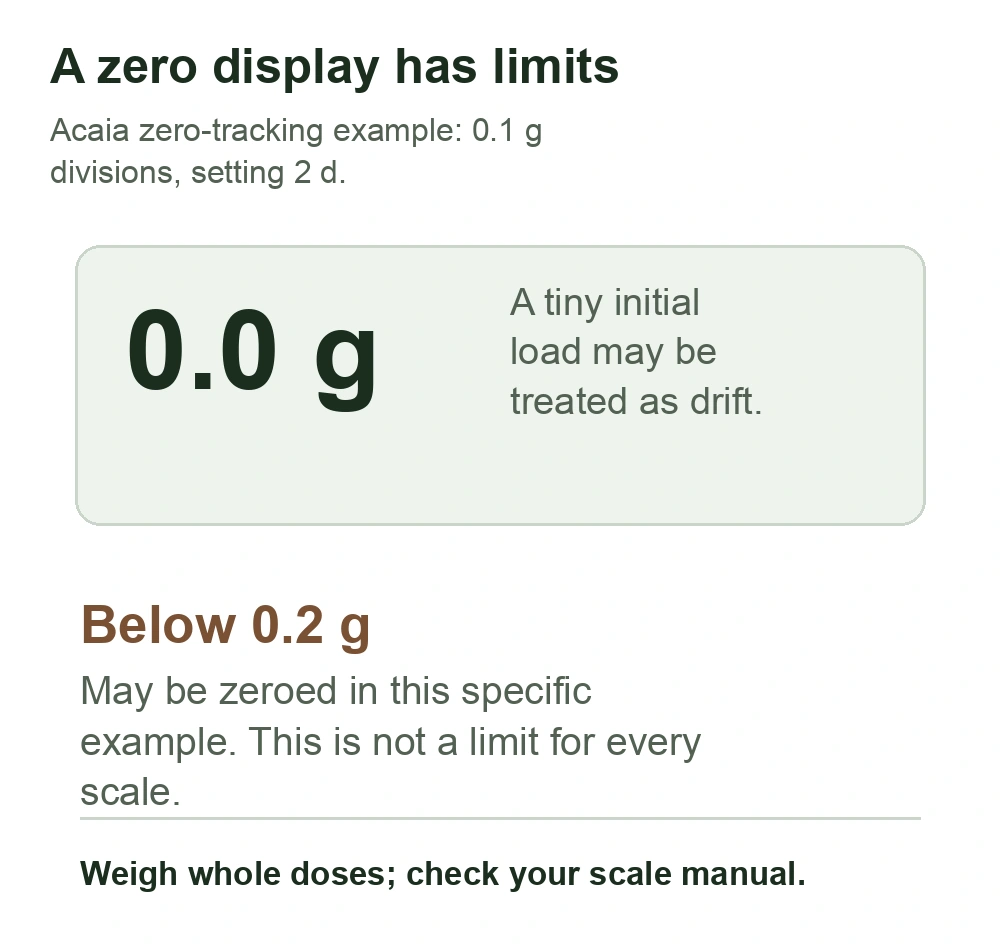
A 0.0 g display does not always mean the weighing pan is empty. Some scales use zero tracking to keep the reading stable near zero. Check the scale model, resolution and setting before interpreting tiny initial loads.
Acaia gives this example: with 0.1 g divisions and zero tracking set to 2 d, an initial load below 0.2 g can be treated as drift and zeroed out. That is Acaia’s stated example, not a specification for every coffee scale. [2]
For this dose check, weigh complete bean and ground-coffee doses. Do not sprinkle individual particles onto an empty, zeroed scale and use a motionless display as proof that nothing was recovered. If a dose difference is only one displayed division, repeat the measurement before drawing a conclusion. More decimal places alone do not establish greater accuracy.
If your current scale cannot resolve the change you are trying to measure, compare its limits with the coffee scale versus kitchen scale guide before replacing it.
What should you change after the check?
Choose the next action from what you observed. A short dose, a spill and carryover between coffees do not call for the same response.
| What you observe | What to check next | What the observation does not establish |
|---|---|---|
| Matching weights while switching coffees | Follow the maker’s switching guidance; treat carryover as a separate question | That the output contains only the new coffee |
| Grounds visibly missing the cup | Cup position and the amount spilled | That the missing coffee is inside the grinder |
| A short first dose after cleaning | Subsequent doses under the same conditions | That every future dose will be short by that amount |
| A different output after a finishing action | Record that action as part of the method | That results with and without it are interchangeable |
| A sudden large drop in output | Stop and use the model’s troubleshooting instructions | That running more beans through will fix the problem |

When you change coffee or grind settings
Retained grounds can carry the previous coffee, or the previous grind setting, into a later dose. Allow for that possibility before making another adjustment. Barista Hustle discusses purging after larger grind changes, while Baratza suggests a small preliminary grind when changing coffee or brew method. Neither establishes one clearing weight for every grinder. [1, 4]
Record any purge separately from the dose you intend to brew. Otherwise, a routine that uses extra beans can look identical to one that does not.
When switching from regular coffee to decaf, do not call the shared grinder caffeine-free on the strength of a weight check. Weight alone cannot establish the composition of the output. Once the switching routine is settled, use the decaf espresso guide to work on the brew recipe.
When static makes a mess
Check the exact grinder’s guidance before adding water to beans. Mazzer currently advises against spraying beans, citing blockage, jamming and oxidation risks. For the Philos, Mazzer instead describes its grounded collection canister and dedicated finishing accessories. [3]
That is model guidance, not evidence that every static-management technique works identically on every grinder. Do not copy another owner’s wet-bean routine without checking whether your manufacturer allows it.
When the grinder needs cleaning
Use the manual’s cleaning procedure and disconnect power before opening the grinder or brushing accessible parts. Acaia’s Orbit cleaning guide explicitly begins with disconnecting the power supply. [6]
Do not remove a declumper or defeat a safety interlock to improve a number in the log. Measuring all the coffee left inside is a different task. Barista Hustle’s published retention protocol collects retained material for weighing; the dose check here does not reproduce that procedure. [8]
How should you read a low-retention claim?
Look for the test method before comparing numbers. Ask whether the grinder started clean, which coffee and setting were used, how many runs were made, what finishing actions were included and what the scale could resolve.
Two current manufacturer examples show why that detail belongs beside a result. Acaia includes a knocker and purge in its Orbit grinding instructions. Mazzer connects its Philos retention guidance with the chute knocker and Dose Finisher. A measurement made after a finishing routine should not be presented as the result of grinding and doing nothing else. [3, 7]
Check accessory compatibility separately. Eureka’s Mignon Single Dose Kit page specifies models with a removable fork. The series name alone is not the complete fit check. That compatibility statement also does not prove how much the kit will change retention on your machine. [5]
For your own setup, start with the recurring problem. Frequent coffee changes make carryover worth investigating; an inconsistent collected dose calls for a dosing check. Neither requires buying a modification before you have usable notes.

Questions about grinder retention
Does equal weight in and out mean zero retention?
No. Equal input and output show a matching collected mass for that run. Old coffee can leave while new coffee remains. The hypothetical 20.0 g example above produces equal weights while still containing coffee from the previous dose.
Can two different-colored coffees measure exchange?
Visible differences may give you a qualitative clue, but color alone does not establish exchanged mass. Do not turn a few lighter or darker particles into an exact carryover percentage. Particle appearance is not a substitute for a defined measurement method.
Should you purge before every shot?
Start with the manufacturer’s guidance and the reason for the purge. An ordinary consecutive dose, a first grind after an idle period, a bean change and a large grind adjustment are different situations. Record any extra coffee used rather than hiding it in a retention figure. [1, 4]
Does using bellows prove that the grinder is empty?
No. The released grounds show that the action moved some coffee, not that every internal space is empty. Use a compatible accessory as instructed and include its use in the method whenever you report a before-and-after weight.
Do varying weights mean you need a new grinder?
One short dose is not enough to make that decision. Check the scale, spills, starting condition and the approved maintenance routine first. If the problem continues, take the recorded conditions and measurements to the manufacturer rather than relying on a single unexplained number.
For the next few brews, record beans loaded, grounds collected and the finishing routine. Keep notes about the coffee bag and roast date alongside those measurements so that later comparisons use the same coffee.
Related HomeBaristaMods guides
- Coffee grinder static: RDT, ionizer or grounded cup?
- When should you replace grinder burrs?
- Eureka Mignon single-dose workflow
- Niche Zero calibration after cleaning
References
- Barista Hustle — Recap and Glossary. Retention definition and grind-change context.
- Acaia — Zero Tracking. The scale-setting example used above.
- Mazzer — Consumer FAQ. Philos finishing routine, canister and water-spray guidance.
- Baratza — Don’t Waste Your Grind. Dial-in notes and preliminary grinding.
- Eureka — Mignon Single Dose Kit. Manufacturer’s compatibility condition.
- Acaia — Orbit Cleaning and Storage Recommendations. Model-specific cleaning safety.
- Acaia — Guide to Orbit Grinding Modes. Actions included in the manufacturer’s grinding routine.
- Barista Hustle — A BH Protocol for Measuring Grind Retention. Context for a separate retained-material measurement.