
If espresso from a De’Longhi Dedica EC685 feels too cold, do not diagnose the Thermoblock from one thermometer reading in the cup—or from sour taste alone. De’Longhi gives the EC685 three programmable brewing-temperature levels and a specific “hotter coffee” workflow, and its newer manual explicitly warns that the programmed temperature is the water temperature in the Thermoblock, not the temperature of the drink in the cup.
Scope: EC685 / EC685 EX:4 and closely related EC695/EC785 manuals share much of this workflow, but button behavior and menu details can vary by revision. Use the manual for the exact model suffix printed on your machine.
1. What does the Dedica temperature setting actually control?

De’Longhi’s current EC685 product page identifies the heating system as Thermoblock. The EC685 settings menu offers three brewing-temperature selections: Low, Medium and High. Importantly, a current De’Longhi manual states that this setting refers to the temperature of the water in the Thermoblock; it is not the beverage temperature in the cup or necessarily the temperature at the moment coffee leaves the portafilter.
That sentence is the key to this entire diagnosis. If somebody says “my Dedica is set to High, so the espresso should measure exactly X°C in the cup,” the premise is wrong unless they have a validated measurement model connecting the internal control point to the beverage.
De’Longhi does not publish a universal Low/Medium/High table of exact cup temperatures in the manuals reviewed for this guide. HBM therefore does not assign made-up °C values to those three settings.
2. Use De’Longhi’s official hotter-coffee workflow before modifying anything

The EC685 instruction manual gives four direct recommendations for hotter espresso:
- Warm the cup with hot water before brewing.
- Lock the filter holder into the machine with the filter installed but without coffee, then run hot water through it into the cup you will use.
- Raise the coffee-temperature setting in the settings menu.
- Use the machine’s cup-warmer area to keep cups warm during operation.
This is stronger evidence than an internet “temperature-surfing trick” because it is the manufacturer’s own workflow. Run this baseline first. If it solves the complaint, you do not have evidence for an internal repair.
3. How do you set Low, Medium or High correctly?
On the current EC685-family instructions, the settings menu is entered by holding the steam/settings button for about 10 seconds until the three buttons flash in sequence. Select the brewing-temperature setting, then choose Low, Medium or High using the button mapping shown in your exact manual.
The reason this article does not replace those icons with a memorized button sequence is revision control: De’Longhi has EC685 variants including EX:4, and the current manual itself notes revision-specific differences elsewhere in the settings menu. Follow the diagram for the suffix on your machine.
If you bought the machine used, verify the setting rather than assuming the previous owner left it on High. A factory reset can also restore programmed settings/quantities, so a recent reset is relevant history.
4. Why can a cold cup make a normal Dedica shot feel wrong?
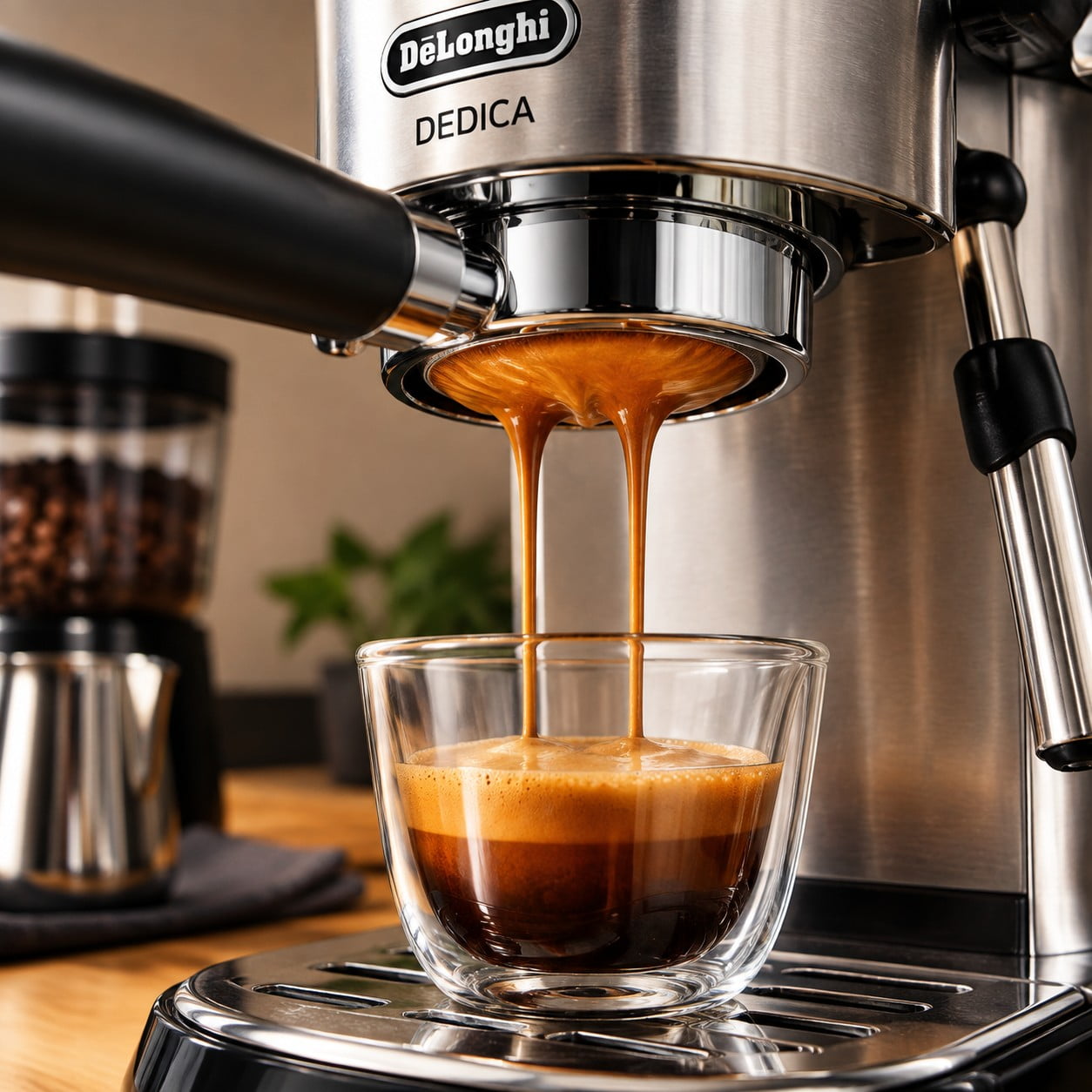
An espresso is a small amount of hot liquid poured into a relatively large mass of cup material. A cold ceramic cup, cold filter holder and cold basket can absorb a meaningful amount of heat before you take the first sip. That is exactly why De’Longhi’s own hotter-coffee instructions preheat both the cup and filter holder.
For diagnosis, compare the same cup preheated the same way. Do not compare one shot in a thick cold mug against another in a small warmed espresso cup and attribute the difference to the Thermoblock.
If you add cold milk, cream or a large volume of room-temperature water, you have changed the beverage-temperature problem again. Diagnose straight espresso first if the complaint is specifically “the machine brews too cold.”
5. Can you diagnose brew temperature with a thermometer in the cup?
You can use a cup thermometer as a relative repeatability check, but not as a direct reading of the Thermoblock or puck temperature. De’Longhi explicitly separates the programmed Thermoblock temperature from beverage temperature. Heat is lost through the portafilter, basket, coffee bed, air, cup and time delay before measurement.
If you want to compare the machine against itself, standardize the experiment:
- Use the same temperature setting.
- Use the same preheated cup and filter holder.
- Use the same coffee, dose and target yield.
- Start only when the coffee-ready lights are steady.
- Place the thermometer the same way and read at the same point in time.
- Repeat at least three times before treating one number as a pattern.
Do not compare that number directly with a café machine’s group-head specification or an internet “ideal brew temperature” unless the measurement methods are equivalent.
6. Does sour espresso prove the Dedica is too cold?

No. Sourness can be associated with insufficient extraction, but temperature is only one extraction variable. Grind, yield/ratio, coffee age, roast, basket, channeling and water all matter.
A May 2026 EC685 owner reported persistent sharp sourness despite fresh coffee, a grinder, maximum temperature setting and a blank-shot preheat. Another July 2026 EC685 owner reported a 16 g in / 32 g out shot in roughly 25 seconds that tasted bitter with a dark roast. Those two cases are useful precisely because the same machine family can produce opposite taste complaints under different recipes.
If the shot is sour and fast, diagnose grind/flow before declaring a heater failure. If you moved to a non-pressurized basket and flow is unstable, use the Dedica bottomless-basket dialing guide.
7. What if the espresso is cold only on the first shot?
That pattern makes thermal preparation especially relevant. The Thermoblock can reach its control state quickly while the metal filter holder, basket and cup are still colder. De’Longhi’s official recommendation to run hot water through the empty locked filter holder directly addresses that first-shot heat sink.
Compare first shot versus second shot using the same preheat routine. If the second is consistently hotter only because the hardware has now been warmed by the first, improve the preheat baseline before opening the machine.
Do not run endless blank shots as a universal fix. The goal is a repeatable manufacturer-supported preheat, not wasting a tank of water trying to force a specific internet thermometer number.
8. What if you just finished steaming milk?
This is the opposite problem: the EC685 can be too hot for coffee after steam mode. De’Longhi’s manual says that after frothing, the coffee lights can flash to indicate the temperature is too high for brewing and instructs the owner to run the cooling cycle. The manual warns that making coffee before cooling can burn the coffee.
So “my temperature is inconsistent after cappuccino” should not automatically be solved by selecting High or adding more preheating. First return the machine to the documented coffee-ready state after steam.
For a multi-drink workflow, De’Longhi recommends preparing the coffees first and then frothing the milk for all cappuccinos. That reduces unnecessary cycling between coffee and steam temperatures.
9. When does a real Thermoblock/control fault become more plausible?
Move from workflow to machine diagnosis when the evidence is broader than taste or one cool cup.
| Observation | Interpretation / next move |
|---|---|
| Machine reaches ready state; preheated shots repeat normally | No heater repair justified from “feels cool” alone |
| Only first cold-hardware shot is noticeably cooler | Preheat workflow first |
| Sour + fast extraction | Grind/dose/yield/puck branch first |
| After steaming, coffee lights signal high temperature | Run official cooling cycle |
| Hot-water and steam performance also become abnormally weak/cool | Heating/control or scale/water-path diagnosis becomes more relevant |
| Machine will not reach normal ready state or shows persistent abnormal lights | Follow exact EC685 light/support path |
| All lights flash persistently and machine does not function | De’Longhi says disconnect and contact authorised support |
A functioning steam mode does not prove brew control is perfect, but it is evidence against a completely dead heater. Conversely, weak coffee plus weak hot water/steam and abnormal ready-state behavior is a much stronger machine-side pattern than sour espresso alone.
10. What about scale?
Scale belongs in the diagnosis when the maintenance history and other symptoms support it. De’Longhi’s troubleshooting links limescale to multiple water-path problems and provides a dedicated EC685 descaling program. Use the manufacturer procedure rather than an improvised acid recipe.
If the orange descale light will not clear after maintenance, use the Dedica descale-light guide. For general maintenance boundaries, use the HBM maintenance guide.
Do not descale repeatedly just because one espresso tastes cool. Repeated chemical treatment without evidence is not a temperature diagnostic.
11. A repeatable 15-minute cold-coffee test
- Record exact model suffix (for example EC685.M or EC685 EX:4).
- Check the current Low/Medium/High setting.
- Use one coffee, basket, dose and target yield.
- Let the coffee-ready lights become steady.
- Lock in the empty filter holder and run the manual’s hot-water preheat into the cup.
- Prepare the coffee consistently and brew into the warm cup.
- Record yield, shot time, taste and—if comparing temperature—one standardized cup measurement.
- Repeat twice under the same conditions.
- If the complaint remains, compare hot-water and steam behavior and note abnormal light states.
- Only then decide whether you have a recipe/preheat problem or enough machine-side evidence for service.

For broader EC685 context, use the Dedica vs Gaggia workflow page. If the problem is steam rather than brew temperature, use the Dedica steam diagnosis.
References
- De’Longhi — EC685 Dedica Support Center and current manuals
- De’Longhi — EC685-family manual: Thermoblock temperature-setting measurement boundary
- De’Longhi — Dedica EC685 product page: Thermoblock heating system
- Owner case — maximum temperature + blank-shot preheat but persistent sourness, May 2026
- Owner case — EC685 dark-roast shot reported bitter at a normal-looking ratio/time, July 2026
Evidence boundary: De’Longhi documentation establishes the Thermoblock architecture, Low/Medium/High setting, hotter-coffee workflow, steam-to-coffee cooling cycle and fault-state guidance. Owner cases show why taste alone cannot diagnose brew temperature; they are not used to invent fixed temperature values for the three settings.