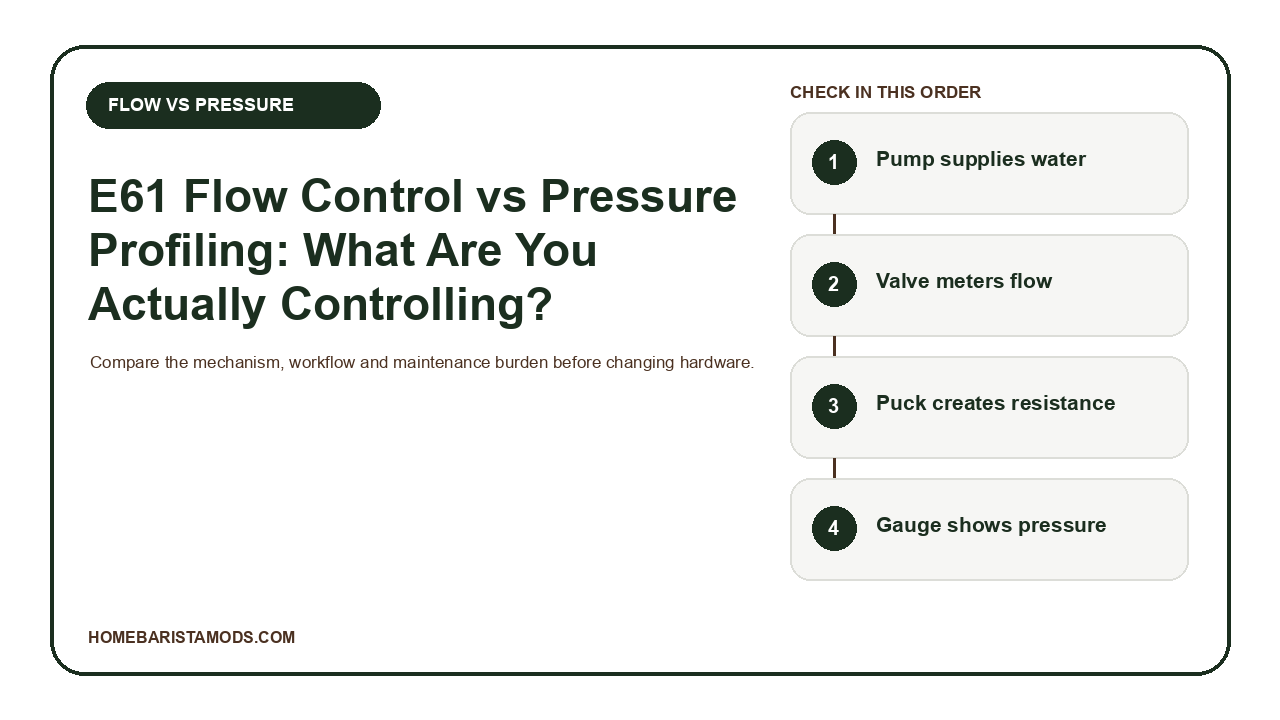
Profitec and ECM describe their E61 retrofit valves as manual flow-control or flow-regulation devices in the brew group. Mechanically, the valve changes the opening/restriction in the group water path; the group pressure you observe then depends on the rest of the hydraulic system, including puck resistance.
Pressure-profiling machines may regulate pump pressure more directly. Because flow and pressure are coupled, an E61 flow-control valve can still produce different pressure curves during a shot. That does not make “flow control” and “pressure control” identical terms.
What does an E61 flow-control kit physically change?
Profitec describes its E61 Flow Profile Valve as an upgrade that manually controls the flow rate in the brew group. ECM similarly describes its E61 flow-profile valve as a manual flow regulator and includes a group pressure gauge with the kit.
Mechanically, the usual retrofit places an adjustable valve in the flow path at the E61 group. Turning the paddle or knob changes the opening, restricting or increasing water delivery.
The pump is still the pump. You are not replacing it with a different pressure-regulation system every time you move the paddle.
That distinction is useful because the pressure gauge is showing the hydraulic result of the valve position, puck resistance and pump system together.

Real E61-group espresso machine for grouphead context; this is a Vetrano 2B Evo and does not depict the ECM or Profitec retrofit kit discussed below. Photo: EspressoExpresso / Wikimedia Commons, CC BY-SA 4.0.
Why does pressure change when you adjust flow?
Water flow and pressure are coupled through resistance.
A useful hydraulic shorthand is that flow, pressure difference and resistance are coupled. In espresso, the coffee puck is a changing resistance.
At the start of a shot, a dry puck can accept water without immediately building full pressure. As it saturates, pressure rises. During extraction, the puck structure changes and resistance can fall.
A flow-control valve gives you another way to influence that process. Restrict the incoming water and pressure may rise more slowly. Open the valve and the system can deliver more water, allowing pressure to rise if the puck provides enough resistance.
The exact gauge response is not fixed because the puck is part of the hydraulic system.
Is flow control the same as pressure profiling?
No, but they overlap in practice.
A pressure-profiling machine is designed to control or limit pump pressure according to a target curve or operator input. A flow-control E61 machine primarily changes an upstream restriction.
Because pressure and flow affect each other, moving the E61 valve can produce a pressure curve that looks like a profile. That is useful. It still matters which variable the mechanism controls directly.
This is why two shots showing the same pressure at one moment can still have different flow histories and puck saturation.
Why do E61 kits include a group pressure gauge?
The gauge gives you feedback near the group while you adjust the valve.
ECM’s current flow-profile kit includes a manometer up to 16 bar. The gauge does not measure water flow in millilitres per second. It shows pressure.
If you want to know the free-flow rate of a valve position, that is a separate measurement. Once a coffee puck is installed, the puck changes the resistance and therefore the relationship between valve position, flow and pressure.
Do not treat “paddle at 50%” as a universal 4.5-bar setting. Coffee, grind, dose and basket resistance change the result.
What is the simplest useful flow-control experiment?
Start with one coffee and one recipe you already know.
Instead of trying to copy a five-stage internet profile, change only the opening phase. Use a restricted flow at the beginning, watch the group pressure and first drops, then open toward your normal setting for the rest of the shot.
Keep dose, yield and grind unchanged for the first comparison.
Use a completed comparison protocol rather than an empty worksheet:
| Variable | What to keep/change | What to record |
|---|---|---|
| Coffee and roast date | Keep identical | Exact coffee and roast date |
| Dose | Keep identical | Dose in grams |
| Beverage yield | Keep the same target | Final beverage mass |
| Grind | Keep identical for the first comparison | Grinder setting |
| Opening phase | Shot A = your normal baseline; Shot B = one repeatable restricted opening | Describe the valve position in a way you can reproduce |
| First drops | Observe | Time from pump-on to first drops |
| Group pressure | Observe, do not chase a preset number | Peak and broad pressure shape |
| Total shot | Observe | Total time to target yield |
| Taste | Compare after the controlled change | One or two concrete sensory notes |
That tells you more than moving the paddle continuously while also changing grind and yield. It is a learning protocol, not a manufacturer-prescribed profile.
Does low initial flow prevent channeling?
Profitec says a low flow at the beginning can reduce the risk of uneven extraction. That is a manufacturer claim about the purpose of the device, not proof that every slow pre-infusion fixes every puck.
Channeling can still come from distribution, cracks, basket fill, tamping or a grind that is too fine or too coarse for the recipe.
Use flow control as another variable after the puck-preparation basics are repeatable.
Can flow control rescue a shot that is running fast?
Sometimes it can slow the extraction by restricting incoming water, but that is not the same as fixing the underlying grind.
If every shot needs the valve nearly closed to stop it from gushing, adjust the grinder. The flow valve is most useful when the basic recipe already works and you want to explore saturation, declining flow or different roast behaviours.
Do not use the paddle to hide a grinder that cannot dial espresso finely enough.
Does an E61 flow-control kit fit every E61-looking machine?
No.
ECM says its kit is for ECM espresso machines with an E61 group. Profitec sells a dedicated kit for its brew group. Third-party sellers advertise broader E61 compatibility, but visual similarity is not enough.
Before ordering, check the exact machine model, mushroom/thread design, included spring, gauge clearance and manufacturer warranty position.
A compatibility article should list exact confirmed machines, not promise “all E61” based on the group shape alone.
When is flow control worth learning?
Flow control makes the most sense after your ordinary 9-bar-style recipe is repeatable.
If your dose changes every shot, the grinder is inconsistent or the puck channels badly, adding another moving variable usually makes diagnosis harder.
Once the baseline is stable, flow control can become a useful experimental tool because you can change how water arrives at the puck without replacing the whole machine.
The goal is not to move the paddle on every shot. The goal is to know why you are moving it.
Questions about E61 flow control
Does closing the flow valve lower pump pressure?
The valve does not necessarily change the pump’s own set point. It restricts flow toward the group, which changes group pressure according to the resistance in the rest of the system.
Can an E61 flow-control kit create a lever-style shot?
It can create a declining group-pressure curve, but it is not mechanically the same as a spring lever. Describe the resulting curve rather than claiming the machines work the same way.
Do I need a scale with flow control?
A scale is useful for tracking beverage mass and flow at the cup. The E61 group gauge measures pressure, not beverage flow. You can learn with dose, yield, time and pressure before adding more instrumentation.
Should beginners install flow control immediately?
Usually not as a first fix. Learn a repeatable standard shot first. Flow control is easier to interpret when grind, dose and puck preparation are already stable.
Is a pressure gauge required?
The valve can physically restrict flow without one, but a group pressure gauge gives important feedback about what the puck is experiencing. Use the kit configuration recommended for your machine.
Related HomeBaristaMods guides
– E61 flow-control kit compatibility – E61 lever squeak after backflushing – E61 maintenance reference – Espresso-machine diagnosis library
References
– Profitec — Flow Profile Valve E61 – ECM — Flow Profile Valve E61 – Whole Latte Love — Intro to Calculating Flow Rate on E61 Group Machines – Home-Barista — Flow-rate control vs pressure profiling discussion
Research note: PASS — Fact / Solution Gate as a mechanism/learning article, not an installation guide. Manufacturer sources establish what the E61 valves control and their compatibility boundaries; the controlled experiment is explicitly a HomeBaristaMods learning protocol. Any retrofit installation guide still requires the exact machine model and real model-matched technical photos.