

Espresso channeling means water is finding easier paths through some parts of the coffee puck than others. The result is uneven extraction: some coffee sees too much flow, some sees too little, and the average shot time can still look completely normal.
What is espresso channeling actually doing inside the puck?
Water follows the path of least resistance. If one part of the puck is looser, cracked, clumpy or less dense, more water travels through that weak area instead of being shared evenly across the coffee bed.
Even resistance vs one easy path
Water meets similar resistance across the bed, so extraction is shared more evenly.
A lower-resistance path attracts more water, leaving other areas under-used.
Conceptual flow diagram, not a model-specific internal machine diagram.
Barista Hustle describes the same mechanism: visible channeling happens when water preferentially moves through a less dense region of the bed. Uneven distribution and uneven tamping are two common causes.
What does visible channeling look like?
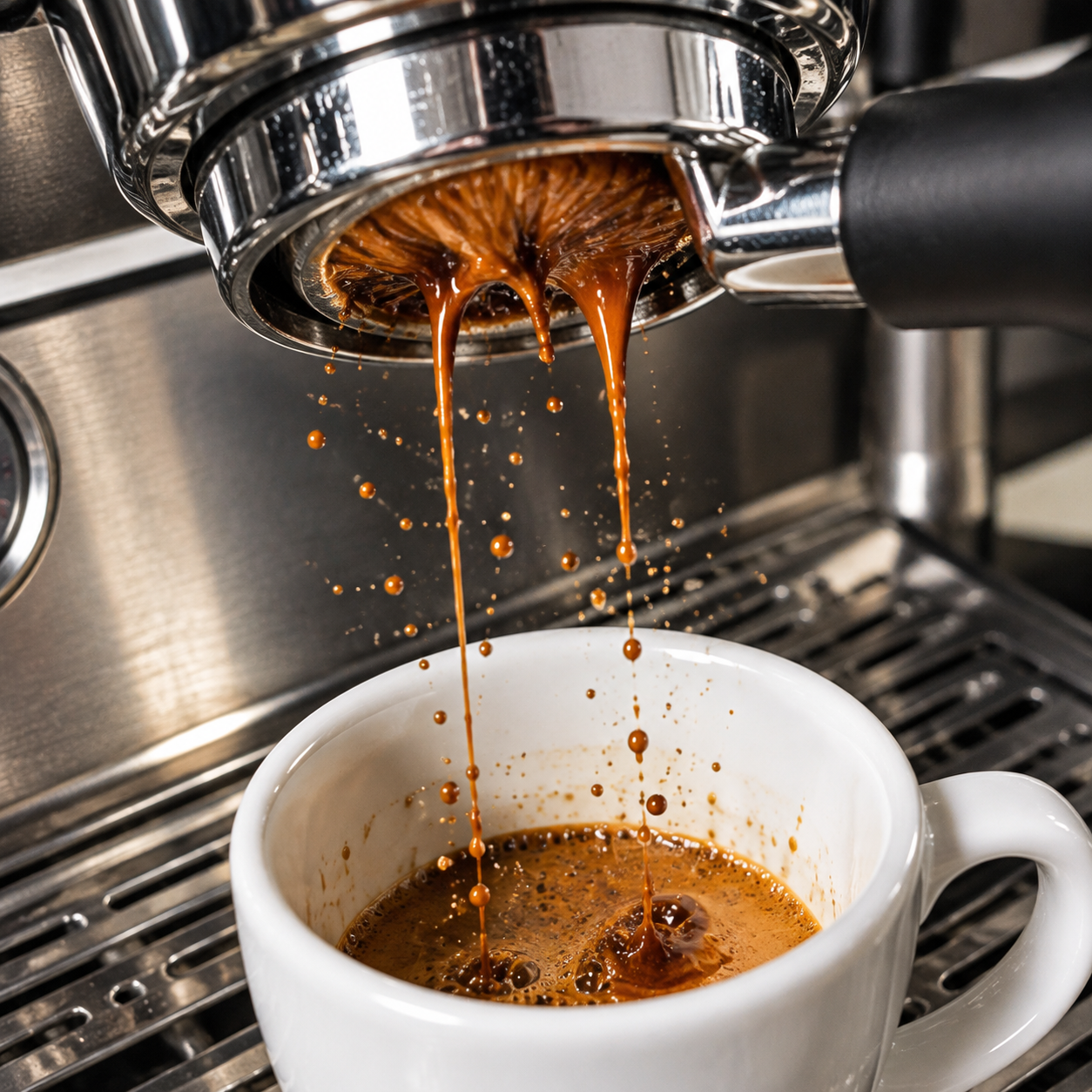
With a bottomless portafilter, obvious channeling can show up as:
- fine side sprays or “spritzers”;
- a pale watery jet from one area of the basket;
- one side starting much earlier than the other;
- separate fast streams that never settle;
- a sudden gush after a slow start.
With a spouted portafilter, you cannot see the basket bottom, but severe uneven flow may still make the streams look turbulent, unusually pale or inconsistent from side to side.
Does a perfect-looking bottomless shot prove there is no channeling?
No. This is one of the most useful boundaries to understand.
What you can see vs what you can only infer
Barista Hustle notes that microchannels may exist without dramatic visible spraying. Decent Espresso’s puck-prep comparison likewise found that visual uniformity did not always track perfectly with taste or extraction-yield results in its tested setup.

What causes channeling most often?
| Cause | Why it creates uneven resistance | First correction |
|---|---|---|
| Clumped or unevenly distributed grounds | Dense and loose zones sit next to each other | Break clumps and distribute before tamping |
| Crooked tamp | One side of the puck is compressed differently | Tamp level on a stable surface |
| Grounds along the basket wall / edge voids | Water can find an easier path around the puck edge | Distribute to the perimeter and tamp cleanly |
| Dose too low for the basket | The puck can become thin and mechanically unstable | Use a basket-appropriate dose |
| Dose too high / poor headspace | The puck may contact the shower screen before brewing and disturb the bed | Verify dry headspace for the machine/basket |
| Extremely fine grind | High resistance can amplify weak spots and make water seek local escape paths | Do not keep grinding finer to solve every fast or sour shot |
Should you use WDT to fix channeling?
WDT can be useful when your grinder produces clumps or your basket receives an uneven pile. Breville’s current tamping guide now explicitly mentions WDT as a way to break up hidden clumps and improve evenness before tamping.

In Decent Espresso’s 2020 puck-preparation comparison, the tested combination of full-depth WDT plus gentle vertical taps produced the best and most consistent results in that specific setup. That is useful evidence for the technique, but it should not be turned into “every espresso shot requires this exact WDT pattern.”
How should you tamp after distribution?
Once distribution is even, tamp straight and level. Breville’s current tamping advice emphasizes a level tamper, centered force and repeatable pressure. The exact number of pounds matters less than keeping the puck flat and consistent from shot to shot.

What is the fastest channeling-fix workflow?
Fix the basics in this order
Do not change grind, dose, WDT pattern, temperature and ratio at the same time. Fix the mechanical puck-prep problem first, then return to dialing in.
Can channeling make espresso taste sour and bitter at the same time?
Yes, uneven extraction can create a confusing cup. Some parts of the puck receive less effective extraction while other regions see much more water flow. The result may taste hollow, sharp, harsh or poorly integrated rather than simply “too sour” or “too bitter.”
If your shot time looks normal but the cup is still sharply sour, use the broader sour espresso diagnosis. If the recipe itself is unclear, start with the 1:2 brew-ratio guide.
Should you judge channeling from the spent puck?
Be careful. A dramatic hole or crack can be useful evidence, but the puck changes when pressure releases and when you remove the portafilter. A clean-looking spent puck does not prove even extraction, and a wet or messy puck does not automatically prove channeling.
Use the spent puck as one clue alongside flow behavior, recipe repeatability and taste.

FAQ
Does spraying from a bottomless portafilter always mean channeling?
A localized side spray is a strong visible sign of uneven flow. Check distribution, edge voids and tamping before changing machine pressure or temperature.
Can I have channeling without any spray?
Yes. Smaller uneven-flow paths can exist without dramatic visual signs. Taste and repeatability still matter.
Does WDT always improve espresso?
No technique is automatically better in every setup, but WDT is useful for breaking clumps and redistributing an uneven bed. Controlled tests from Decent Espresso found strong consistency from WDT plus gentle taps in the tested configuration.
Can tamping too hard cause channeling?
A level, fully compressed puck is generally more important than chasing an exact tamp force. Uneven or tilted tamping is the clearer channeling risk.
Do I need a bottomless portafilter to diagnose channeling?
No. A bottomless portafilter makes major visual flow defects easier to see, but you can still improve distribution, tamping and repeatability with a spouted portafilter.
References
- Barista Hustle — Channelling: identifying critical unevenness
- Barista Hustle — What Causes Channelling? / microchannels
- Decent Espresso — Puck Preparation Techniques Comparison
- Breville — How to tamp espresso
- Breville — How to use the Distribution Duo
- Breville USA — How to prevent channeling and make a balanced espresso shot
Evidence boundary: visible bottomless-portafilter patterns are diagnostic clues, not a complete extraction measurement. HomeBaristaMods does not treat one visual stream shape as proof of flavor quality or perfect puck uniformity.
 English
 Deutsch