

4:06
Do not substitute an ordinary coffee-oil cleaning tablet for a descaler. The product's stated job and your machine's instructions decide what to use. Bosch, for example, explicitly says its cleaning tablets numbered 00312502 do not descale and identifies a different product for limescale. [1]
“Tablet” describes a product's form, not everything it can clean. Before starting a cycle, match three things: the maintenance task, the exact cleaning product and the machine-specific procedure. A container labeled only “coffee machine cleaner” leaves too much unresolved.
Coffee residue and mineral deposits need different checks
Breville describes its cleaning tablets as removing coffee oils and residue from the shower screen and filter baskets. Urnex describes Dezcal as a descaling product for mineral deposits. Those are different intended jobs. [2, 5]

| Task named in the instructions | Product type to verify | What not to assume |
|---|---|---|
| Remove coffee oils and brewing residue | Approved espresso-machine cleaner | That running it through the water tank will descale the machine |
| Remove mineral scale | Approved descaler | That it replaces the machine's separate coffee-cleaning cycle |
| Clean removable accessories | Product and dilution approved for those particular parts | That all handles, finishes and seals can be soaked |
| Clean a milk system or grinder | The dedicated procedure and approved product for that component | That an espresso cleaning tablet belongs anywhere in the machine |
Use the instructions for the actual product, not a rule about all powders or all liquids. A descaler can have a different physical form from the one supplied with your machine. Conversely, two products that look like white tablets may have different purposes or doses.
The distinction is easy to lose when a package says “deep clean” or a search result describes both tasks in one paragraph. Read the intended-use statement and part number before reading the marketing promise.
One warning light can refer to two separate jobs
The cited Barista Express BES870 US/Canada instruction book provides a useful example. On printed page 22, a flashing CLEAN / DESCALE light calls for the cleaning cycle. Printed page 23 identifies a steady light with descaling. The book explicitly separates the cleaning backflush from descaling. [6]
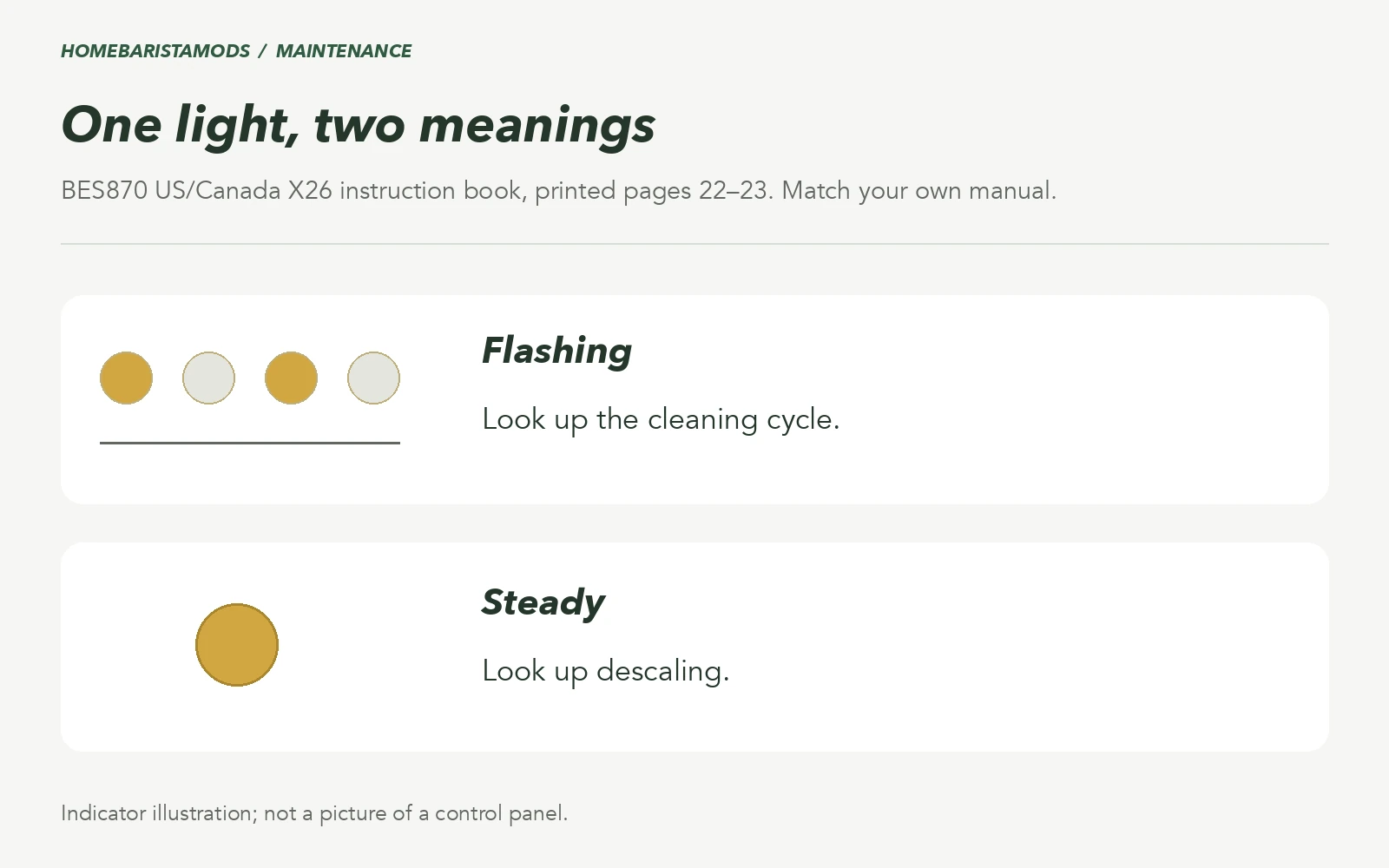
| BES870 condition in the cited manual | Task to look up |
|---|---|
| CLEAN / DESCALE flashes | Cleaning cycle, printed page 22 |
| CLEAN / DESCALE stays on steadily | Descaling, printed page 23 |
This table applies to the cited manual, not to every Breville machine or every generation. Match your model, region and instructions before interpreting a light or pressing a button combination.
That example also explains why “I ran the clean cycle” is an incomplete maintenance record. Write down which cycle and which product. A successfully completed program confirms that program ran; it does not prove that every different maintenance task has been completed.
Do not use this comparison page as a substitute for the whole procedure. Keep the machine's instructions open through preparation, the operating cycle and the required rinsing.

The exact tablet matters
“One tablet” is meaningful only when the instructions identify which tablet. Urnex lists Cafiza E16 as 12 mm and 1.2 g, while Cafiza E31 is 15 mm and 2.0 g. Both are Cafiza cleaning tablets, but they are not the same physical dose. [3, 4]
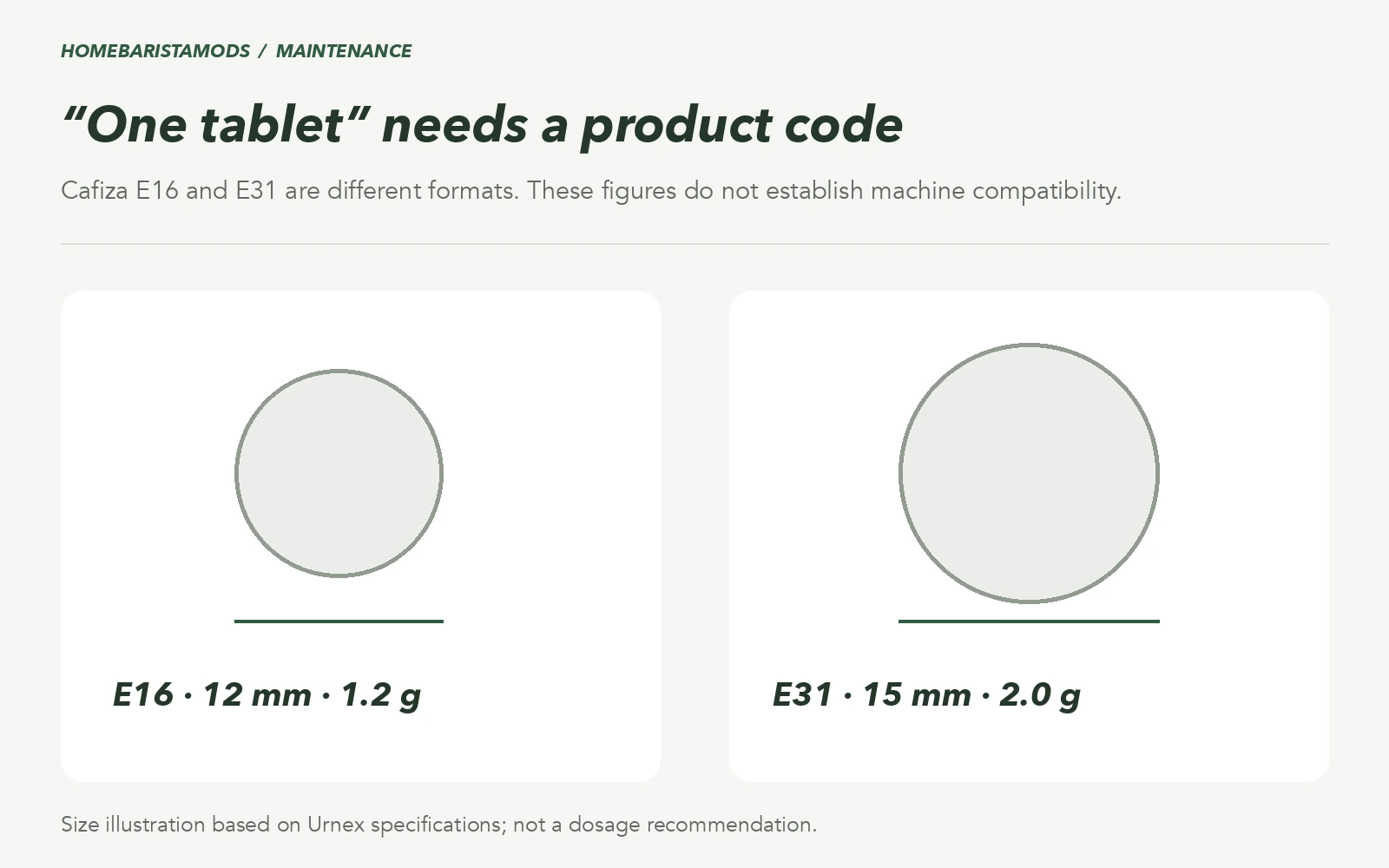
| Product | Manufacturer's stated tablet size | What this establishes |
|---|---|---|
| Cafiza E16 | 12 mm; 1.2 g [3] | Identity of that tablet format |
| Cafiza E31 | 15 mm; 2.0 g [4] | A different tablet format within the same product family |
This is not a recommendation to substitute either product into every home machine. Check the appliance maker's approval, the cleaner's instructions and the precise product code. Do not increase a dose because a larger tablet seems likely to clean better, or split tablets to invent an equivalence that neither manufacturer specifies.
Tablet size is one more reason to retain the packaging. Once several similar tablets are tipped into an unmarked jar, a future cleaning instruction cannot tell you which one is in your hand.
Product, placement and cycle checks before starting
A correct product still needs the correct destination. For the cleaning cycle in the cited BES870 manual, the tablet is used with the specified basket and cleaning disc. The descaling section has a separate tank-solution procedure. [6]

Do not transfer that arrangement to a machine whose instructions describe a different cleaning chamber, cycle or maintenance method. In particular, do not improvise a blind-basket backflush merely because a cleaner's generic directions describe one. Establish that your machine permits the procedure first.
Use this short record before beginning:
| Check | What you should be able to identify |
|---|---|
| Machine | Full model code and applicable manual |
| Task | Coffee-residue cleaning, descaling or another named maintenance job |
| Product | Brand, exact product code and intended use |
| Dose | The quantity and dilution specified for that product and procedure |
| Placement | Where the instructions tell you to put it |
| Completion | Required rinse, checks and criteria for returning to brewing |
If any entry is uncertain, resolve it before adding chemicals. Guessing the rinse volume afterward is a poor substitute for knowing the procedure at the start.
What if you already added the wrong product?
Stop preparing drinks and consult the appliance and chemical manufacturers with the exact details. Identify the machine, product code, amount, where it was added and whether a cycle ran. Follow the product's safety instructions; do not taste the water to decide whether it is clean.
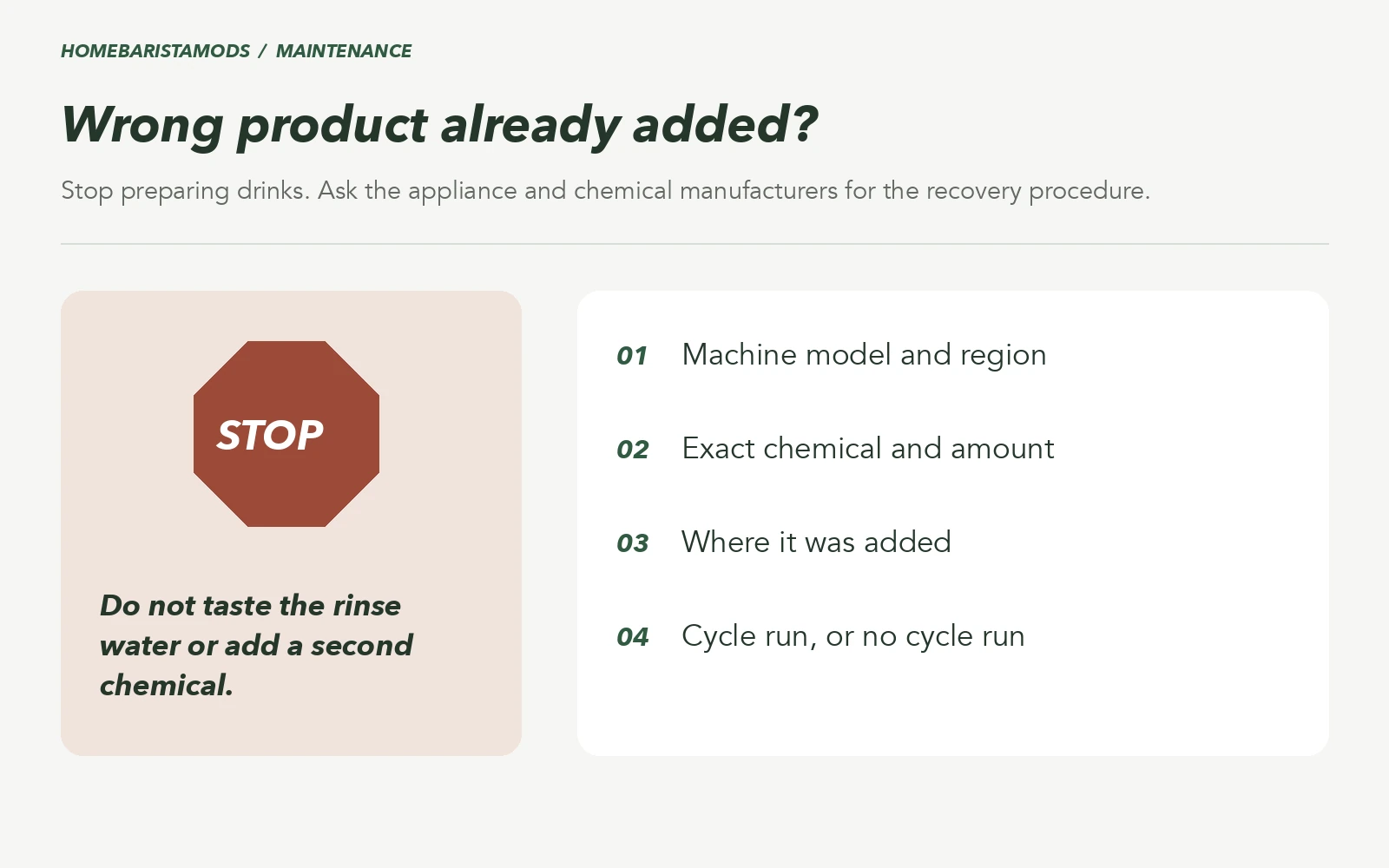
Do not add another chemical to “cancel out” the first or improvise a neutralizing mixture. A suitable recovery procedure depends on what entered the machine and which paths it reached. This page does not prescribe an all-purpose recovery flush.
A message that helps support respond is:
I have a machine and regional model. I added product code and amount to location and ran cycle or no cycle. Please tell me the safe recovery and rinsing procedure before the machine is used for drinks again.
Keep the packaging available so that support can identify the formulation. If there was exposure or a spill, use the immediate safety guidance on that product rather than treating it as only a machine-maintenance issue.
Cleaning tablets and descaler by maintenance task
Look up the required job before building a cleaning basket. Owning both a cleaner and a descaler may be appropriate when the machine's instructions call for both, but the labels still need to stay distinct.

The number of tablets in a package is not enough to compare cost per cycle. You need the prescribed quantity per cycle and the exact format. Likewise, a large bottle of concentrate needs its approved dilution before you can compare it with sachets. Do not assume the cheapest pack contains the most usable maintenance cycles for your machine.
This article does not set one descaling schedule for all owners. It also does not diagnose scale from a bitter shot or a slow flow alone. Use the model's maintenance instructions and troubleshooting checks, and keep the record of what was done.
For Gaggia owners, the backflushing guide and descaling guide address separate tasks. Confirm applicability to your particular Classic before following either procedure.

Questions at the cleaning cupboard
Can Cafiza replace a descaler?
The Cafiza products cited here are espresso-machine cleaners for residue, while Urnex sells Dezcal for descaling. Do not substitute one for the other because both are used in coffee maintenance. The machine must also be compatible with the chosen product and procedure. [3–5]
Does a tablet marked “cleaner” always go in the water tank?
No. Check its intended use and the machine's procedure. In the cited BES870 instructions, the cleaning tablet belongs in the specified basket-and-disc arrangement, while descaling uses a separately prepared tank solution. Another machine may use another arrangement. [6]
Can a single product claim to clean and descale?
Judge that exact formulation and its approved application rather than rejecting or accepting it by its shape. A combined claim does not establish approval for your machine or permission to merge two programs. Follow the appliance and product instructions for the actual combination.
Is a cleared warning light proof that the machine is fully maintained?
It confirms less than that. Identify which task the warning represented and which procedure was completed. Keep other prescribed maintenance tasks separate, and investigate a warning that persists according to the model's troubleshooting instructions rather than repeatedly adding cleaner.
Put the intended job and exact product code beside your next maintenance entry. That small record prevents the same uncertainty when the warning appears again.
Related HomeBaristaMods guides
- Maintenance library
- Espresso-machine diagnosis library
- Gaggia Classic backflush guide
- Gaggia Classic descaling guide
References
- Bosch — Cleaning tablets 00312502. Explicit distinction from descaler; Bosch appliance compatibility must be checked separately.
- Breville — Espresso cleaning tablets. Stated coffee-oil and residue-cleaning purpose.
- Urnex — Cafiza E16. Format, mass and intended use.
- Urnex — Cafiza E31. Different format and mass.
- Urnex — Dezcal descaling powder. Mineral-deposit removal; not a blanket approval for all home machines.
- Breville — BES870_USCM_IB_X26_LR instruction book. Printed pages 22–23, visually checked; consult the complete applicable procedure before use.