
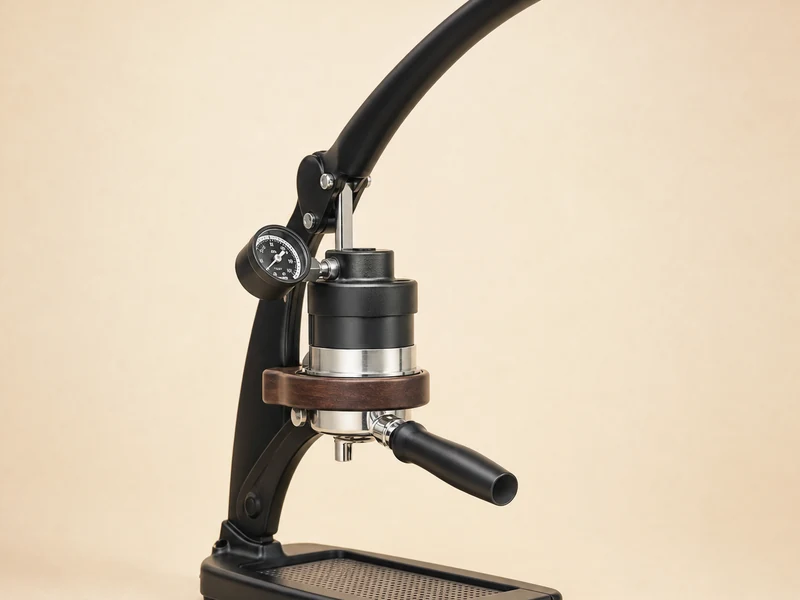
Moving the same coffee, basket and grinder setting from a Breville Dual Boiler, Gaggia Classic or another pump machine to a Flair 58 can produce a surprise: the pump machine builds normal espresso pressure, while the Flair barely reaches 2–4 bar and water runs through quickly.
That does not automatically mean the Flair is leaking or the pressure gauge is broken. Flair’s own support documentation says the 58’s wide basket creates a relatively thin coffee bed and often requires a finer grind to build the resistance needed for espresso pressure.

Does the Flair 58 really need a finer grind?
Often, yes. Flair’s current grind guidance explicitly says the Flair 58 requires a finer grind than its narrower, deeper standard Flair baskets. Its low-pressure troubleshooting page repeats the same logic: the 58’s wider basket creates a thinner puck, so finer grounds are needed to compensate and create enough resistance.
That manufacturer statement is stronger than the generic internet advice to “grind finer.” It explains why a grind that worked in a deeper basket—or even a grind that seemed espresso-fine elsewhere—can still be too open for the 58 workflow.
What pressure and time does Flair actually recommend?
Flair’s current support page says Flair 58/58x extractions may be around 25–35 seconds, with the espresso pressure zone generally around 6–9 bar. Another current grind-support page gives 6–8 bar and roughly 25–30 seconds as a useful 58 target before adjusting to taste.
Those are starting ranges, not a command to make every coffee hit exactly 9 bar. Flair’s own language says pressure and time vary with model and taste.
Why can the same 58 mm basket behave differently on a pump machine?
There is no single manufacturer-published equation that says “move X grinder clicks finer when switching from a BDB to a Flair 58.” Real systems differ in how water reaches, wets and pressurizes the puck.
A pump machine and a manual lever both need resistance to develop pressure. The oversimplified claim that “the pump makes pressure but the Flair only uses the puck” is incomplete. A pump supplies a flow/pressure characteristic against the coffee bed; the Flair plunger applies force to the water against that same kind of resistance.
What changes is the hydraulic history of the puck: fill procedure, headspace, pressure ramp, pre-infusion, saturation time, shower-screen/puck-screen arrangement and the operator’s lever profile can all alter how permeability evolves during the shot. Flair does not quantify one of those as the sole cause of the pump-machine-to-Flair grind shift, so this guide does not pretend there is one.
What do real owners see when switching from a pump machine?
The pattern is repeated across independent first-person reports:
- A December 2025 owner moved a Weber Unibasket and the same grind from a Breville Dual Boiler to a new Flair 58 and could barely generate pressure; after discussion, the owner moved finer.
- A January 2026 owner moving from a 9-bar Gaggia Classic Pro said the Flair 58+2 required dramatically finer grinding to reach the intended profile.
- An earlier owner moved the same VST basket from a Gaggia Classic Pro to a Flair 58 and found the same or slightly finer grind produced much less resistance.
Those reports do not create a universal grinder conversion chart. They do show that “same basket + same coffee + same grind” is not enough to guarantee the same pressure profile across different machines.

Should you copy your pump-machine grind setting as a starting point?
You can use it as a reference note, but do not treat it as a specification. Start there if convenient, observe pressure and flow, then adjust the Flair as its own system.
If the lever is easy to lower, pressure stays below the espresso zone and the shot reaches target yield too quickly, go finer. Make one meaningful change at a time and keep dose, coffee and target yield stable while you learn the new baseline.
Could the coffee dose be too low?
Yes. Flair’s official low-pressure troubleshooting says that if grinding finer is not enough—or your grinder cannot go finer—raising the dose is another way to increase puck resistance. Flair’s 58 brew guide uses roughly 18–20 g as a normal starting range.
That does not mean every basket should be forced to 20 g. Basket geometry and coffee density matter. Increase dose only while maintaining sensible headspace and a portafilter that locks normally.
What is the low-flow basket for?
Flair’s current low-pressure support page explicitly suggests the low-flow/chamfered basket when finer grinding or dose adjustment is not enough. It has fewer holes and therefore provides a more restrictive flow path that can help build pressure.
This is especially useful for a grinder that is near the edge of its espresso capability. It is not evidence that every new Flair owner should replace the standard basket before learning to dial it.
| What you observe | Next move | Do not do first |
|---|---|---|
| 1–4 bar, fast flow, lever easy | Grind finer | Push dramatically harder |
| Still low pressure at grinder limit | Evaluate dose / low-flow basket | Assume gauge is broken without other evidence |
| Lever extremely difficult to lower | Go coarser / reduce excessive resistance | Force the lever into danger zone |
| Visible water leak outside normal brew path | Stop and diagnose seals/setup | Keep changing coffee variables |
Can stale coffee cause low pressure even at a fine setting?
Yes. Flair’s grind guidance explicitly lists roast, dose and bean freshness as variables that change the coffee bed. Older coffee can require a different grind and can make pressure-building less predictable.
If you are troubleshooting a new Flair, use coffee you know is reasonably fresh. Do not calibrate your entire workflow around pre-ground coffee that has been open for months.
Does pre-infusion change the pressure you see later?
It can change the puck before the main pressure phase. Flair says light roasts may benefit from an 8–15 second pre-infusion. Owner discussions frequently report that longer pre-infusion changes subsequent flow and may require a finer grind than a fast-ramping pump-machine recipe.
That owner observation is plausible and useful, but Flair does not publish a universal “pre-infuse 10 seconds = grind X microns finer” rule. Treat pre-infusion as part of the recipe and re-dial when you change it.
Should you always aim for 9 bar?
No. Flair’s own support range spans roughly 6–9 bar, and the point of a manual lever is that you can choose and shape the pressure profile. A tasty 6-bar declining shot is not defective because the gauge never touches 9.
The problem is not “I only reached 7 bar.” The problem is when you cannot create enough resistance to control the shot at all, or when you need unsafe lever force to do so.
What if you can only reach 2 bar no matter how hard you push?
Do not make “push harder” the test. If the shot gushes and the lever remains easy, go finer. If you have already moved much finer and pressure still cannot build, check dose, basket choice, fresh coffee, correct puck-screen use and the brew-head fill/setup.
Flair’s support says that, when there is no obvious seal leak, low/no pressure is related to the coffee bed. If there is visible water escaping where it should not, move out of the grind branch and diagnose the hardware/setup.
Use the existing Flair 58 pressure diagnosis if the symptom is broader than a machine-to-machine grind transition.
Does the brew head need to be completely filled?
Follow Flair’s current fill procedure for your 58 revision. The official brew guide instructs owners to fill the brew head using the valve-plunger method before brewing. Owner reports of no-pressure setups sometimes turn out to involve incomplete fill or air handling, so verify the basic setup before blaming the grinder.
Do not invent your own fill volume from another lever machine. Use the 58/58+ instructions matching your hardware.
What if the pressure gauge itself is the problem?
A gauge fault is possible, but compare it with lever resistance and actual flow. If the lever is almost effortless and water gushes through, the coffee bed really is offering little resistance. If the lever has strong resistance but the gauge remains dead, the gauge/path becomes more plausible.
That distinction is covered in the Flair 58 gauge-not-moving guide.
A pump-machine-to-Flair 58 migration workflow
- Use fresh coffee and a known basket.
- Start near your old pump-machine grind only as a reference.
- Use a repeatable dose; Flair’s guide commonly starts around 18–20 g.
- Install the puck screen as Flair specifies.
- Fill the brew head correctly.
- Pull the shot without forcing pressure.
- If pressure is low and flow fast, grind finer.
- Repeat with the same dose and target yield.
- If the grinder runs out of useful fine range, evaluate dose or the low-flow basket.
- Once resistance is controllable, tune pressure profile, pre-infusion and taste.
This sequence separates “can I build controllable resistance?” from the more advanced question “which pressure profile tastes best?”

What should you record while re-dialing?
| Record | Why it matters |
|---|---|
| Coffee / roast date | Freshness changes resistance |
| Basket | Flow geometry changes the required grind |
| Dose | Changes bed depth/resistance |
| Grinder setting | Lets you compare each adjustment |
| Pre-infusion time/pressure | Changes puck saturation before main extraction |
| Peak / declining pressure | Defines your lever profile |
| Yield and total time | Provides repeatable shot endpoints |
| Taste | The final reason for changing the recipe |
Where should a new Flair owner continue?
Use the Flair 58 machine hub for model context and the Flair 58 guide for the broader workflow. If temperature rather than resistance is the next problem, continue with the Flair 58 temperature/preheat guide.
The important habit is to stop importing fixed settings from another machine. Bring over your coffee knowledge and measurement discipline; re-establish the hydraulic baseline on the Flair itself.
References
- Flair Espresso — unable to hit pressure on Flair 58
- Flair Espresso — grind-size guidance
- Flair Espresso — pressure and brew-time guidance
- Flair 58 official brew guide PDF
- Owner case — same basket/grind from Breville Dual Boiler to Flair 58
- Owner case — Gaggia Classic Pro to Flair 58+2 grind shift
Evidence note: Flair documentation establishes the wide/thin puck, finer-grind requirement, pressure range and low-flow-basket remedy. Cross-machine explanations beyond that are presented as hydraulic reasoning and owner observations, not as a manufacturer-published conversion formula.