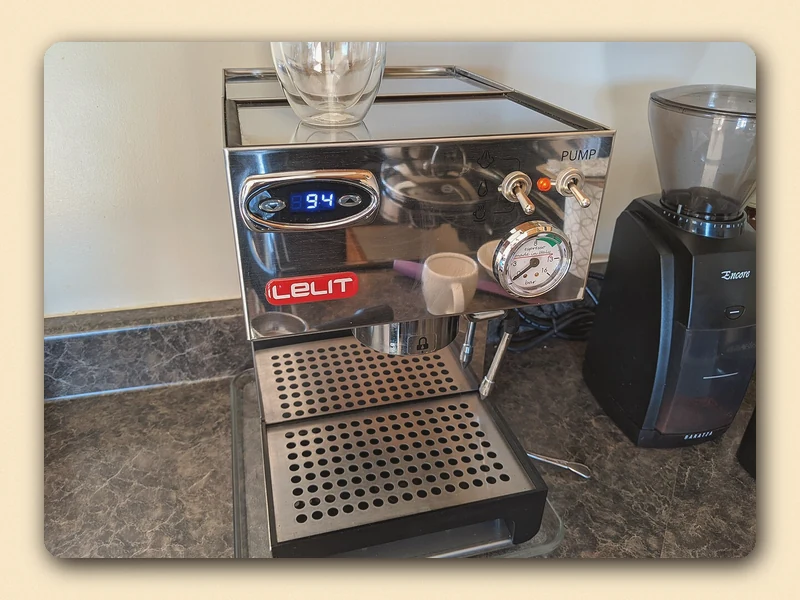
A Lelit Anna pressure gauge reading of 4 bar, 11 bar or even 14 bar does not identify one fault by itself. The useful question is what pressure does the machine build against a blind basket, and what happens when real coffee replaces that fixed restriction?
LELIT’s current Anna product documentation says the manometer is there to check coffee-delivery pressure and that the green area—currently shown as roughly 8–12 bar on regional Anna product pages—indicates the optimal extraction zone. That is important because it means “anything above 9 bar is automatically broken” is not an accurate reading of LELIT’s own current documentation.

What does the green zone on the Anna gauge mean?
LELIT’s current Anna pages describe the green zone as the optimal coffee-extraction pressure area. Some current regional pages explicitly define that green band as 8–12 bar. The PL41TEM page also confirms that the machine uses a manometer for coffee pressure, a three-way solenoid valve and the LELIT57 group.
The gauge is therefore a diagnostic aid, not a command to force every shot to one exact number. Coffee resistance changes the pressure the pump sees during extraction.
Why should you test with the blind basket?
A blind basket blocks normal flow. That gives the pump/OPV system a repeatable high-resistance condition and removes grind, coffee freshness, distribution and channeling from the test.
A 2024 Home-Barista owner with a new PL41TEM saw about 10 bar with the blind basket but only around 4 bar with a 7–9 g single dose. The machine was able to build pressure; the advice was to grind finer because the coffee bed was not providing enough resistance.
What if the blind basket reaches 8–10 bar but the coffee gushes in about 10 seconds?
This is a useful split test because the blind basket removes the coffee bed from the equation. A July 2026 Anna owner reported roughly 19 g in and about 40 ml out in around 10 seconds, while backflushing/blind-basket pressure behaved normally. The owner even tried coffee sold as “espresso ground” by a local roaster and the shot still ran fast.
That does not prove the pump or OPV is weak. If the machine can build repeatable pressure against a blind basket, it has demonstrated pressure capability under a fixed restriction. The next test is whether the actual coffee puck can create enough resistance.
Pre-ground coffee is a poor diagnostic control because you cannot move finer if the shot is fast. “Espresso” covers a wide range of grind requirements across different baskets and machines. A known espresso-capable grinder gives you a falsifiable test: keep moving finer until the shot meaningfully slows or chokes, then back off.
If verified espresso-fine coffee still gushes while blind pressure remains normal, inspect basket choice, dose/headspace and channeling before changing the OPV.
What if the blind basket reaches 8–10 bar but coffee only reaches 3–5 bar?
First make the coffee bed more resistant: grind finer, use reasonably fresh beans and keep the dose within a sensible range for the basket. LELIT supplies the Anna with a 7–9 g single basket and a 14–18 g double basket; those ranges are useful starting boundaries for the stock filters.
If a finer grind raises pressure but chokes the shot immediately, stop chasing the gauge by grind alone. Basket choice, dose, coffee age and puck integrity need to be considered together.

What if the coffee shot reaches 11–12 bar but still runs too fast?
That combination deserves a careful re-test rather than a one-line diagnosis. A May 2026 Anna owner reported exactly this: the blind basket remained around 8–9 bar, but a coffee shot showed 11–12 bar while yield was still too fast.
Because a blind basket is the stronger hydraulic restriction, a coffee reading that appears materially higher than a repeatable blind-basket ceiling is internally inconsistent. Recheck the test conditions, gauge behavior, basket, dose and shot timing before touching the OPV. Do not assume the portafilter is “locked too tightly”—locking force does not create coffee-bed resistance.
Record video of both tests if necessary. A trend that cannot be reproduced is poor evidence for an internal adjustment.
What if the blind basket itself reaches 14–15 bar?
Now the machine-side pressure-control branch becomes more relevant. A 2025 PL41EM owner reported a machine that had previously behaved around 9 bar but suddenly climbed to about 14 bar; the blind basket also reached about 14 bar. Community responders suspected an OPV that was sticking or obstructed by scale/debris.
A separate 2024 Anna owner reported full-shot pressure around 15 bar rather than a brief spike. Community troubleshooting again focused on a potentially blocked/sticky OPV and the return hose.
Should you immediately adjust the OPV to exactly 9 bar?
No. First establish that the OPV actually needs adjustment. LELIT’s current public Anna product documentation describes an optimal green range rather than publishing “every PL41TEM must be set to exactly 9.0 bar.” Machines also exist across production years and regions.
Owner reports show that some Anna machines have been adjusted successfully, while others have an older OPV whose adjustment screw is seized or thread-locked. One owner stripped the soft brass adjustment screw while trying to turn a scaled/stuck valve and ultimately replaced the OPV.
That is why an internal pressure adjustment should follow diagnosis, not precede it.
What if the OPV adjustment screw will not move?
Stop before damaging it. Multiple Anna owners report older valves with stubborn or thread-locked adjustment screws. Use the correct tool fit and the exact service procedure for your valve revision; if the adjuster is seized, replacement can be safer than destroying the brass screw.
Do not copy an Anita, Victoria or another Lelit OPV video solely because the valve looks similar. Confirm the Anna’s part and plumbing arrangement first.
What if blind pressure is too low?
A blind basket that cannot build normal pressure points away from grind and puck prep because there is no coffee in the test. Then investigate water supply, leaks, OPV bypass behavior and pump condition.
One Anna owner reported that the blind basket slowly climbed only to about 3–5 bar after the pump had accidentally been run with an empty tank. Descaling and an OPV change did not permanently solve the problem; the owner later replaced the pump and reported that normal performance returned. That is one first-person repair outcome, not proof that every low-pressure Anna needs a pump.
| Blind-basket result | Coffee-shot result | Start here |
|---|---|---|
| Normal/green | Low pressure + fast flow | Grind finer / fresh coffee / dose and puck prep |
| Normal/green | Good flow and taste | Do not modify the machine just to chase a number |
| Normal/green | Reported pressure higher than blind ceiling | Repeat test; check gauge/test consistency |
| Suddenly very high | High/choked | OPV/return-path restriction becomes plausible |
| Only 3–5 bar | Also weak | Water supply / leak / OPV bypass / pump branch |
Can scale affect the OPV even if you descale?
It can. Scale can accumulate in small passages, and loosened debris can move during maintenance. Owner reports of Anna pressure spikes frequently mention OPV contamination as a possibility. But “I have hard water” is not enough to prove the OPV is blocked.
Use water-quality and maintenance history as supporting evidence. If pressure changed immediately after descaling or after the machine sat unused, record that timing.
Can grind alone make the gauge hit 12–13 bar?
A very restrictive puck can push the pump toward the machine’s pressure ceiling. That is why pressure and flow need to be read together. If the shot is barely dripping and pressure is high, coarsening the grind may be the correct brewing adjustment even when the machine itself is healthy.
Home-Barista discussions on OPV versus puck prep make the same distinction: the OPV sets a ceiling/bypass behavior, while the coffee bed determines where a normal flowing shot operates below or against that ceiling.
What if pressure starts high and then collapses to 3–4 bar?
That is another different symptom. A 2026 PL41EM owner reported pressure starting high and then falling to 3–4 bar despite careful puck prep. Small grind changes produced large starting-pressure changes. That pattern should not be collapsed into “set the OPV to 9 bar.”
Check coffee freshness, channeling, dose, basket fit and whether the pump/OPV can hold repeatable pressure against a blind basket. A pressure collapse only under coffee can be a puck-flow problem; a pressure collapse with a blind basket points much more strongly toward the machine.
How should you test an Anna before opening it?
- Confirm exact model: PL41TEM, PL41EM or another Anna revision.
- Use fresh water and confirm the tank/feed is normal.
- Warm the machine normally.
- Run a blind-basket pressure test and record the maximum/stable behavior.
- Use one known coffee and basket.
- Weigh dose and yield; do not use only a scoop.
- Record shot time and gauge behavior.
- If the shot is fast/low-pressure with normal blind pressure, grind finer.
- If blind pressure is suddenly abnormal, move to machine-side diagnosis.
- Only then decide whether OPV adjustment/service is justified.

Do you need a pressure mod if the coffee tastes good?
Not necessarily. LELIT’s gauge is there to help you understand extraction, not to replace taste. If the machine is operating consistently, the blind-basket behavior is stable, the shot flows controllably and the coffee tastes good, there is little value in opening the machine simply because another owner prefers a different OPV number.
Use the Lelit Anna machine hub for model context and the Lelit Anna modding guide before deciding that pressure adjustment belongs in your upgrade path.
What should you record for support or repair?
| Record | Example |
|---|---|
| Exact model / voltage / region | PL41TEM, 230 V, EU |
| Blind-basket pressure | Stable 9.5 bar / slow climb / 14 bar |
| Coffee-shot pressure | Peak and stable behavior |
| Dose / basket | 17 g in stock 14–18 g double |
| Yield / time | 34 g in 29 s |
| Coffee age | 12 days from roast |
| Recent descale / repair | Date and what changed |
| Return-hose behavior / visible leaks | Observed / not observed |
References
- LELIT — Anna PL41TEM official product page
- LELIT — Anna PL41TEM technical sheet PDF
- Home-Barista — new Anna low-pressure owner case
- Home-Barista — OPV versus grind/puck discussion
- Owner case — Anna suddenly reaching 14 bar
- Owner case — low blind pressure, later pump replacement
Evidence note: LELIT documentation establishes the gauge purpose, current green-zone guidance, basket ranges and machine architecture. Owner reports are used to show real pressure patterns and repair outcomes; they do not establish one universal OPV setting for every Anna generation.