
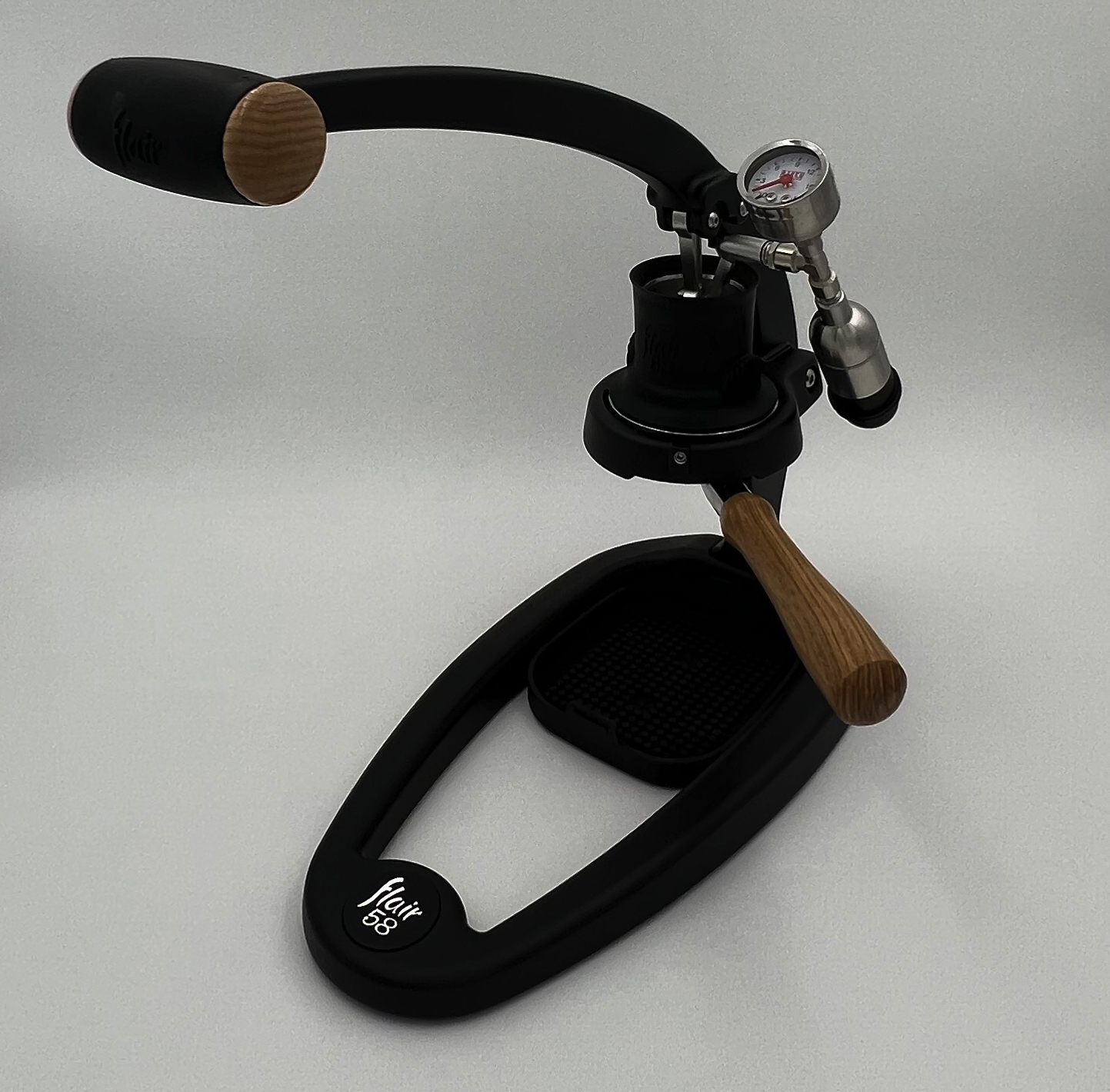
Switching a Flair 58 from the chamfered low-flow basket to the straight-wall high-flow basket often forces a much finer grind. If pressure returns but the espresso becomes bitter, the answer is not automatically to increase the dose to 21–23 g.

What is actually different between Flair’s low-flow and high-flow baskets?
Flair says the low-flow basket is chamfered and has a reduced hole pattern. That makes it more tolerant of coarser or less-consistent grinds and easier to dial in. The high-flow basket is straight-walled, similar in concept to a VST-style basket, and requires a finer grind that mimics a commercial machine.
So when the same grinder setting suddenly cannot build pressure after the basket swap, that is expected behavior—not proof that the Flair gauge or seals failed.
Are both baskets really 18 g?
Yes. Flair currently sells both as 18 g baskets and says they can usually accept roughly 16–20 g depending on roast/freshness/density. Flair’s separate dose FAQ gives the same 16–20 g range for the standard Flair 58 basket.
That means jumping straight from 18–19 g to 22–23 g is outside the usual published range for these standard baskets. If you genuinely want a larger dose, Flair notes that the industry-standard 58 mm portafilter lets you choose an aftermarket basket designed for that capacity.
Why did today’s owner have to grind dramatically finer?
A September 22, 2026 Flair 58 owner moved from the chamfered basket to the regular 18 g basket to make larger milk drinks. At 19 g, the owner had to grind “way way finer” to recover a familiar shot profile, but the result became bitter and unpleasant. The owner then wondered whether 21–23 g was required.
Flair’s own basket documentation explains the grind shift: high-flow requires a finer grind. It does not say high-flow requires a 21–23 g dose.
What if pressure is low after switching baskets?
Flair’s official low-pressure troubleshooting says that, when there is no clear seal leak, pressure is controlled by the coffee bed. First grind finer. If the grinder cannot go finer, increase dose within a sensible range or use the low-flow basket.
Do not force the lever harder to compensate for an under-resistant puck.

What if grinding finer restores pressure but makes the shot bitter?
Now you have moved from a hydraulic problem to a taste problem. Flair’s own dial-in guide says bitter/over-extracted espresso can be corrected by grinding coarser, lowering water temperature or slightly raising dose. Crucially, Flair also tells users to change only one variable at a time.
Start by asking whether you went finer than necessary simply to chase a pressure number. Flair does not require every shot to sit at exactly 9 bar.
Do you need 9 bar with the high-flow basket?
No. Flair’s current pressure guidance gives a broad espresso zone around 6–9 bar and notes that pressure/time vary with taste and model. A balanced 6–7 bar shot is not defective because it never reaches 9.
If you make the coffee unpleasant solely to force the gauge higher, the gauge has stopped being a useful diagnostic tool.
How fine is too fine?
Flair says that if the lever becomes extremely difficult to lower, the grind is too fine. Carefully raise the lever and restart with a coarser grind; never force the machine into the gauge’s danger zone.
A shot can also be “too fine for taste” before it becomes mechanically dangerous. Bitter, drying or harsh flavor after a large grind change is a reason to re-balance grind, temperature and yield.
Should you raise the dose to slow the high-flow basket?
Dose is a valid secondary resistance variable, but use it within the basket’s physical and published range. Going from 18 to 19 or 20 g may be sensible for some coffees. Jumping to 22–23 g in a basket Flair usually describes as 16–20 g risks creating a headspace/fit problem instead of solving the recipe.
If you need 22 g for your drink design, choose a basket intended for that dose.
Could lowering dose actually help a bitter shot?
Possibly, but note the interaction: lowering dose generally reduces puck resistance, so you may need a finer grind or different yield. Flair’s dial-in guide mentions slightly lowering dose as one option for sour/under-extracted coffee and slightly raising dose for bitter/over-extracted coffee, but those are taste-adjustment tools within a complete recipe.
Do not change dose, grind and temperature simultaneously or you will not know what fixed the cup.
What about roast level?
Flair recommends LOW preheat for dark roasts, MEDIUM for medium and HIGH for light. If a medium/dark coffee became bitter after you switched basket and ground dramatically finer, do not automatically add more coffee; confirm temperature is also appropriate for the roast.
Use the Flair 58 temperature/preheat guide if temperature is the next variable.
Why does high-flow often taste different?
Flair describes the high-flow basket as more even/high-clarity oriented and the low-flow basket as producing more viscosity and texture. That is a manufacturer description, not a guarantee that one basket tastes objectively better.
The basket changes the recipe space. Expect to re-dial rather than trying to preserve the exact low-flow grind/pressure profile.
Can your grinder be the limiting factor?
Yes. Flair says the 58 requires a high-quality espresso-capable grinder because its wide, shallow coffee bed needs a very fine and consistent grind. The high-flow basket raises that demand further.
Real owners report needing dramatically finer settings when moving to straight-wall/high-uniformity baskets, and some grinders reach their useful limit. If you cannot create controllable resistance without burr-touching or unusable steps, the low-flow basket may be the better match for that grinder.
High-flow basket decision table
| Symptom | First move |
|---|---|
| Low pressure + fast shot | Grind finer |
| Pressure restored but shot bitter | Stop chasing pressure; adjust grind/taste one variable at a time |
| Lever extremely hard to lower | Go coarser; never force it |
| Grinder cannot go fine enough | Use low-flow basket or a more capable grinder |
| Want 21–23 g dose | Use a basket designed for that capacity |
| 18–20 g fits and tastes good at 6–7 bar | Keep the recipe; 9 bar is not mandatory |
A clean basket-switch test
- Keep coffee and roast date constant.
- Start around 18 g in the high-flow basket.
- Keep target yield fixed.
- Grind finer until flow/pressure become controllable.
- Stop before lever force becomes excessive.
- Taste.
- If bitter, change one variable: slightly coarser grind, lower temperature or another deliberate recipe adjustment.
- Only change dose after you understand what the grind change did.
What if you mainly make milk drinks and want more espresso?
Do not confuse “larger drink” with “overfill the basket.” You can change yield/ratio within a sensible recipe, or choose a higher-capacity 58 mm basket if you specifically want a larger dry dose. Flair’s standard 18 g high-flow basket is not the only 58 mm basket available.
Use the Flair 58 guide for broader recipe planning.
What should you record while comparing baskets?
| Record | Why |
|---|---|
| Basket | Low-flow / high-flow / aftermarket model |
| Dose | Bed depth and resistance |
| Grind setting | Shows how much the basket changed demand |
| Pre-infusion | Affects puck saturation |
| Peak/profile pressure | Hydraulic behavior |
| Yield/time | Repeatable endpoint |
| Temperature setting | Major taste variable |
| Taste | The actual reason to keep/change the recipe |

Where should Flair owners continue?
If the bigger issue is that the Flair requires a much finer grind than your pump machine, use the pump-machine-to-Flair grind guide. For general pressure problems use the Flair 58 pressure guide.
References
- Flair — high-flow vs low-flow baskets
- Flair — 18 g basket specifications and 16–20 g range
- Flair — supported dose
- Flair — low/no-pressure troubleshooting
- Flair — official dial-in guide
- Owner case — high-flow basket grind/dose problem, Sep 22 2026
Evidence note: Flair documentation establishes basket geometry, dose range, grind requirement and dial-in guidance. The current owner case identifies the real-world pain point; its proposed 21–23 g solution is evaluated against Flair’s published basket limits rather than accepted as fact.