
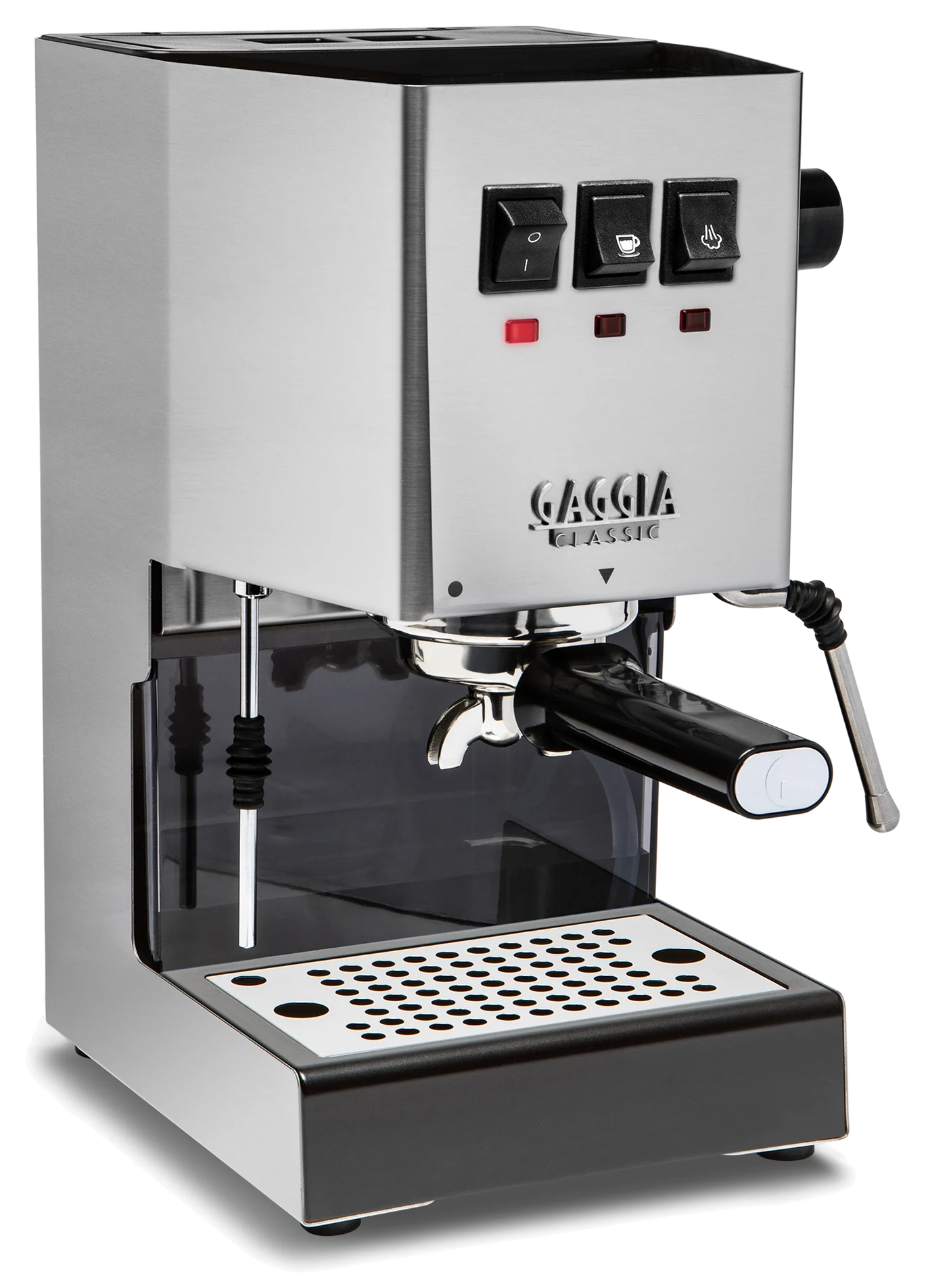
If your Gaggia Classic E24 gives a 30-second shot today and a 15- or 60-second shot tomorrow at the “same grind,” do not start by buying a PID or opening the solenoid. First prove that the inputs are actually the same: dose measurement, grinder output, coffee, basket/headspace and puck preparation. Then test the machine without coffee.
Video: Gaggia Classic Pro E24 temperature and extraction testing
Open on YouTube — Whole Latte Love’s E24 review includes brass-boiler and repeatable extraction-temperature testing. Treat its measurements as distributor testing, not a Gaggia factory temperature specification.
1. Why “same grind and same prep” is not yet a controlled test
A September 2026 refurbished-E24 owner described nearly perfect shots followed by much faster, channeling shots the next day without changing the grinder. An April 2026 stock-E24 owner reported a 16 g target but saw 16.9 g in the portafilter during one bad shot, while also noting that the scale had been behaving strangely. Those details matter more than the grinder dial number.
Before blaming the E24, write down what can be measured: beans in, grounds out, basket, dry dose, beverage yield and timing convention. If the scale, grinder retention or actual dose changes, the machine has not been given the same test twice.
2. Prove the scale before diagnosing espresso
Put one stable object on the scale, remove it, re-zero and repeat five times. If the reading wanders enough to matter for espresso, fix the measurement problem first. Then weigh coffee without anything that may interfere with the scale.
In the April 2026 owner case, commenters noticed the magnetic catch cup from the grinder sitting on the scale; the owner confirmed the cup was magnetic and that the scale had been acting oddly. That is not proof that every magnetic cup breaks every scale. It is a reminder that a suspicious measuring setup must be eliminated before interpreting a one-gram dose difference as a machine fault.

3. Weigh grinder input and output—do not trust the dial alone
A grinder setting is a mechanical reference, not a guarantee of identical particle distribution or identical grounds delivered to the basket. Retained coffee, a setting change that has not fully exchanged through the burr chamber, calibration drift or a coarse/fine step that is too large can all make “same setting” misleading.
A March 2026 E24 owner reported 33–60 g out in the same 30-second window with the same grind click and prep; one click finer could choke the machine while the next setting gushed. That pattern is compatible with a grinder-adjustment-resolution problem and should be tested before changing machine pressure.
For three shots, weigh beans before grinding and grounds after grinding. Keep the same bean bag. If output weight or behavior changes materially, clean/check the grinder and repeat before touching the Gaggia.

4. Keep basket and headspace fixed while testing consistency
The E24 is supplied with multiple filter types, and aftermarket IMS/VST-style baskets can have different dose ranges and flow characteristics. Do not compare yesterday’s stock basket against today’s precision basket and call the result “same prep.”
Use one basket and one dose while troubleshooting. Check dry headspace: tamp, lock in without brewing, unlock and inspect for obvious shower-screen/screw contact. In the April owner case, 18 g had left a clear shower-screw imprint, so the owner moved down to 16 g. That is useful machine-specific evidence that basket/headspace must be verified rather than copied from somebody else’s recipe.
If you use a puck screen, keep it either in or out for the whole comparison. Do not alternate puck-screen thickness while measuring shot-to-shot repeatability.
5. Standardize puck preparation before blaming pressure or temperature
Whole Latte Love’s current Classic extraction troubleshooting emphasizes a repeatable system and changing one variable at a time. That matters because channeling can create a fast shot even when the grinder setting and dose are unchanged.
Use the same distribution method, avoid aggressive side-tapping after WDT, tamp level and stop adding extra puck-prep gadgets during the test. A bottomless portafilter can help reveal obvious side sprays, but a pretty bottomless video is not a pressure measurement.
If one shot chokes and the next gushes while the scale, grounds-out weight and basket are verified, record whether the bottomless extraction shows a repeatable puck failure before moving to the machine.
6. Run an empty-group flow test to separate coffee from the machine

Remove the portafilter and measure water from the group over a fixed time. Whole Latte Love’s current Classic Pro support uses approximately 6 oz in 20 seconds as its group-flow reference; significantly slower flow moves group components or the solenoid restriction higher on the list.
This is a support-center diagnostic reference, not a Gaggia factory brew recipe. Its value is that coffee, grinder and puck prep have been removed from the test.
| Result | Next branch |
|---|---|
| Empty-group flow repeatable and near support reference | Return to scale/grinder/puck/thermal workflow |
| Empty-group flow clearly low | Group cleaning / solenoid / water-path diagnosis |
| Steam wand flows but group does not | Solenoid/group restriction becomes stronger |
| No group or steam flow | Prime/pump/water-supply branch |
If group flow is low, use the existing Gaggia group-flow diagnosis rather than changing grind to compensate for a machine restriction.
7. The E24 brass boiler improves stability—but does not remove workflow
Gaggia’s official E24 page says the larger brass boiler stores more heat and improves temperature stability compared with the previous design. That is real hardware improvement. It does not mean every shot begins at exactly the same brew temperature regardless of warm-up, flushing or back-to-back timing.
Whole Latte Love’s E24 testing found a narrow temperature range during a controlled extraction and developed a repeatable workflow for roughly 200°F extractions. Independent 2026 testing by Kaffeemacher found that shot-to-shot starting temperature could still drift when timing between shots changed, while a more deliberate wait/flush routine improved results.
So temperature belongs in the diagnosis—but after you prove the scale, grinder output and puck. Otherwise temperature surfing can hide a measurement problem without solving it.
8. Standardize one thermal routine instead of changing it every shot
For a consistency test, choose one repeatable warm-up and pre-shot routine and use it for every comparison. Do not do a 5-second flush on one shot, steam-button surfing on the next and a 20-minute idle on the third.
The video above is useful because it documents one E24-specific testing approach. Older aluminum-boiler Classic routines should not automatically be copied onto the brass-boiler E24: the boiler mass and capacity changed.
If the first shot and second shot are systematically different, record machine state and time since the previous brew. That is a different pattern from random day-to-day gush/choke behavior.
9. When should the solenoid or scale restriction become a real suspect?
Gaggia confirms the E24 uses a 3-way solenoid valve. Whole Latte Love’s current support moves toward solenoid/group cleaning when group flow without the portafilter is significantly below its reference, especially when steam flow remains available.
Gaggia’s own E24 maintenance guidance says scale depends on water and use and recommends descaling when flow is reduced (as well as its scheduled interval). Use Gaggia descaler and the model procedure; do not repeatedly descale a machine whose empty-group flow is already normal just because shot time changed.
If a recently descaled machine suddenly develops low/no group flow while the steam wand still flows, use the solenoid diagnosis. Scale debris can obstruct that path; this is different evidence from inconsistent coffee flow with normal empty-group output.
10. A controlled 3-shot test before buying a PID or grinder
- Verify the scale repeats the same known weight.
- Use a non-problematic weighing container and one bean bag.
- Weigh grinder input and actual grounds output for each shot.
- Use one basket, one dry dose and fixed puck-screen choice.
- Keep WDT/tamp technique identical.
- Use one thermal warm-up/flush routine.
- Pull three shots to the same beverage yield and record time.
- If they still vary badly, run the empty-group flow test.
- Normal group flow → investigate grinder/puck/thermal repeatability before machine repair.
- Low group flow → move to group/solenoid/water-path service.
For E24 PID decisions after the baseline is stable, use Does the Gaggia Classic E24 Still Need a PID?. For water/scale strategy use the Gaggia water guide.
References
- Gaggia — Classic E24 official product, specifications and maintenance guidance
- Gaggia — Classic E24 US/Canada instruction manual
- Whole Latte Love — Classic grouphead flow reference and service
- Owner case — refurbished E24 inconsistent shots/channeling, September 2026
- Owner case — stock E24 inconsistency with scale/grinder variables, April 2026
Evidence boundary: Gaggia establishes E24 hardware, brass-boiler design and maintenance. Whole Latte Love provides distributor test/support measurements. Owner cases identify real repeatability failures and useful A/B clues; they are not used to claim that every inconsistent E24 has the same cause.