
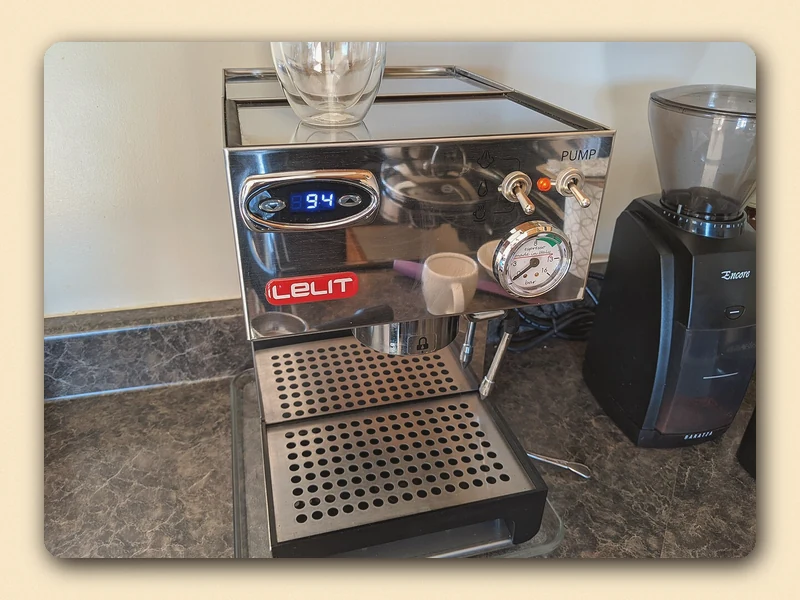
If a Lelit Anna PL41TEM is set to 95°C and the PID display falls into the low/mid-80s during or immediately after a shot, the number looks alarming—but it does not automatically mean 83°C water hit the coffee or that the PID has failed.

What does Lelit officially say the Anna PL41TEM has?
Lelit’s current Anna PL41TEM product/technical documentation describes a 250 ml brass boiler, PID temperature controller, pressure gauge and LELIT57 group. It is a compact single-boiler machine, not a dual-boiler machine with a separate large brew reservoir.
That architecture matters: when the pump delivers a shot, incoming reservoir water replaces water leaving the boiler. The heater/PID then has to recover the boiler’s thermal state.
Does the PID number equal water temperature at the puck?
No. The controller acts on a temperature sensor in the machine’s heating system. The water reaching the coffee has passed through the boiler, hydraulic path and group; the puck itself is not where the PID sensor sits.
This is the same measurement principle that causes confusion on many PID retrofits: boiler/sensor temperature and brew-water temperature are related, but they are not interchangeable measurements.
Why does the display fall during a shot?
A shot removes hot water and introduces cooler tank water into a relatively small boiler. The sensor sees the thermal disturbance and the controller responds by energizing the heater. The displayed number can therefore fall before the heater and boiler recover.
How large the visible drop is depends on starting thermal state, shot volume, incoming-water temperature, sensor/controller behavior and machine conditions. Lelit does not publish one universal “maximum normal drop” in the public Anna material reviewed for this guide.
What do real Anna owners report?
A used/refurbished PL41TEM owner reported starting around 95°C and seeing the display near 83°C by the end of a shot. The espresso was very fruity/sour, which led the owner to wonder whether the temperature collapse caused the taste.
Other Anna owners report visible PID drops during extraction as fresh water enters the boiler. Those experiences show the symptom is real; they do not establish that every 10–12°C display drop is automatically normal or abnormal.
How do you tell normal recovery from a real heating fault?
Look at the whole cycle. Start from a fully warmed machine, pull a repeatable shot, then watch whether the heater engages and whether the display recovers toward the setpoint in a consistent way.
A machine that repeatedly returns to setpoint and produces consistent shots is a different case from one that remains cold, stops heating, trips protection or takes progressively longer to recover.
| Observation | Interpretation / next step |
|---|---|
| Display drops during shot, then recovers consistently | Thermal disturbance/recovery is plausible; evaluate taste and repeatability |
| Display never returns to setpoint | Heating/control diagnosis |
| Recovery becomes much slower than before | Check heating, scale and control behavior |
| Machine overshoots/boils in brew mode | Temperature-control fault branch |
| PID display is stable but espresso tastes sour | Do not blame temperature alone; check grind/ratio/coffee |
How long should the Anna warm up?
Wait for the PID to reach its setpoint, but do not assume the first arrival at the number means the entire group/portafilter has reached thermal equilibrium. The boiler can heat faster than the surrounding brass/metal mass.
Lelit markets the machine as compact and quick to use, but its public documentation does not provide a universal Scace-stable warm-up minute for every room temperature and workflow. For repeatability, use the same warm-up routine each day.
Can an unheated portafilter make a sour shot?
It can contribute to heat loss. Keep the portafilter locked in while the machine warms so the group and portafilter are not a cold heat sink when brewing starts.
But sour espresso also commonly comes from insufficient extraction caused by coarse grind, short ratio, channeling or a light roast that needs a different recipe. Temperature is one variable, not the automatic diagnosis.
What if the shot is sour at 95°C?
First check flow and extraction. A real owner case with 18 g in, roughly 1:2 yield and about 27 seconds still tasted very fruity/sour. That could involve coffee style, grind, channeling, ratio or temperature. The PID drop alone cannot identify which.
Change one variable at a time. If the shot runs fast, grind finer before simply raising the PID. If flow/time are controlled and the coffee is still sharply sour, a higher temperature or longer ratio may be worth testing depending on roast.
Should you set the PID much higher to compensate for the drop?
Not blindly. A higher boiler setpoint changes the entire thermal starting condition; it does not “fill in” the exact number of degrees shown falling on the display during the shot.
Use taste and repeatable tests. Make small changes, keep grind/dose/yield stable and compare. Do not add 10°C merely because the display falls 10°C.
What if pressure is also abnormal?
Separate the two systems. If pressure is low/high or inconsistent, use the Lelit Anna pressure/blind-basket guide. A pressure problem can change flow and extraction enough to mimic a temperature/taste problem.
Can scale make thermal recovery worse?
Scale on heating/water-path surfaces can impair machine performance, so maintenance history matters. But do not diagnose scale from one PID drop. Follow Lelit’s maintenance/descaling guidance appropriate to your water and machine.
If recovery has degraded gradually compared with the machine’s own previous baseline, water quality and scale become more relevant evidence.
How should you test repeatability?

- Use one coffee, basket and dose.
- Warm the machine/portafilter the same way.
- Record PID setpoint immediately before brewing.
- Record lowest displayed temperature during/after the shot.
- Record recovery time to setpoint.
- Record pressure, yield and shot time.
- Repeat for three shots under the same routine.
Patterns matter more than one alarming number.

What would make the PID itself suspicious?
Examples include implausible readings unrelated to machine heat, failure to control the heater, persistent large overshoot/boiling in brew mode, or a display/control behavior that suddenly changes from the machine’s established baseline. Those symptoms deserve model-specific electrical/sensor diagnosis.
Do not open a mains-powered espresso machine solely because the number moves during a shot.
Does Anna’s small boiler make it a bad espresso machine?
No. It defines the workflow and thermal capacity. A 250 ml single boiler will behave differently from a large dual-boiler machine, especially across repeated shots and steam transitions. The PID improves control of that system; it does not turn the boiler into an infinite heat reservoir.
What if you pull several shots back-to-back?
Give the machine time to recover to a repeatable starting condition. If you start the next shot while the PID is still recovering, you have changed the experiment. For comparison, wait until the machine returns to the same state before each shot.
Anna temperature decision table
| Symptom | First move |
|---|---|
| 95°C start, display drops, then recovers | Test repeatability/taste before repair |
| Sour + fast shot | Grind/flow first |
| Sour + controlled flow | Test small temperature/ratio changes |
| Never recovers to setpoint | Heating/control diagnosis |
| Brew mode boils/steams abnormally | Stop and diagnose temperature control |
| Pressure also abnormal | Separate pressure diagnosis with blind basket |
What should you record before asking for support?
| Record | Example |
|---|---|
| Exact model / voltage | PL41TEM / 230 V |
| PID setpoint | 95°C |
| Lowest displayed temp | 84°C |
| Recovery time | Observed consistently |
| Warm-up routine | Same each test |
| Dose / yield / time | 17 g / 34 g / 29 s |
| Pressure | Peak/stable gauge reading |
| Coffee / roast date | Known |
| Recent descale/repair | What changed |
Where should Anna owners continue?
Use the Lelit Anna machine hub and Anna modding guide for model context. If pressure rather than temperature is the unstable variable, use the Anna pressure diagnosis.
References
- LELIT — Anna PL41TEM official product page
- LELIT — Anna PL41TEM technical sheet PDF
- LELIT — Anna user manual
- Owner case — refurbished PL41TEM, 95°C start and low post-shot display
- Home-Barista — Anna PID/display temperature discussion
Evidence note: LELIT documentation establishes the 250 ml brass-boiler/PID architecture. Public LELIT material reviewed here does not publish one universal acceptable during-shot display drop, so owner observations are used to frame repeatability tests rather than inventing a pass/fail number.