
Choose a manual coffee grinder if your usual dose fits, turning the crank is comfortable and the model supports your brew method. Choose an electric grinder when you want the motor to handle repeated doses or when hand grinding has become a chore. For coffee quality, compare the actual grinders, their burrs and their adjustment range.
If you already like the coffee from your hand grinder, an electric model can still be a worthwhile purchase for convenience. Work through your largest regular batch before deciding. Grinding one cup for yourself and preparing several coffees before breakfast are different tasks.
The daily grinding task as the deciding factor
A hand grinder asks you to hold the body and turn a crank for each dose. An electric grinder supplies that rotation with a motor. Try the whole task, including loading beans and collecting grounds, to decide how much convenience you would gain.

On r/Coffee, an owner of a manual burr grinder asked what an electric grinder would add beyond convenience. If your current coffee already tastes good, identify the part of preparation you want to change before replacing the grinder.
For a single dose, you may enjoy hand grinding and finish before the kettle is ready. With several doses, you must repeat the work. Test the hand grinder with the beans and grind setting you plan to use, particularly if grip strength or wrist comfort affects your choice. Stop if the trial is painful; a motor removes the cranking task, although you still need to check that filling and collecting are comfortable.
In Brian Williams’s account for Brian’s Coffee Spot, he preferred using an available Baratza Encore when making coffee for two. He still enjoyed his hand grinders for himself and did not feel a need to buy an electric replacement. His decision was tied to his doses and daily use.
Compare burr grinders with burr grinders when considering that change. “Electric” also includes blade grinders, which are a separate choice. Our burr vs blade grinder guide explains that distinction before you compare a crank with a motor.
Espresso adjustment varies by model
For espresso, confirm that the candidate supports espresso and lets you adjust finely enough for your recipe. A motor alone tells you neither. For filter coffee, check that the grinder covers your brewer’s range and that changing settings is practical.
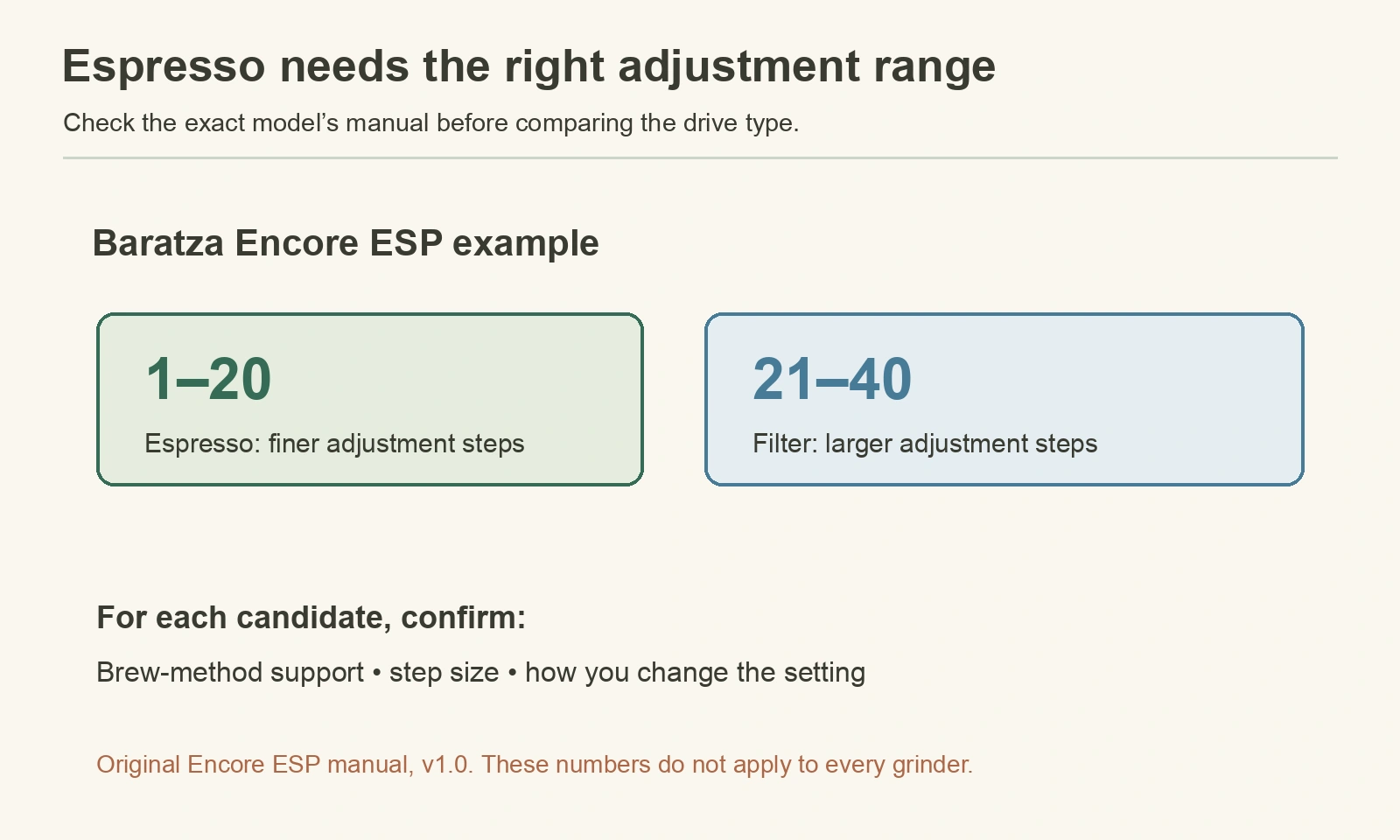
The original Baratza Encore ESP manual, January 2023 v1.0, gives a concrete example. Settings 1–20 use small changes for espresso; settings 21–40 make relatively larger changes for filter coffee. Those ranges belong to the original Encore ESP described in that manual. They are not settings to copy onto another electric grinder, the Encore ESP Pro or a hand grinder.
Hand grinders also differ in adjustment design. 1Zpresso’s FAQ describes internal, top and external adjustment systems across its models. Check where the dial sits, how you record a setting and how easily you can return to it. Avoid assuming that every hand grinder requires removing the grounds cup to adjust.
If you alternate between espresso and filter coffee, try that setting change during a demonstration. Follow the instructions for the candidate. For example, Baratza says the original Encore ESP must be running or completely empty of beans when you adjust it. Our Encore ESP espresso dial-in guide covers the next step for that model.
Lance Hedrick’s espresso comparison of hand and electric grinders is useful if you want to see several models discussed together. Treat the individual grinders as his comparison cases when making your own shortlist.

Capacity, travel needs and noise
Check your usual dose against the exact grinder’s published capacity. If the dose needs two fills, include refilling in your trial. For travel, check packed size, weight and power requirements; for a shared home, listen to the candidate while it grinds beans.

The 1Zpresso Q-Series manual lists a maximum capacity of around 20 g. Compare that with your normal coffee dose, rather than treating “one cup” as a fixed amount. If you routinely grind more than the stated capacity, decide whether an extra fill is acceptable or shortlist a larger grinder. Use the specification for the actual model; the Q-Series figure is not a capacity for every 1Zpresso grinder.
Williams’s experience illustrates why size changes the answer. His small Aergrind held roughly 25 g, so it needed refilling for a larger brew. He reported grinding up to 40 g in a larger Feldgrind. That larger hand grinder reduced the capacity problem without adding a motor. These are his reported examples, not capacity specifications for every revision of those grinders.
A manual grinder needs no electrical supply for its crank. Check whether the body, handle and grounds cup fit the bag you will carry. An electric candidate may use mains power or a battery, so confirm its own power and charging requirements. A portable electric model can be an option; “electric” does not automatically mean a large countertop machine.
Noise also deserves a trial. Hand grinding is audible, and electric grinders differ in their sound. Ask for a demonstration with beans rather than relying on an empty motor recording. If early-morning noise is the deciding issue, listen to the specific model in a comparable room. A general manual-vs-electric label cannot supply a reliable decibel figure.
The usual dose and brewer as a test before buying
Shortlist models that support your brew method, then try the task you will repeat at home. Record what changed compared with your current grinder: hand comfort, refilling, setting changes, collection and the coffee you brewed.

- Weigh the coffee dose you normally use. Check it against the grinder’s stated capacity.
- Load, grind and collect that dose using the model’s instructions. Note any awkward grip, refill or grounds transfer.
- Repeat for your largest regular batch. If you change brew methods, try changing the setting and returning to it.
- Brew with the same beans, water and recipe when comparing cups. Adjust each grinder for that recipe instead of copying a dial number between models.
If you want better taste, compare the resulting cups after dialing in both candidates. Williams explicitly did not make side-by-side taste tests in his manual-vs-electric account. His preference for using the Encore for two people is evidence about his experience of preparation, not proof that adding a motor improved the coffee.
Include maintenance and ownership costs before ordering. For the Q-Series, 1Zpresso says not to wash or soak the grinder and describes brush cleaning. Baratza requires unplugging the Encore ESP before cleaning and says not to wash its burrs with water. Follow the manual for each candidate; washable plastic parts do not make the burrs washable. Our manual grinder cleaning guide covers routine care.
Compare current local prices for the models that passed your trial, including shipping, warranty service and replacement parts. If your hand grinder remains comfortable and produces coffee you like, keeping it is a reasonable outcome. If repeated cranking is the problem, choose an electric burr grinder with the adjustment range you need. Before ordering, ask the seller to demonstrate your usual dose and the setting change you expect to make.

FAQ
Will an electric grinder automatically make better coffee?
Choose by the actual grinder and its suitability for your recipe. Electric drive supplies the rotation; it does not specify the burrs or espresso adjustment. Compare brewed cups after dialing in the candidates, and keep the beans, water and recipe steady.
Can a hand grinder be the right choice for espresso?
Yes, if the model supports espresso, has suitable adjustment and is comfortable with your usual beans and dose. Check the exact model’s documentation and try the grind. Being manual does not establish espresso capability, and having a motor does not establish it either.
Is a larger grinder useful if I only brew filter coffee?
It can be useful when your usual batch exceeds a small grinder’s capacity. The Q-Series manual lists around 20 g, while Williams reported using a larger Feldgrind for up to 40 g. Compare your dose with the specific model’s capacity and test any required refill.
References
- 1Zpresso Q-Series manual: operation, approximate capacity and cleaning
- 1Zpresso FAQ: adjustment systems and care
- Baratza Encore ESP manual v1.0, January 2023: grind ranges, adjustment and safety
- Brian Williams: his Aergrind, Feldgrind and Encore experience
- r/Coffee: an existing hand-grinder owner considering an electric grinder
Main photo: Nenad Stojković (Shixart1985), CC BY 2.0.