
For most home coffee, a burr grinder is the better long-term choice. Its adjustable burr gap gives you a setting you can return to, and it usually produces fewer extreme fines and large fragments than a blade grinder. That makes recipes easier to repeat and correct.
A blade grinder is cheaper and can still make a drinkable cup, especially for drip, French press or cold brew. It asks you to control grind time, batch size and pulsing by hand. Espresso exposes its limits fastest because shot flow often needs small, repeatable grind changes.
Burr vs blade grinder at a glance
| Buyer check | Burr grinder | Blade grinder |
|---|---|---|
| How it works | Coffee exits through a set gap between two burrs | A spinning blade repeatedly strikes coffee in a chamber |
| Grind adjustment | Repeatable stepped or stepless settings | Grind time and pulsing are the rough controls |
| Particle range | Narrower range, although never perfectly uniform | More fines and large fragments in the same batch |
| Best fit | Repeatable drip, pour-over, immersion and, with the right model, espresso | Temporary or budget use for forgiving brew methods |
| Cost and space | Usually higher and often larger | Usually lower and compact |
How blade and burr coffee grinders work
A blade grinder puts coffee in the same chamber as a fast-spinning metal blade. Every piece takes a different path. Some pieces are hit many times while others spend more time away from the blade. You stop when the batch looks close enough.
A burr grinder draws beans between two toothed surfaces. One burr moves while the other stays fixed in most designs. Changing the adjustment changes the space through which the coffee must pass. That gap gives you a repeatable way to move finer or coarser.

Burr shape is a separate decision. If you are comparing conical and flat burrs, start with brew range, adjustment and daily workflow instead of treating either shape as a guarantee of flavor.
What particle distribution changes in the cup
Coffee grounds always contain a range of particle sizes. A burr grinder does not make every particle identical. Its practical advantage is a narrower and more repeatable range, particularly when the burrs are aligned and the grinder is working within its intended range.

Water extracts smaller particles faster than large ones because more surface area is exposed. A batch with many fines and large fragments can pull the brew in different directions: the fines may add bitterness or dryness while the largest pieces contribute weak or sour flavors. Roast, water, ratio and brewing technique still matter, so grinder type alone cannot predict whether you will prefer a cup.
When a blade grinder is good enough
A blade grinder can be a reasonable stopgap for drip coffee, French press or cold brew when the budget is tight. Those methods usually tolerate a wider grind range than a non-pressurized espresso basket. You can also use a blade grinder to learn whether grinding immediately before brewing matters in your own routine.
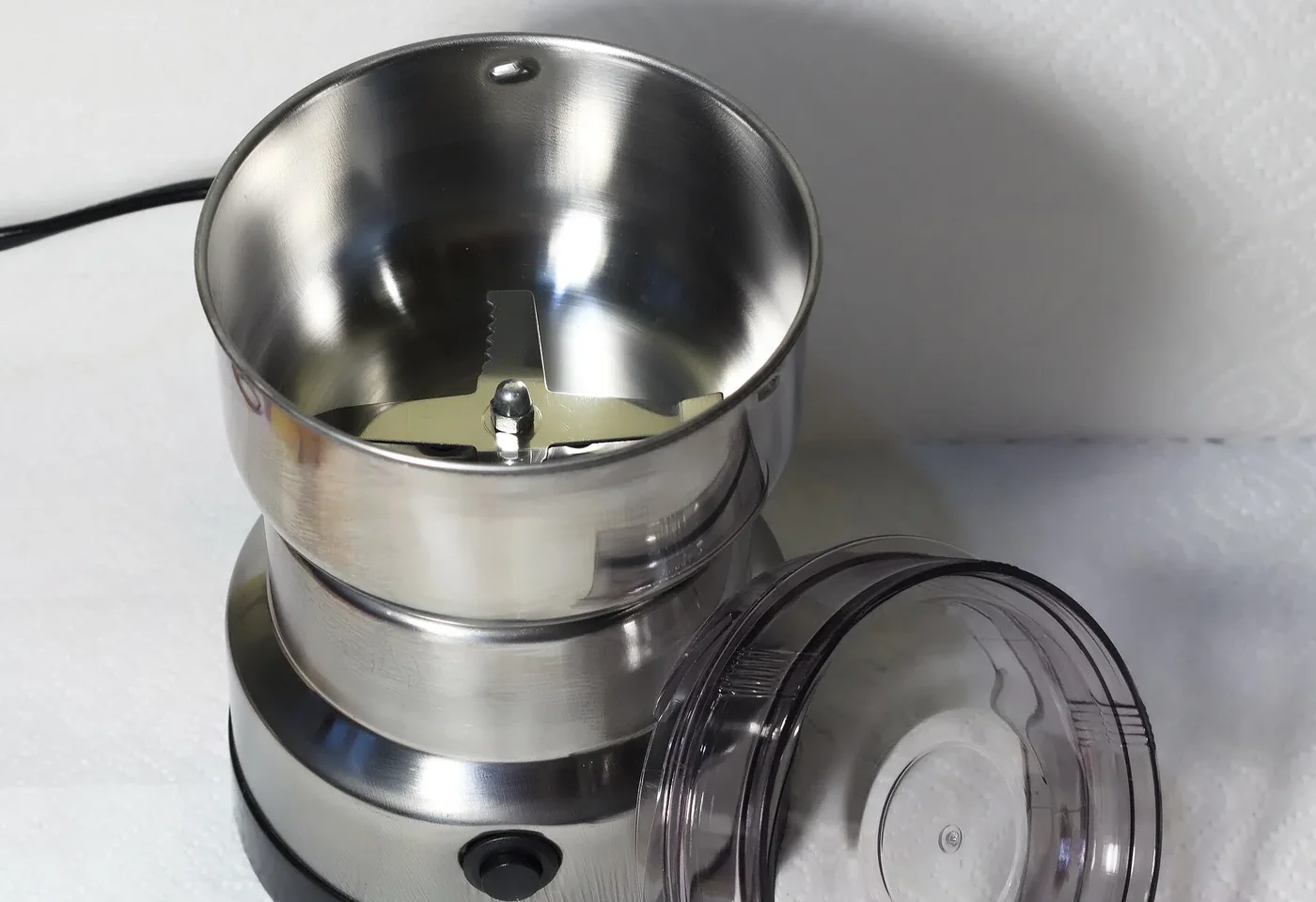
Keep it if you enjoy the coffee and can repeat your recipe. Upgrade when you are adjusting several other variables to compensate for the grind, when drawdown changes from brew to brew, or when you want to dial in espresso. A grinder earns its place by fixing a problem you can taste or measure.
How to get better results from a blade grinder
Give the blade grinder a repeatable routine. Weigh the same dose, use the same number and length of pulses, and redistribute the beans with the lid closed so larger pieces return toward the blade. Stop before the batch becomes dominated by powder.

- Use a small, fixed batch. Do not fill the chamber differently every morning.
- Pulse instead of running continuously. Short bursts give you time to redistribute the coffee.
- Tilt or shake with the lid secured. Stop the motor before checking the grounds.
- Inspect the extremes. Stop when the largest pieces are acceptable, before too much powder builds up.
- Keep one grind time for a full week. Adjust the brew recipe only after you know the grinder routine is stable.

A repeatable routine tells you whether the grinder is the real limit.
The brew method decides the grinder
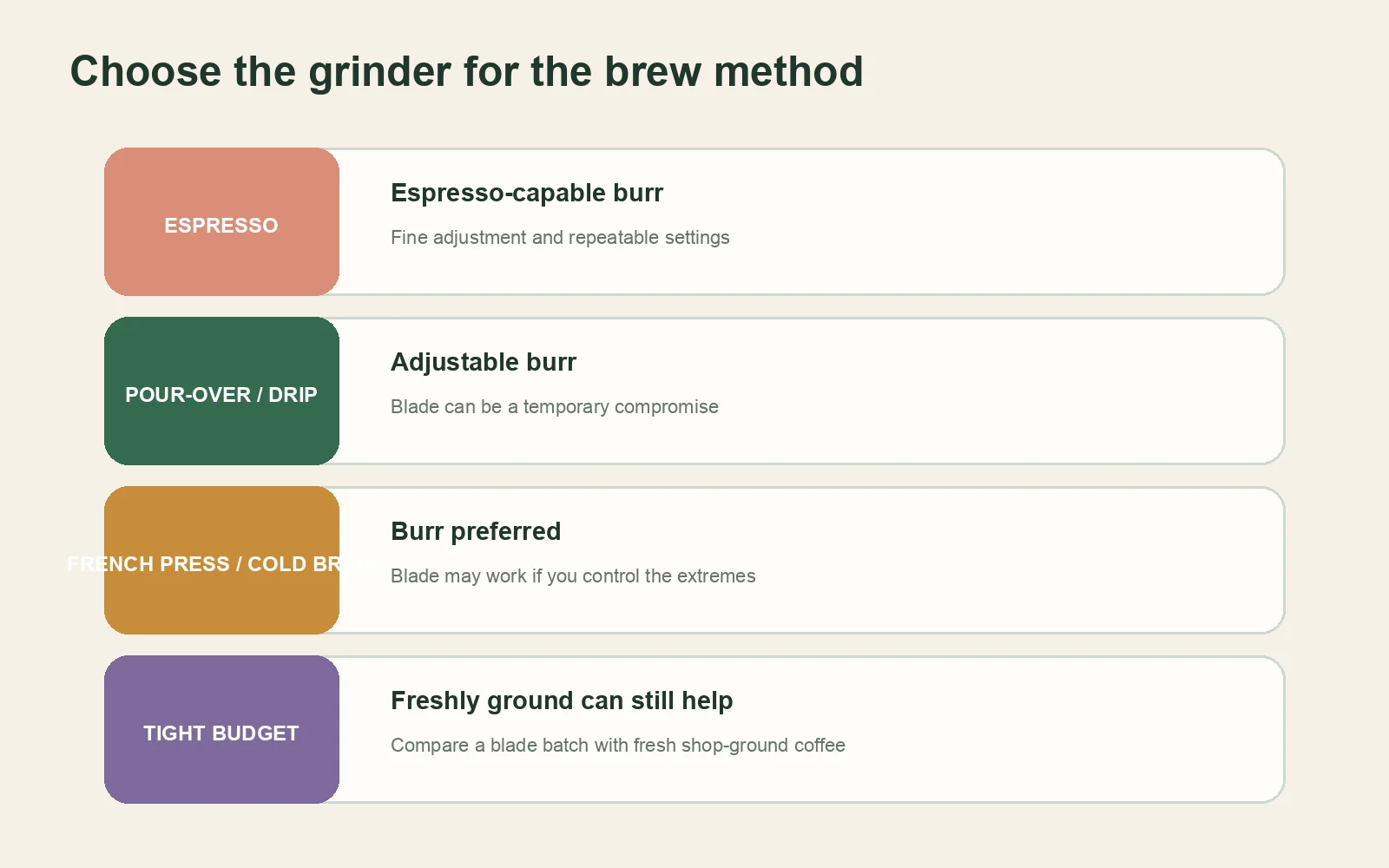
Espresso: use an espresso-capable burr grinder for a non-pressurized basket. Small grind changes alter resistance and shot flow, and many general-purpose burr grinders still lack enough adjustment in the espresso range. A pressurized basket is more forgiving, but a blade grinder still offers no setting you can return to. If a shot runs fast or slow, change grind before dose when the basket is filled appropriately.
Pour-over and automatic drip: an adjustable burr grinder makes drawdown and flavor corrections easier to repeat. A blade grinder can work as a temporary option if you keep dose and grind time fixed. The brewer still matters; compare the routines in our pour-over versus automatic drip guide.
French press and cold brew: a burr grinder is still easier to control, but these immersion methods are the most forgiving place to use a blade grinder. Pour gently and avoid disturbing settled fines. If the cup feels muddy, our French press sediment guide separates normal silt from a grinder or screen problem.
What to look for in your first burr grinder
Start with the brew range. A filter-focused grinder can be excellent for drip and pour-over yet frustrating for espresso. An espresso grinder should offer fine control near your usual setting. A grinder marketed for every method still needs enough usable steps, or a practical stepless adjustment, where you brew.


Then check adjustment, capacity, noise, cleaning access and service support. A manual burr grinder can put more of the budget into the burr set, but hand grinding a large batch takes time. An electric grinder is faster and easier for several cups. Before buying, confirm whether replacement parts and burrs are available. Once you own one, clean it without wetting parts the manufacturer says must stay dry; see our manual grinder cleaning guide.
A fair test before upgrading
Do not compare a new bag in one grinder with old coffee in the other. Use the same coffee, water, dose, brewer and ratio. Set the burr grinder for a balanced baseline. For the blade grinder, weigh the same batch and use one recorded pulse routine.
| Test step | Keep fixed | Record |
|---|---|---|
| Prepare three brews from each grinder | Coffee, dose, water, ratio and brewer | Grinder setting or total blade grind time |
| Taste at a similar temperature | Cup type and tasting order | Sweetness, acidity, bitterness, dryness, body and clarity |
| Check repeatability | Your brewing steps | Brew time or drawdown for each repetition |
| Make the decision | Your real morning routine | Which grinder gave the better average cup with less correction |
Taste blind if another person can label the cups. One excellent cup does not prove consistency. The upgrade becomes useful when the burr grinder improves the average result or makes a good result easier to repeat.
Frequently asked questions
Are burr coffee grinders always better?
Burr coffee grinders are better for repeatable grind adjustment and usually produce a narrower particle range than blade grinders. Grinder quality still varies. A filter-focused burr grinder may not adjust finely enough for espresso, and a poorly maintained burr grinder can perform below its design. Choose by brew range, adjustment and workflow.
Is a blade grinder okay for espresso?
A blade grinder is a poor match for non-pressurized espresso because it cannot make small, repeatable grind changes. A pressurized basket can tolerate a wider grind range, so it may produce a usable drink, but shot-to-shot control remains limited. An espresso-capable burr grinder is the practical upgrade.
Can a blade grinder make good coffee?
A blade grinder can make enjoyable drip, French press or cold brew when the dose and pulse routine stay consistent. Expect more fines and large pieces than a burr grinder. If the cup is already good and repeatable, keep using it. Upgrade when grind variation causes a problem you can taste or measure.
Should I buy a manual or electric burr grinder?
A manual burr grinder suits one or two cups, travel and a limited budget if hand grinding is acceptable. An electric burr grinder is faster for larger doses and frequent brewing. Check the usable grind range first. Motor type does not tell you whether the grinder has enough control for espresso.
References
- Serious Eats: blade and burr grinder mechanisms, particle range and brew-method limits
- Moccamaster USA: manufacturer comparison of burr and blade grinders
- James Hoffmann: Coffee Hack, The Best Blade Grinder Results
- r/Coffee: reader experiences and disagreement around blind burr-versus-blade comparisons

Choose the adjustment range your daily brew actually needs.