
For normal espresso dial-in, keep the dose fixed and change the grind first. Dose should match the basket and stay repeatable; grind controls how quickly water moves through the puck without changing the dose.

Why should dose usually stay fixed while dialing in?
Because dose defines how much dry coffee is in the basket and is part of your brew ratio. If you change dose every time you change grind, you are changing two variables at once.
La Marzocco’s dial-in guidance starts by locking a dose that closely matches the basket size, then fine-tunes the grind to control flow and shot time. Breville’s grinder documentation gives the same practical direction: establish the correct dose height and tamp, then adjust grind size for the desired espresso flow.
Which variable should move first?
The shot runs too fast and tastes thin or sour, or runs too slowly and tastes bitter or dry.
The puck hits the shower screen, the basket is obviously under-filled, or the chosen dose does not suit the basket.
What does changing the grind actually change?
Grind size changes the resistance of the coffee bed. Finer particles generally slow flow; coarser particles generally let water move through more easily.
Follow your grinder’s instructions when adjusting finer or coarser, including whether the burrs should be running. If the grinder retains grounds, account for coffee left from the previous setting before judging the next shot. The retention guide explains why the first dose after an adjustment may not represent the new setting.

What does changing the dose change besides shot speed?
Dose affects more than resistance. It changes puck depth, headspace and—if you keep the same beverage yield—the brew ratio.
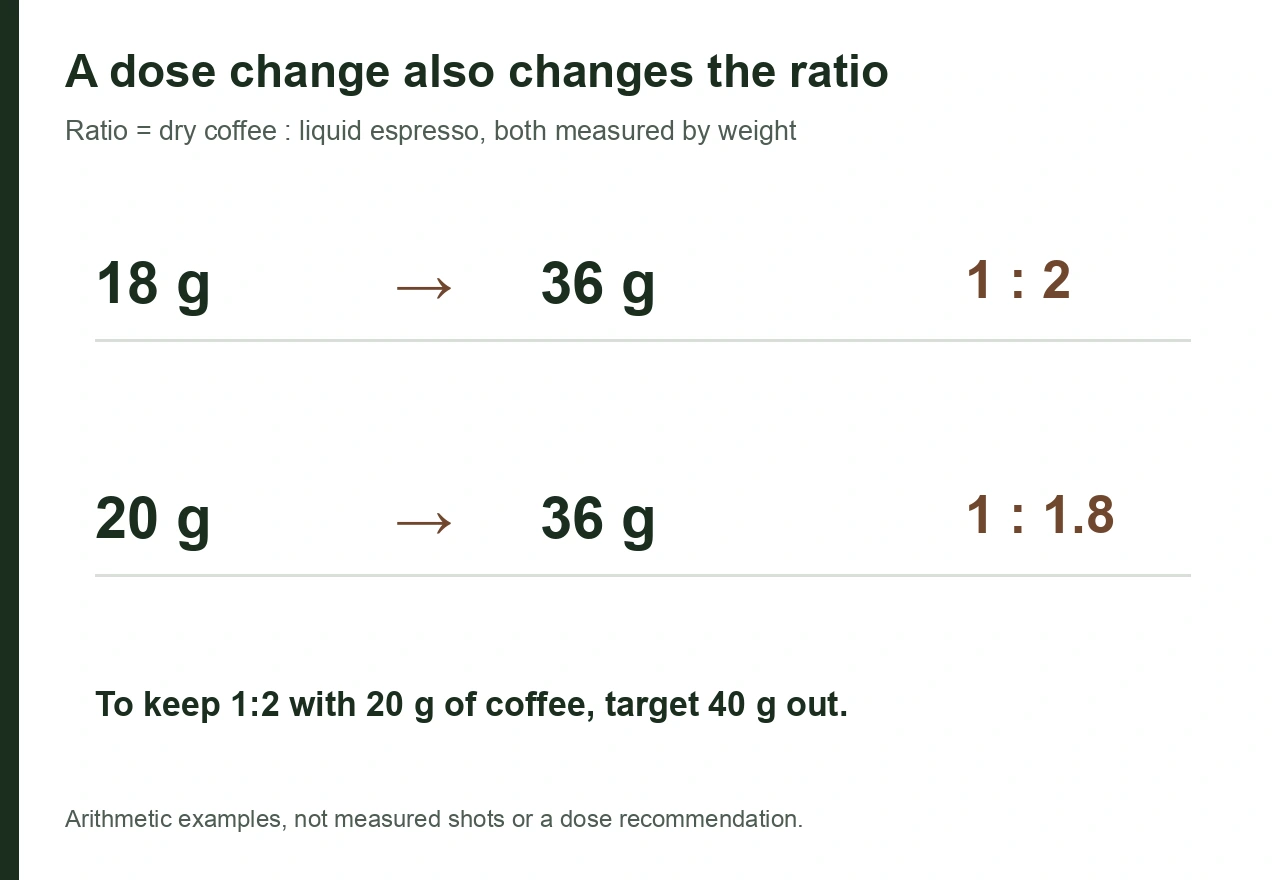
For example, 18 g in and 36 g out is 1:2. If you increase the dose to 20 g but still stop at 36 g, the ratio is now 1:1.8. To keep a 1:2 ratio with 20 g in, the target would be 40 g out. These are arithmetic examples; they do not mean every basket should hold 20 g.
| Change | What else changes | What to check |
|---|---|---|
| 18 g → 19 g dose, same 36 g yield | Brew ratio becomes shorter | Strength, body and extraction balance can shift |
| More coffee in same basket | Puck becomes deeper and headspace smaller | May increase screen contact or disturb the puck |
| Less coffee in same basket | Puck becomes thinner and headspace larger | May change puck stability and flow behavior |
| Change dose and grind together | Two variables move | You lose a clean comparison between shots |
When should you change dose before grind?
Change dose when the dose does not fit the basket or leaves the wrong headspace. Do not force a portafilter to lock into the group.
- The dry puck leaves a clear shower-screen or screw imprint before brewing.
- The portafilter is difficult to lock because the puck is overfilled.
- The basket is obviously designed for a different dose range.
- The puck is so shallow that the chosen dose is a poor match for the basket.
- You are intentionally building a different espresso recipe with a different dose.
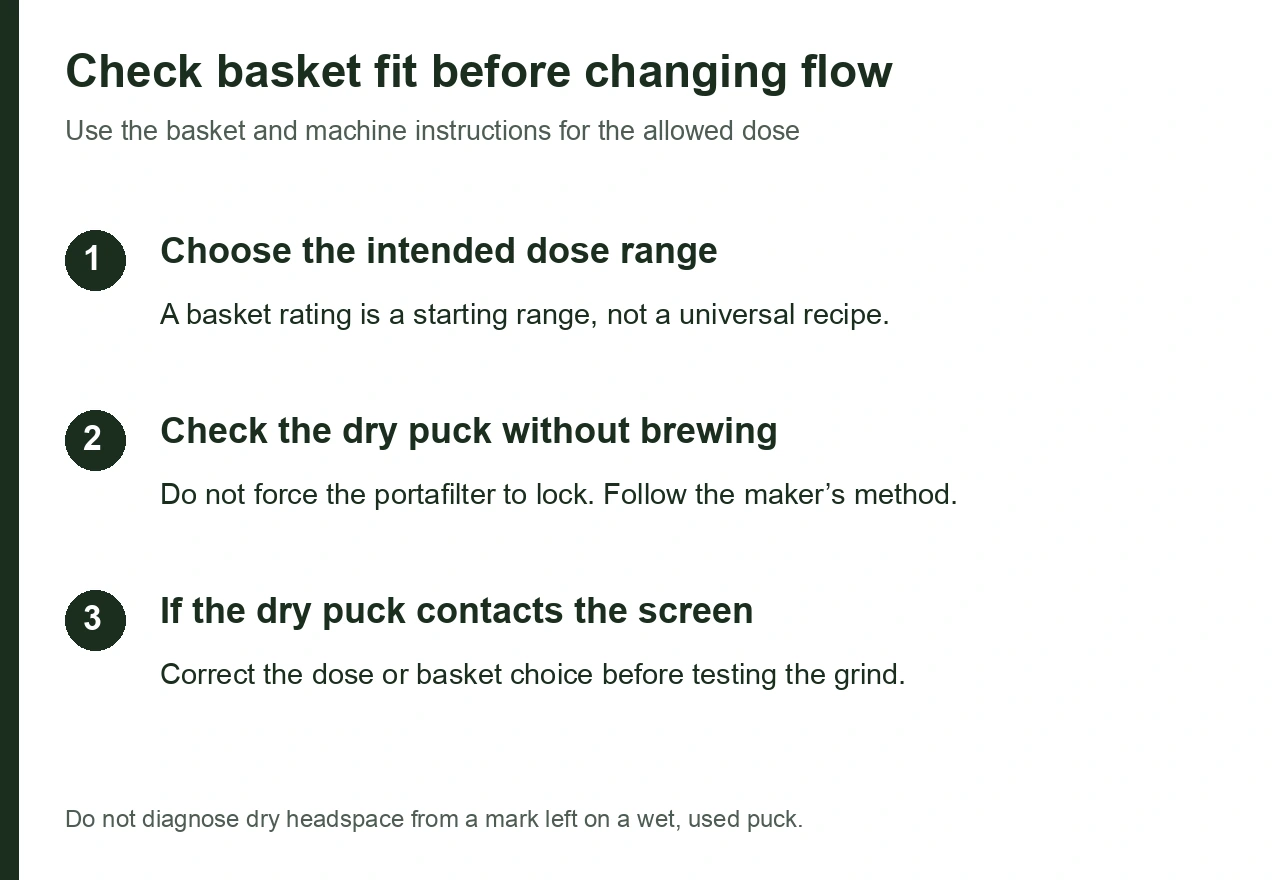
Breville’s BCG600 US/Canada manual describes a Razor-tool method for checking dose height on non-Breville machines: insert and remove the prepared portafilter without extracting, then adjust the dose height in small steps. Its clearance instruction belongs to that method; do not apply it as a universal measurement. Follow the basket and machine maker’s instructions, keep the accepted dose height consistent, and then use grind to adjust flow.
What if your grinder step is too large?
A stepped grinder can sometimes put one setting slightly too fast and the next setting slightly too slow. A small dose adjustment can bridge that gap, provided it stays within the basket’s usable range. Dose changes puck depth and changes the ratio unless you also choose a new target yield to preserve it. Mark Prince describes this stepped-grinder exception in CoffeeGeek’s dial-in guide.
Before using dose as a micro-adjustment, make sure your grinder is purged of the previous setting, the puck prep is repeatable and the basket can safely handle the new dose.
Should you change dose to fix a sour shot?
Usually not first. If the dose fits the basket and the shot runs fast while tasting thin or sour, keep dose and target yield fixed and test a finer grind. If the time already looks reasonable, check even preparation; a slightly longer yield may be a better next test. If repeated finer settings make the result erratic or both sour and harsh, stop chasing fineness and check channeling. Shot time alone does not tell you whether the coffee is well extracted.
Use Why Does Espresso Taste Sour Even When Shot Time Looks Right? for that branch of the diagnosis.

Should you change dose to fix a bitter shot?
Again, not automatically. A bitter, dry shot may be running too slowly, using too long a ratio or extracting unevenly. Try the simplest variable that matches the evidence rather than adding or removing coffee at random.
If the shot is slow with a basket-appropriate dose, grind slightly coarser. If the ratio is long, test a shorter yield. If the cup is both sour and harsh, check channeling and puck prep.
What is the cleanest dial-in loop?
One-variable-at-a-time dial-in
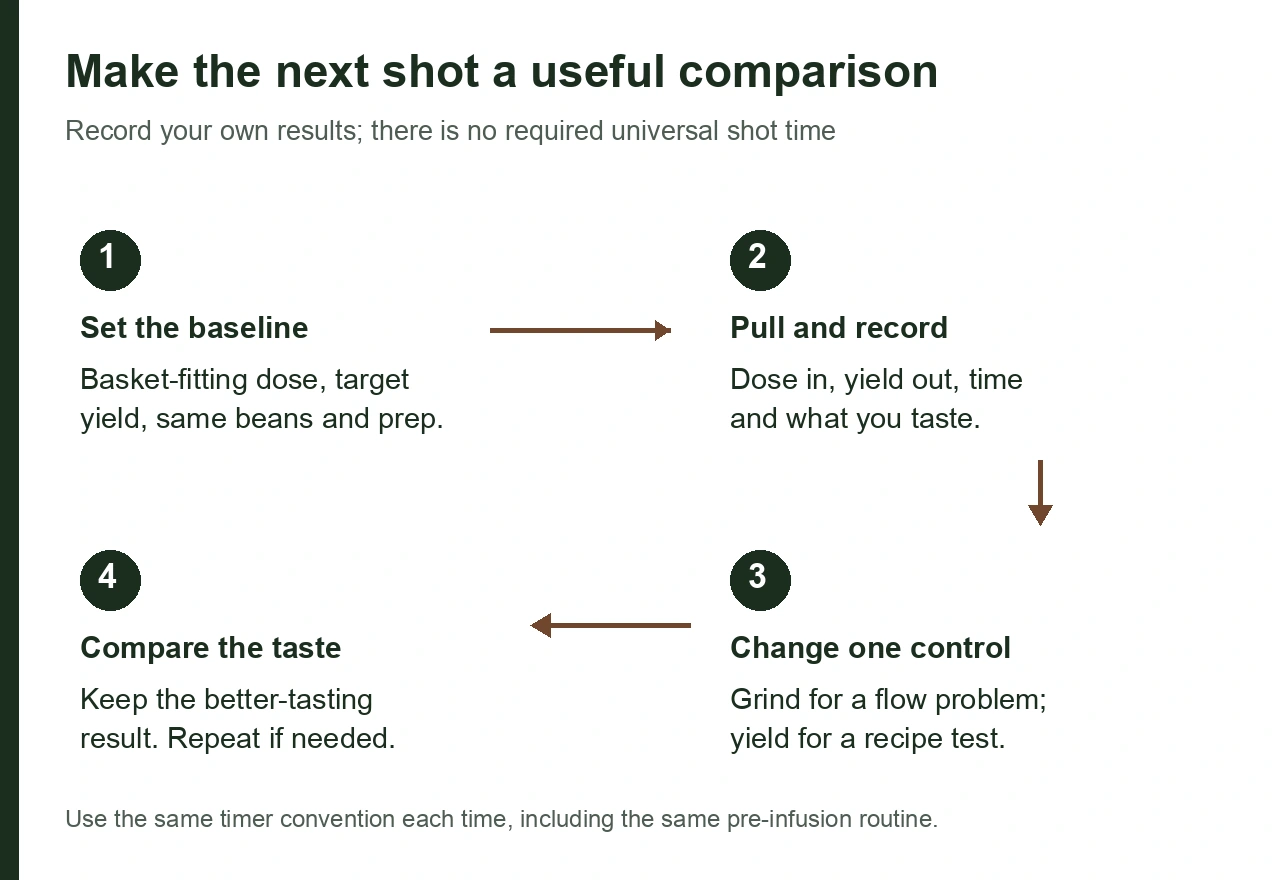
Use a scale that can measure your dose and espresso yield, and record dry coffee in, espresso out, time and taste for each trial. Start the timer the same way for every shot and keep any pre-infusion routine unchanged.
Choose a starting ratio using the 1:2 brew-ratio guide. Make one small grind adjustment for the next shot and stop at the same target weight. Compare the taste, keep the better result, then decide whether another change is needed.
Can changing dose fix bad headspace?
Yes, when the dose leaves the wrong headspace. But first confirm that the basket itself is appropriate for the dose you want to use. If you routinely need to force a dose far outside the basket’s intended range, a basket designed for that dose may be a better fit.
The espresso puck headspace guide covers dry-puck checks. For exact clearances, use your machine and basket instructions; diameter alone does not determine a suitable dose.
FAQ
If espresso runs too fast, should I add more coffee?
Not first if the existing dose fits the basket. Keep dose and yield fixed and grind finer.
If espresso runs too slow, should I lower the dose?
Not first if dose and headspace are already correct. Grind coarser. Lower dose only when the puck geometry or recipe calls for it.
Does adding 1 g of coffee make a big difference?
It can. One gram changes puck depth and also changes the brew ratio if the target yield stays the same. One gram is a larger proportion of a small dose than of a large dose.
Should dose match the basket rating?
Use the basket rating or manufacturer guidance as the starting range. Coffee density, roast and basket design can shift the practical dose slightly, but the basket is a better anchor than an arbitrary internet recipe.
What should I change after dose and grind are stable?
Use taste to decide whether yield, temperature or puck prep deserves the next test. Do not change all of them together.
References
- La Marzocco — Dialling-In with Coffee Station
- La Marzocco Home — Dialing in a Modern Espresso
- La Marzocco Home — Dialing in a Traditional Espresso
- CoffeeGeek / Mark Prince: Dialing in Espresso in Three Shots
- Breville BCG600 manual — dose height, headspace and grind adjustment guidance
Cover photograph: studio tdes, CC BY 2.0.