

2-minute conversation
Choose a conical or flat burr grinder by the coffee it can make, the adjustments it offers and the routine you can live with. Neither burr shape is an automatic upgrade. For espresso, confirm that the exact grinder supports espresso and offers useful fine adjustments. For filter coffee, compare its intended brew range and the cup you prefer.
A flat-burr grinder built for pour-over can be the wrong purchase for an espresso machine. Two conical grinders can also differ substantially in how easily they dial in a shot. Start with your brewing method before choosing a side in the burr debate. If you are replacing a blade grinder, start with the burr vs blade grinder comparison.
What is the difference between conical and flat burrs?
A conical set uses an inner cone and an outer ring. A flat set uses two facing circular burrs. Their cutting surfaces break the beans into grounds; the adjustment mechanism changes the working gap. Baratza’s burr guide illustrates both arrangements.
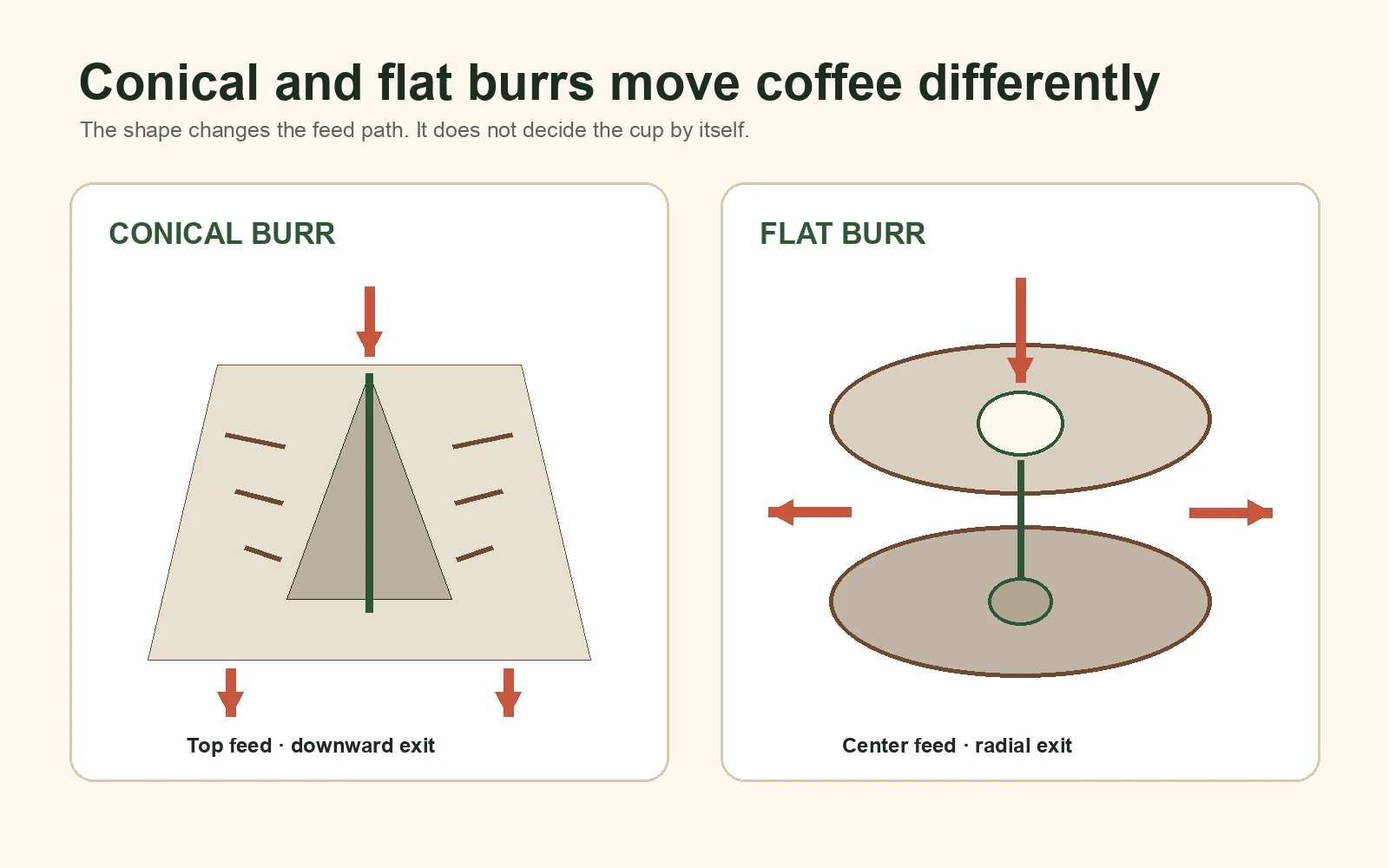
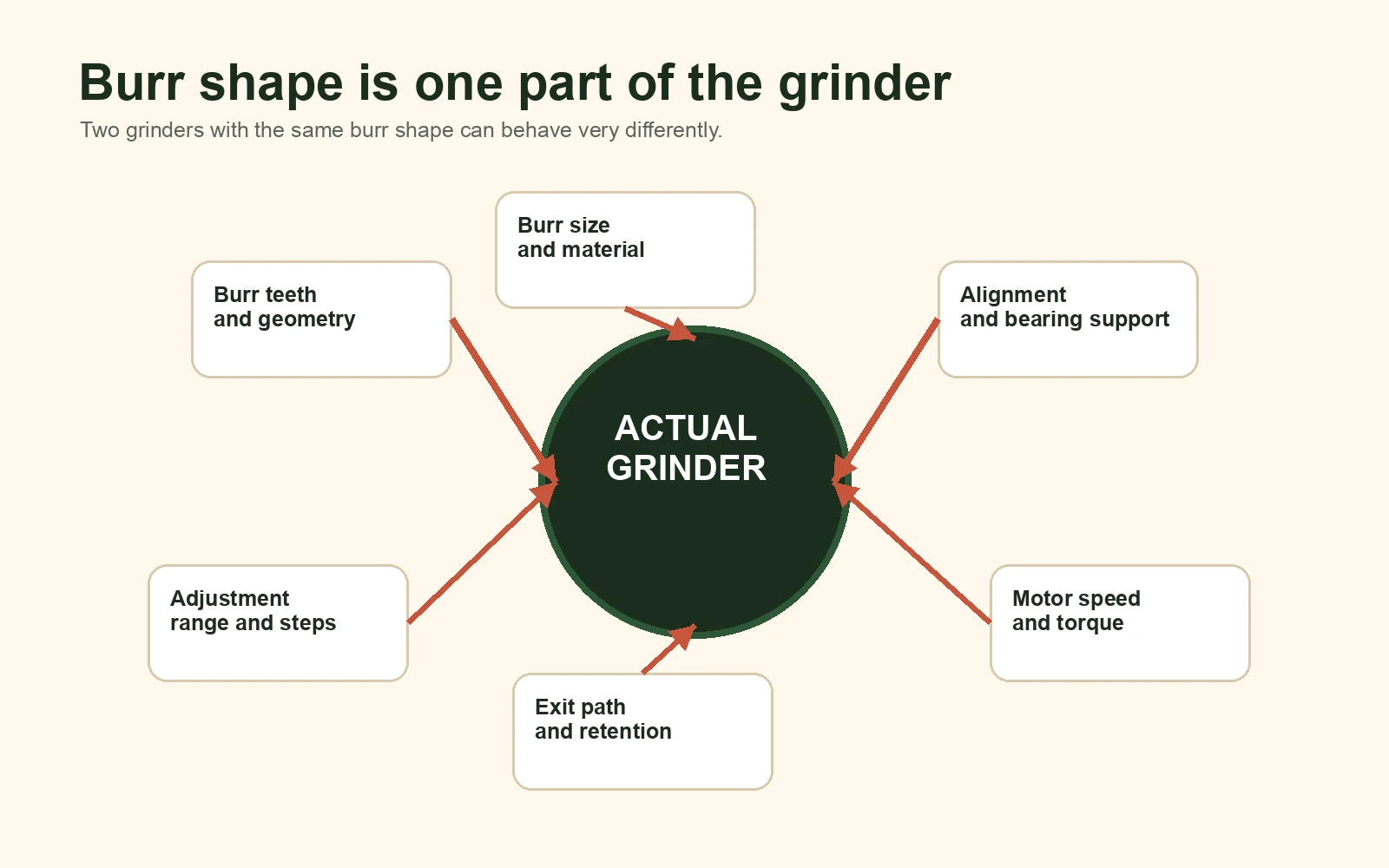
The words conical and flat describe that arrangement. They do not tell you the complete cutting pattern, adjustment system or intended brewing range. Ask for the exact grinder and burr version when comparing two machines.
Do not expect perfectly identical particles from either shape. Baratza’s guidance on grinding myths explains that a spread of particle sizes is normal. A claim that every flat burr produces identical grounds is not a useful buying criterion.
Sunergos Coffee’s Coffee Burr Grinder Overview offers a hardware introduction. Use current manufacturer documentation, rather than this older overview, to check a model you are buying today.
Does flat mean clarity and conical mean body?
Treat those descriptions as leads for tasting, not promises. Baratza describes its flat steel burrs in terms of clarity, yet describes its flat ceramic burrs as producing a rounded, syrupy texture. Those are the manufacturer’s descriptions of particular burrs, not an independent taste ranking. They also show why “flat” alone cannot specify the cup.
When a review says a grinder tastes clearer, look for the missing context: the exact burr set, coffee, roast, brew method and comparison grinder. A filter-coffee result is not automatically an espresso result. A preference for one particular conical grinder does not establish a rule for every conical design.

| Claim you hear | Better question |
|---|---|
| Flat burrs always taste cleaner | Which burr set, coffee and recipe were compared? |
| Conical burrs are always better for dark roasts | Did the reviewer test the sort of coffee and drink you make? |
| Larger burrs guarantee better coffee | What repeatable improvement did that complete grinder deliver? |
| One shape needs no dialing in | Can the grinder make the adjustment your next cup needs? |
Write down the result you want before shopping: less harshness, more distinct flavors, a texture you prefer, or fewer wasted shots. “Buy flat burrs” is a product feature, not a description of the problem you need solved.
Espresso, filter coffee or both
Check the manufacturer’s intended use before the burr dimensions. Fellow’s Ode Gen 2 documentation says its 64 mm flat burrs and motor are geared toward brewed coffee and that Ode is not suitable for espresso. A flat burr label therefore does not establish espresso capability.
Adjustment is a separate check. A stepped grinder has defined positions; a stepless grinder allows adjustment between fixed clicks. Neither term alone tells you whether switching methods will be easy. In its adjustment guide, Baratza distinguishes the original Encore from the Encore ESP: both are conical, but the ESP provides finer changes in its espresso range.
| Your routine | Check first | A useful demonstration |
|---|---|---|
| Espresso every morning | Documented espresso use and fine adjustment | Make a small grind change without changing the dose |
| Pour-over or batch brew | Documented filter range and cup preference | Brew your usual coffee at your usual batch size |
| Espresso and filter on one grinder | Both ranges, readable settings and a practical switching routine | Switch to filter, then return to the espresso setting |

Choose the brew range before the burr shape.
For a second-hand grinder, verify the installed burrs as well as the model name. A replacement set or conversion can change the comparison. Request the actual part number and the maker’s compatibility information; do not assume equal diameter means interchangeable.
Retention and daily handling across the whole grinder
Ask how the grinder behaves during your routine: loading beans, grinding, collecting the dose, changing settings and cleaning afterward. A quiet showroom demonstration does not tell you whether the grinder will be pleasant beside your kitchen wall at breakfast. Listen to the exact model and check its physical fit.
For single dosing, weighing beans in and grounds out is a useful routine check. Repeat it rather than judging one dose. Similar weights do not prove that no older coffee was exchanged with the new dose; see the grinder retention guide for that distinction. Do not assign a retention number from burr shape alone.
If you regularly switch beans, ask for the manufacturer’s purge and adjustment procedure. If you keep one coffee in a hopper, judge that workflow instead of automatically adopting a single-dose routine you do not need.
Read the cleaning instructions before buying. Check which parts the owner can remove, whether the calibration changes afterward and whether replacements are available in your region. Unplug an electric grinder before owner-permitted internal cleaning. Do not transfer water, cleaning tablets or disassembly instructions from an unrelated machine. Hand-grinder owners can start with the model-bounded manual grinder cleaning guide. For dark-roast coffee, check how oily beans affect grinder maintenance.
Comparing two grinders before an upgrade
This is a practical preference test, not a way to isolate burr geometry in a laboratory. Two grinders differ in more than their burr shape. The result helps you choose between those complete machines. Use the side-by-side coffee tasting method to label the cups and record the differences you notice.

- Use the same coffee and water. Keep the brewer, filter or basket, dose and beverage target consistent. Compare the kind of drink you normally make.
- Dial in each grinder separately. The same number on two adjustment dials is not the same grind. Follow each maker’s adjustment procedure and give each machine a fair chance to make a balanced cup.
- Record the routine as well as the result. Note the setting, dose, beverage weight and any purge. Include time spent switching or cleaning. The espresso dial-in log guide explains which observations are useful.
- Taste at similar drinking temperatures. Compare sweetness, unpleasant bitterness, clarity, texture and finish separately. Ask someone to label the cups A and B without revealing the grinder when practical.
- Repeat before deciding. Reverse the brewing order on another round. A small preference that disappears is a weaker reason to upgrade than a repeatable improvement you notice every day.

Dial in both grinders before choosing your favorite cup.
Keep your present grinder when it already makes coffee you enjoy and supports your routine. Upgrade when you can name the limitation and verify that the replacement addresses it. Borrowing a grinder or tasting a properly prepared demonstration is more informative than choosing a shape from a feature list.
Quick questions
Are flat burrs better for espresso?
Not universally. Espresso-capable grinders exist with either shape. Check the exact model’s intended range, adjustment and workflow; a filter-focused flat-burr grinder can be unsuitable.
Will a different burr shape fix inconsistent shots?
Do not assume it will. Record dose, beverage weight and preparation first. Baratza also notes that coffee aging and changes in the beans can require adjustment. A different grinder cannot remove every variable in the brewing routine.
Can I swap conical burrs for flat burrs?
Do not treat them as interchangeable replacement parts. Use only a conversion or replacement explicitly supported for the exact grinder. A diameter specification is not a compatibility check.