
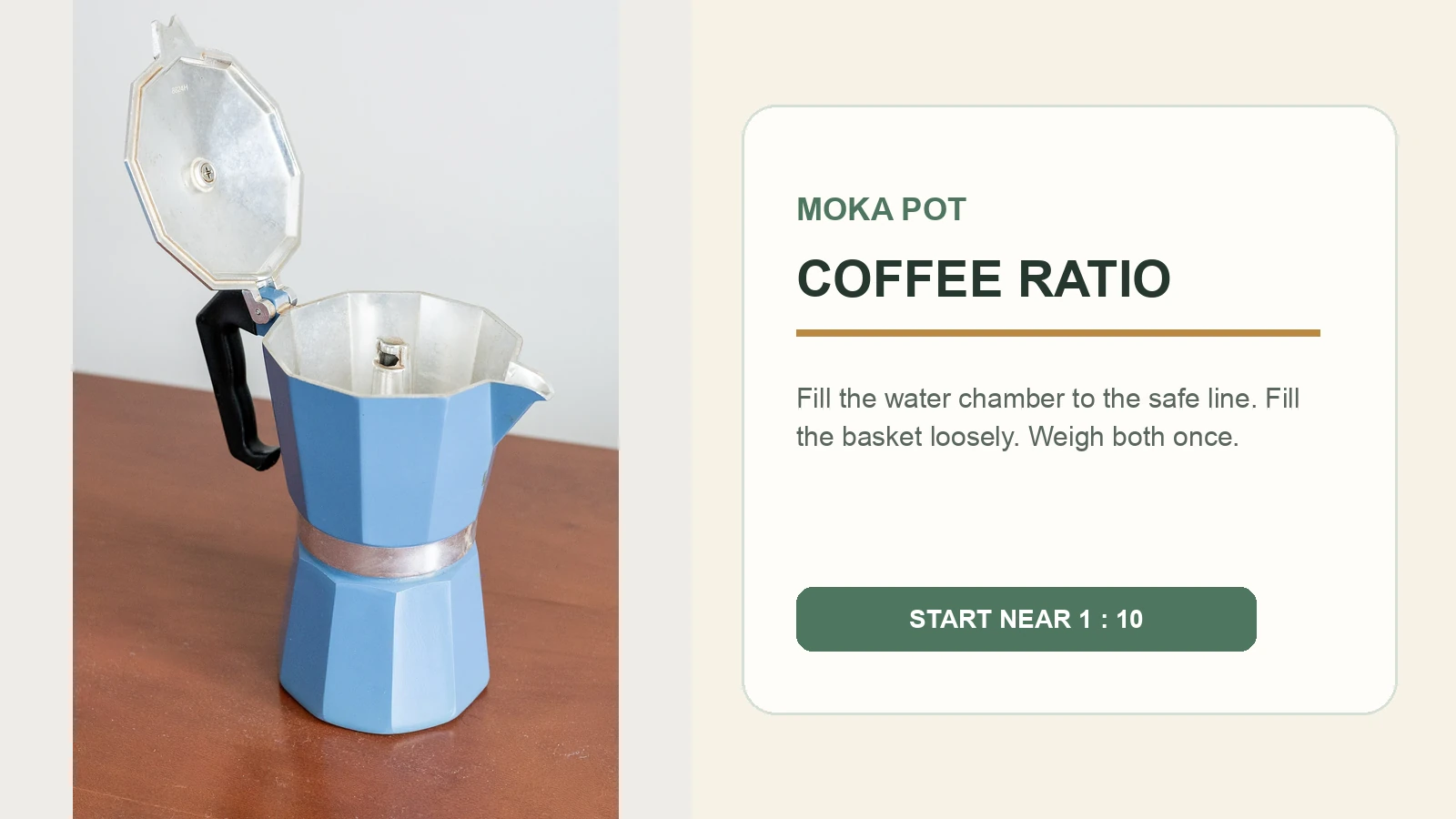
A useful moka pot coffee ratio is about 1:10 by mass: one gram of coffee for every 10 grams of water placed in the lower chamber. A 300 g water fill, for example, pairs with roughly 27–30 g of coffee. Treat that number as a starting note, not a reason to overfill either chamber.
Your moka pot sets the working dose. Fill water only to the level allowed by its manual, then fill and level the basket without tamping. Because basket shape and stated “cup” size vary, weighing your own pot once gives you a more repeatable recipe than copying a universal chart.
The short answer: how much coffee and water to use
| Starting point | Coffee | Water in lower chamber | Use it this way |
|---|---|---|---|
| Small measured batch | 15 g | 150 g | Only if 150 g stays at or below your model’s safe fill line |
| Medium measured batch | 20 g | 200 g | Only if the loose, level basket naturally holds about 20 g |
| Common 6-cup example | 27–30 g | 300 g | Steampunk Coffee’s starting recipe for a 6-cup brewer |

The ratio uses input water, not the amount of brewed coffee collected in the upper chamber. Some water remains below after brewing, and the coffee bed retains water. A pot filled with 300 g of water will not deliver a 300 g drink.
Published recipes also differ for the same nominal size. Stumptown uses about 15–17 g for a 4-cup Bialetti, while Steampunk Coffee uses 18–20 g with 200 g water. The gap is a good reason to record the basket dose that fits your pot and coffee instead of treating one number as universal.
Moka pot size chart
Bialetti’s Moka Express manual lists the following lower-chamber capacities and nominal outputs. These numbers apply to the Moka Express model covered by that manual. Other moka pots can use different chamber shapes, baskets and stated capacities.
| Moka Express size | Lower chamber | Nominal output |
|---|---|---|
| 1 cup | 63 ml | 60 ml |
| 2 cup | 103 ml | 90 ml |
| 3 cup | 150 ml | 130 ml |
| 4 cup | 220 ml | 190 ml |
| 6 cup | 300 ml | 270 ml |
| 9 cup | 460 ml | 420 ml |
| 12 cup | 670 ml | 600 ml |
| 18 cup | 885 ml | 800 ml |
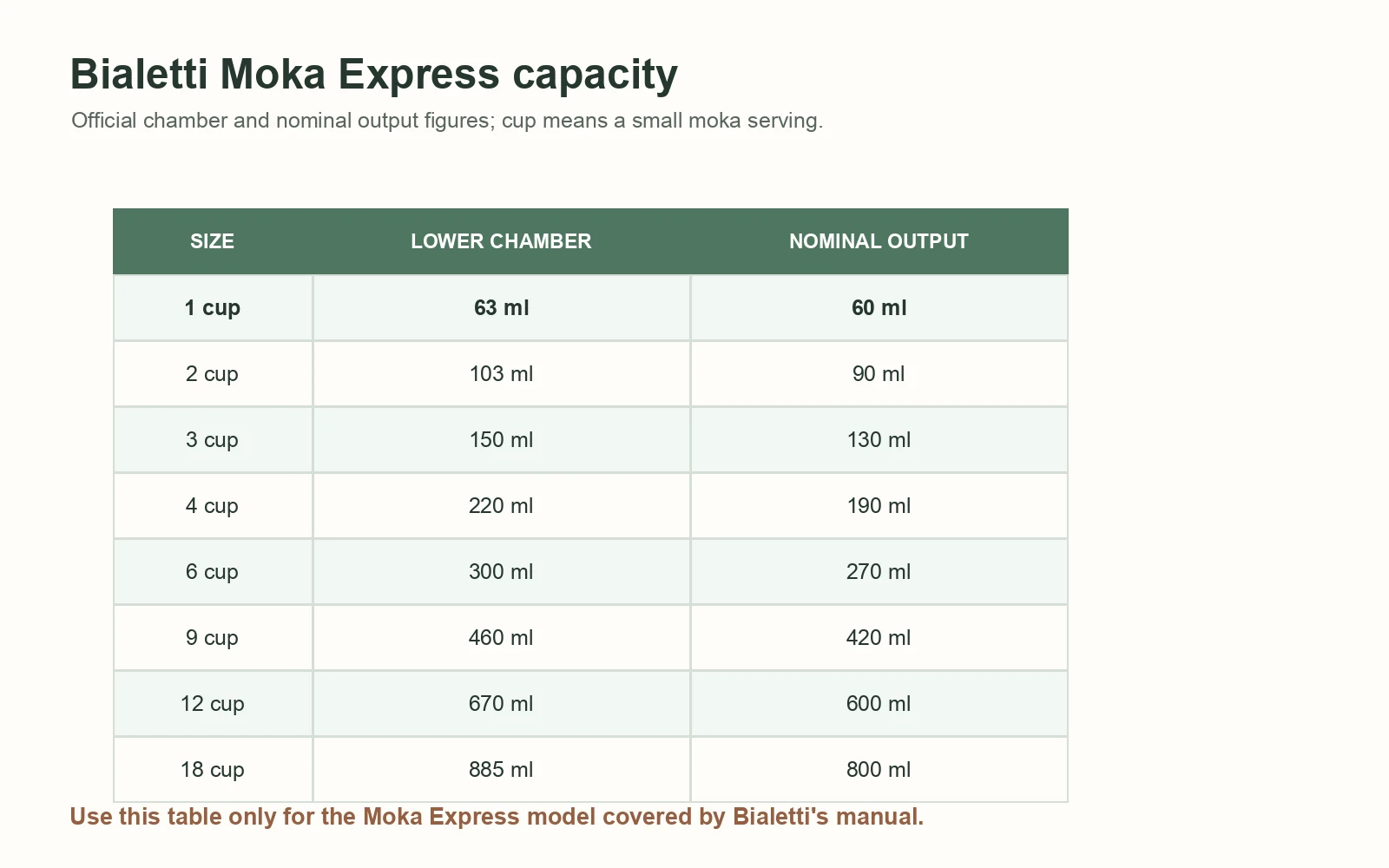
The 3-cup Moka Express has a 150 ml lower chamber and a nominal 130 ml output. The 6-cup version has a 300 ml lower chamber and a nominal 270 ml output. Those figures tell you the scale of the brewer; they do not replace the safe fill line or give a universal coffee dose in grams.
Measuring your own moka pot
Use a scale for one baseline brew. The two measurements take less time than trying to identify the correct dose from photographs or store listings.
- Set the empty lower chamber on the scale and tare it.
- Add water to the level specified by your manual. Record the water weight.
- Dry the basket, set it on the scale and tare it.
- Fill it loosely with moka-appropriate ground coffee. Level the top without pressing and record the coffee weight.
- Divide the water weight by the coffee weight. A result near 10 means the brew is near a 1:10 coffee-to-water ratio.
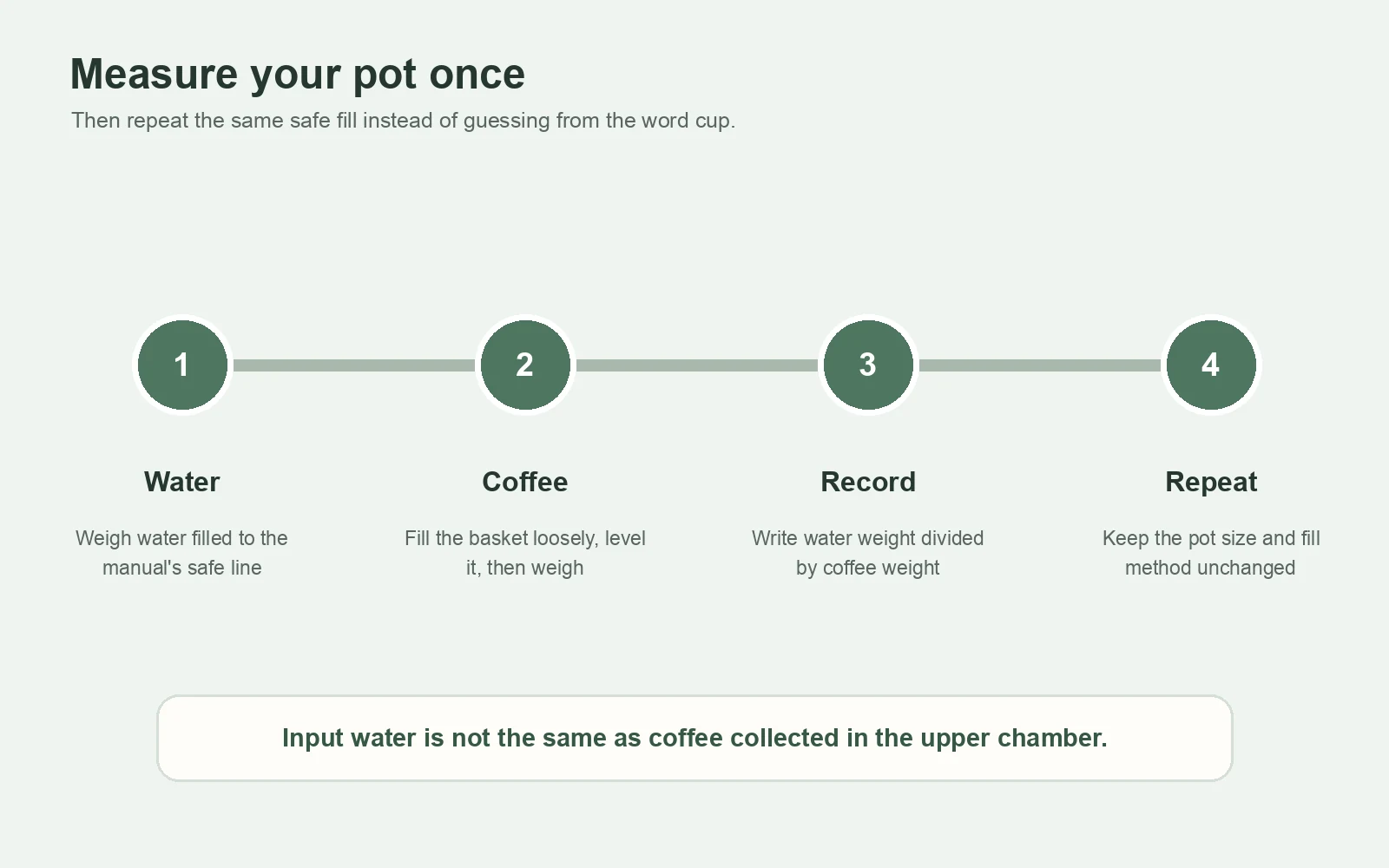
Write down the pot size, water weight, coffee weight, grind setting and result. Coffee density changes with roast and grind, so the gram weight of a level basket can move slightly when you change beans. Reweigh after a major coffee or grind change.
If you are comparing brewing ratios, the French press coffee ratio guide explains why input ratio and beverage yield are different measurements across brewing methods.
Filling the water chamber safely
For the Moka Express, Bialetti instructs the user to add cold water up to the lower edge of the safety valve. Do not cover the valve. If your pot uses a different mark or design, follow the manual supplied with that model.

Stumptown and Steampunk Coffee publish methods that begin with heated or boiling water. Those are recipe choices rather than the cold-water method in the Moka Express manual. If you use preheated water, the base becomes hot before assembly, so use suitable hand protection and keep the handle away from the burner.
Do not add extra water to make a target ratio fit. Too much water can cover the valve or place the brewer outside its intended fill. A smaller serving is better made with a smaller brewer.
Filling the coffee basket without tamping
Use coffee ground for moka brewing. Bialetti warns against fine-ground coffee, and Stumptown describes a drip-coffee consistency similar to table salt. Grinder labels vary, so use the flow and taste as feedback rather than assuming one setting number transfers between grinders.
- Fill the basket to its natural full level.
- Level the surface gently with a finger or straight edge.
- Do not tamp, press or pack the coffee bed.
- Brush grounds from the basket and sealing rim before assembly.


If the basket fill is right but the cup is harsh, change heat before changing the dose.
Heat control and stopping at the right time
Set a gas flame so it stays within the base. On an electric or glass-ceramic cooktop, the Moka Express manual says not to use the highest setting. Stay beside the brewer and watch the upper chamber.
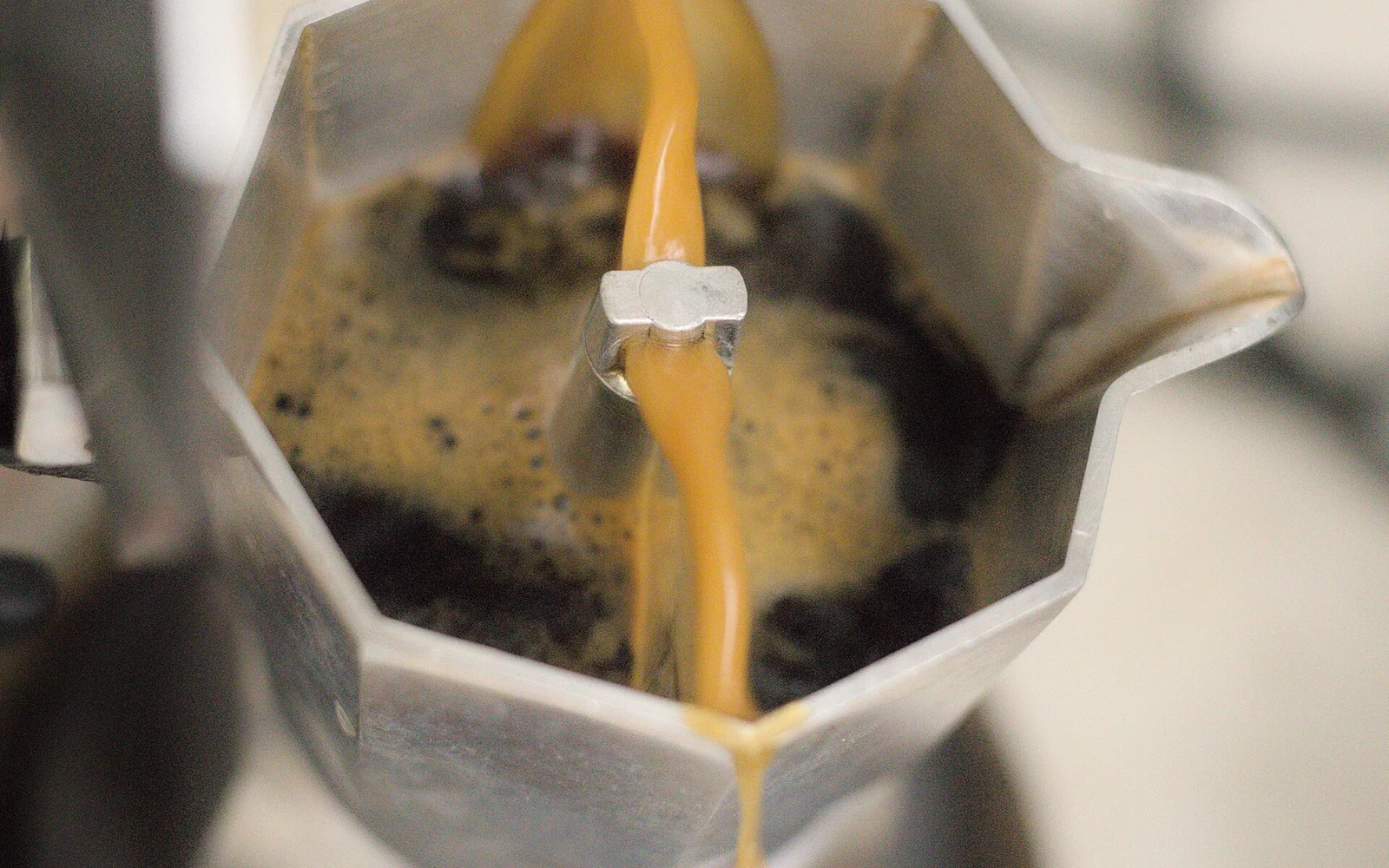
Remove the pot from the heat when the upper chamber has filled. Stumptown uses the color of the stream as an earlier cue and removes the pot when the coffee turns light, then cools the base to halt extraction. Whichever stopping cue you use, avoid leaving the pot on high heat through loud, prolonged sputtering.

Stir the coffee in the upper chamber before serving. The first liquid and the final liquid do not have the same concentration, so a quick stir gives each cup a more even mix.
Can you make half a moka pot?
A standard moka pot works most predictably at its designed water and basket fill. Half-filling both chambers changes the headspace, coffee-bed depth and flow resistance at the same time. The result is harder to repeat, even if the arithmetic still looks like 1:10.

Do not cover part of the basket, improvise a spacer or tamp a shallow dose to make it stay in place. If you regularly need one small serving, a 1-cup, 2-cup or 3-cup pot gives you a stable chamber and basket geometry.
Causes of weak, harsh or spurting moka pot coffee
| Symptom | Check first | Next controlled change |
|---|---|---|
| Weak or thin | Basket was loosely filled to the intended level; no channel or missing grounds | Try a slightly finer grind while keeping dose, water and heat steady |
| Harsh or bitter | Heat was not excessive; brewer was removed before prolonged sputtering | Lower the heat or try a slightly coarser grind |
| Slow flow | Coffee was not tamped; grind is not espresso-fine; filter and funnel are clear | Cool and clean the pot before changing one variable |
| Spurting or valve venting | Stop heating, move away and let the pot cool fully | Check the fill level, untamped basket, clean passages, gasket and valve before reuse |

If the safety valve vents after you correct the water level, grind and basket fill, stop using the brewer until it has been inspected and the affected parts have been serviced or replaced. Do not block, adjust or defeat the safety valve.
For the Moka Express, Bialetti specifies hand washing with water and says not to use detergents, abrasive products or a dishwasher. Let every part dry before reassembly. Clean grinder burrs also make a baseline dose easier to repeat; see the manual coffee grinder cleaning guide.

If the ratio is steady but the flow changes, check cleaning and sealing before changing the dose.
Frequently asked questions
What is the best moka pot coffee ratio?
A practical moka pot coffee ratio starts near 1:10 by mass, such as 20 g coffee with 200 g water. The safe fill line and the untamped basket take priority over the number. Weigh your own pot once, record the actual ratio, then adjust grind and heat before changing both amounts.
How much coffee and water go in a 3-cup moka pot?
A 3-cup Bialetti Moka Express has a 150 ml lower chamber and a nominal 130 ml output. The official manual tells you to fill its basket without tamping rather than giving a coffee weight. Weigh the loose, level basket once, then reuse that dose with water kept below the safety valve.
How much coffee and water go in a 6-cup moka pot?
A 6-cup Bialetti Moka Express has a 300 ml lower chamber and a nominal 270 ml output. Steampunk Coffee starts a 6-cup brewer with 27–30 g coffee and 300 g water. Confirm that 300 g matches your model’s safe fill and keep the basket loose rather than tamped.
Can I make one cup in a 2-cup moka pot?
A 2-cup moka pot is designed around its full safe water level and full untamped basket. Half-filling changes the coffee-bed depth and flow. For a smaller drink, use a smaller moka pot or a manufacturer-approved reducer supplied for that model. Do not improvise a spacer or press a partial dose.
Why is my brewed coffee less than the water I added?
A moka pot does not transfer every gram of lower-chamber water into the cup. Some water remains in the base, and the coffee bed retains water. Bialetti lists 300 ml lower-chamber capacity and 270 ml nominal output for its 6-cup Moka Express, so input water and beverage yield are different figures.
References
- Bialetti: Moka Express instructions, capacities, filling, heat and cleaning
- Stumptown Coffee Roasters: 4-cup dose, water line, basket fill and stopping method
- Steampunk Coffee: 90–100 g/L starting ratio and 4-cup and 6-cup examples
- Alternative Brewing: Bialetti Moka Express demonstration
Featured photo: ajay_suresh, CC0.