
Cover photograph: Chuck Grimmett, CC0.
Use the roaster’s recommendation for your coffee, counted from its roast date. There is no single waiting period established by the recommendations below: Tim Wendelboe suggests approximately 5–10 days for its coffees, April at least 14 days, and La Cabra at least 10 days. These are roaster-specific starting points, not interchangeable espresso standards. [1–3]
If your bag has an espresso-specific recipe or rest recommendation, start there. If it does not, ask the roaster when to begin brewing that particular coffee and keep a few notes as you use it. You are choosing when to start learning the bag, not finding a date that guarantees a perfect shot.
Each rest recommendation belongs to its coffee
It is tempting to collect every number online and turn the shortest and longest into a universal “best window.” That loses the conditions attached to each recommendation.

| Roaster | Published rest guidance | What the guidance does not establish |
|---|---|---|
| Tim Wendelboe | Approximately 5–10 days after roasting [1] | A rule for every roast sold by other companies |
| April | At least 14 days before brewing [2] | That all coffee peaks precisely on day 14 |
| La Cabra | At least 10 days; it also reports good results with some particularly dense coffees beyond six weeks [3] | That all espresso beans should be stored for six weeks before use |
Checked October 7, 2026. These pages discuss the roasters’ coffees and brewing practices; they are not three controlled trials using identical beans, roast profiles and espresso equipment.
Read a specific coffee’s current instructions before applying a general FAQ. Also check the brewing method. La Cabra’s resting page includes V60 examples; those temperatures, pours and contact times should not be copied directly into an espresso recipe. [3]
A recommendation is still useful without being universal. It tells you what the producer expects from its own coffee. The next useful question is whether your particular bag has more specific guidance.
Rest time counts from roasting, not from delivery or opening
Record the roast date and the date you first brew. Keep the opening date too, but do not reset the roast-age clock when you break the seal.
Here is a calendar example, not a coffee recommendation. A bag roasted on September 1 reaches 14 elapsed days on September 15. If it arrives on September 10, waiting another 14 days after delivery would take it to September 24, when it is 23 days from roast.

Both calculations are valid arithmetic. They answer different questions. Write “days after roast” beside the number so that you and the roaster are talking about the same interval.
| Date on your notes | What it tells you |
|---|---|
| Roast date | Starting point for roast age |
| Delivery date | When you received the bag |
| Opening date | When the sealed bag was first opened |
| Brew date | Date of the observation you are recording |
| Best-before date | A separate package statement; it does not supply an exact roast date |
When the roast date is missing, do not reverse-engineer it from a generic shelf-life assumption. Ask the seller what the printed date means. The coffee-bag reading guide covers the other label details worth recording.
What does resting change?
Roasted coffee releases gas after roasting. Both Tim Wendelboe and La Cabra discuss this degassing period when explaining why they rest their coffees. La Cabra also describes how its own brewing approach changes as its coffees age. [1, 3]
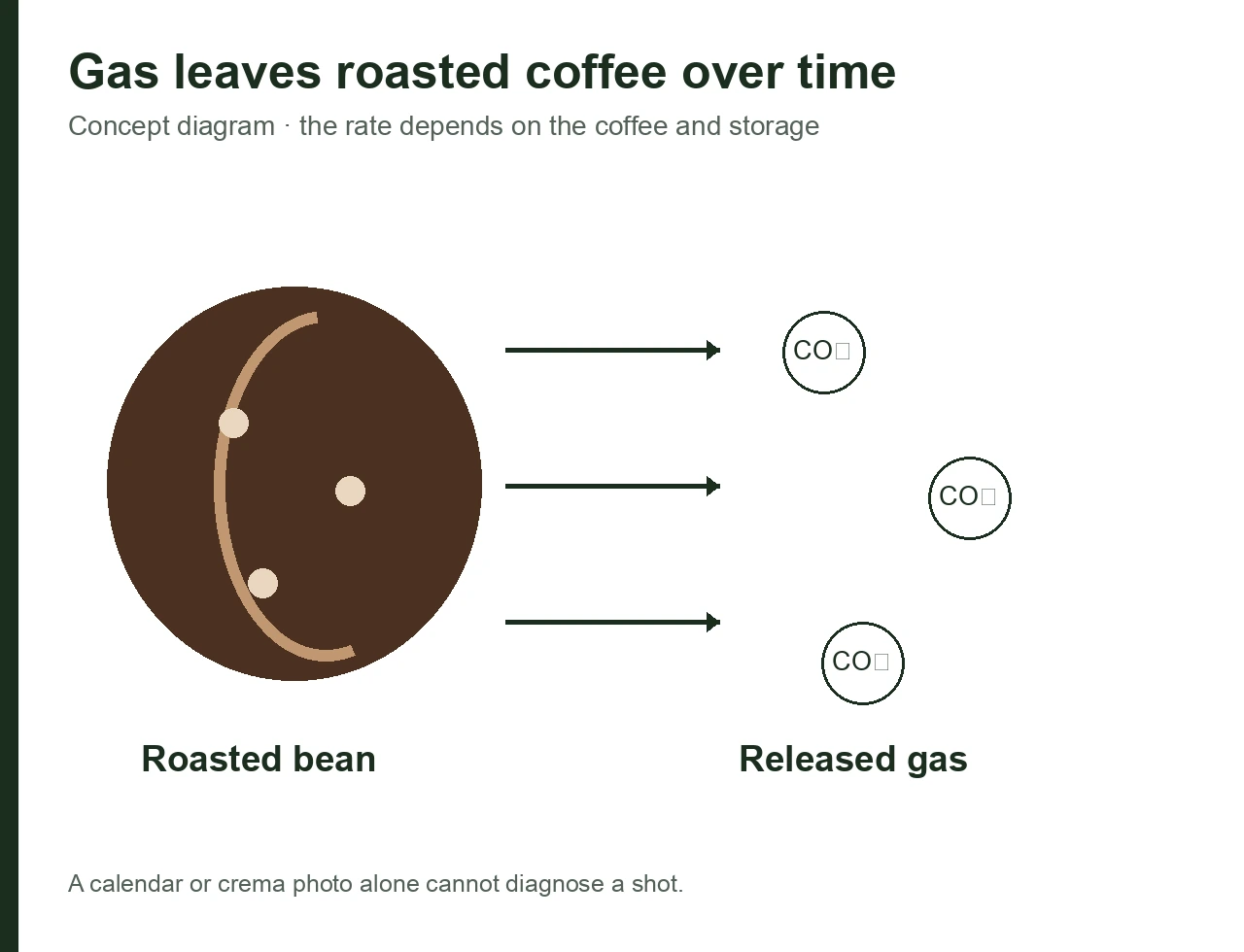
That gives you a reason to consider age when a fresh bag is awkward to dial in. It does not let you diagnose a bad shot from the calendar alone. A day count contains no information about your dose, grind setting, yield or preparation. Record those rather than assuming another week will resolve everything.
Do not use crema appearance as a countdown clock. Even without deciding what caused a particular appearance, it cannot identify the exact roast date, storage history and recipe together. Treat what you see and taste as observations, not as proof that all beans of that age behave alike.
The practical choice is modest: follow the bag’s guidance, make a repeatable first attempt, and leave enough coffee for a later comparison. There is no need to throw away the first part of the bag just to obey a number borrowed from another roaster.
A small, repeatable home comparison
The following is a suggested way to keep notes. It is not an HBM test result or a laboratory protocol, and it will not isolate every effect of aging.
Start around the time your roaster suggests. Choose a recipe appropriate to your basket and coffee, then record the dose, beverage weight and time. Note the grinder setting, machine and temperature setting if your machine exposes one. Do not invent a brew-water temperature from a display that measures something else.
For example, you could compare an early session with another session a few days later, without treating that interval as a new universal rule. Keep the same coffee, water, basket and preparation routine. Separate the first shot after warming the machine from later shots if the warm-up routine differs.
Copy the blank table into your notes and fill it during each brew. Enter your own dates and readings in the spaces; the table contains no test results. Use “not recorded” or “not applicable” where needed.
| Brew date / days from roast | Dose / beverage weight | Grind setting / time | Other changes | Taste note / next move |
|---|---|---|---|---|
| First planned session | ______ | ______ | ______ | ______ |
| Later comparable session | ______ | ______ | ______ | ______ |
| Next useful comparison | ______ | ______ | ______ | ______ |
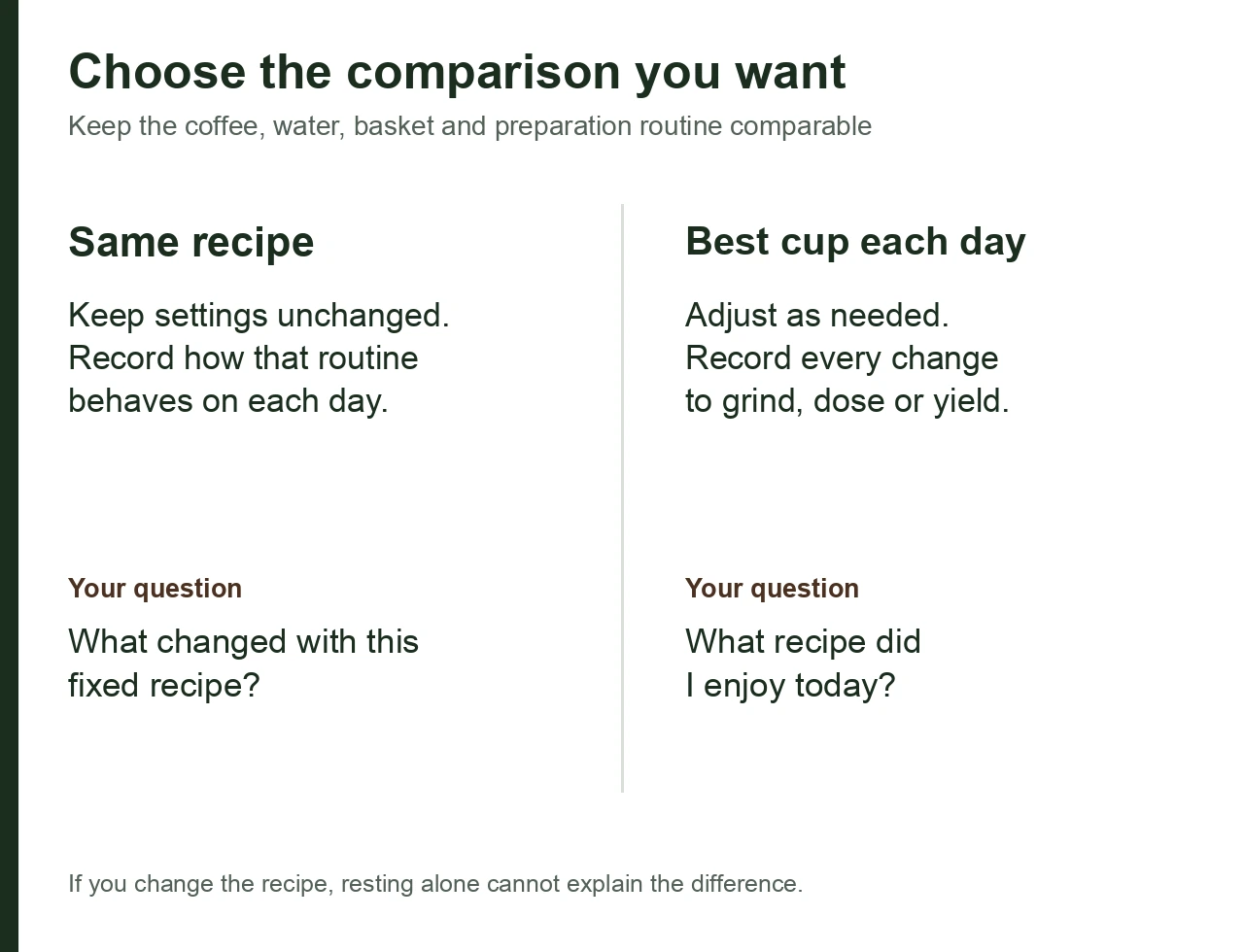
You do not have to freeze the grind setting for the entire bag. Decide which of two questions you are asking:
Same-recipe observation: keep the recipe and settings unchanged for the comparison, then describe what changed. This shows how that fixed routine behaved on those days.
Best practical brew on each day: adjust the recipe as needed and record every change. This shows how you made a cup you liked, but it cannot attribute the result to resting alone.
If you need to adjust the recipe, the dose or grind first guide explains which variable to change.
Either can help at home. Mixing them without notes is what makes the conclusion confusing. “Day 18 tasted sweeter after I changed the grind and increased yield” is a useful record. It is not evidence that six extra resting days caused the entire improvement.
Waiting is not a storage experiment
Follow the coffee’s storage guidance while it rests. Do not spread beans over the counter or leave the bag permanently open to try to accelerate the calendar. That changes the storage conditions as well as the elapsed time and makes your comparison harder to interpret.
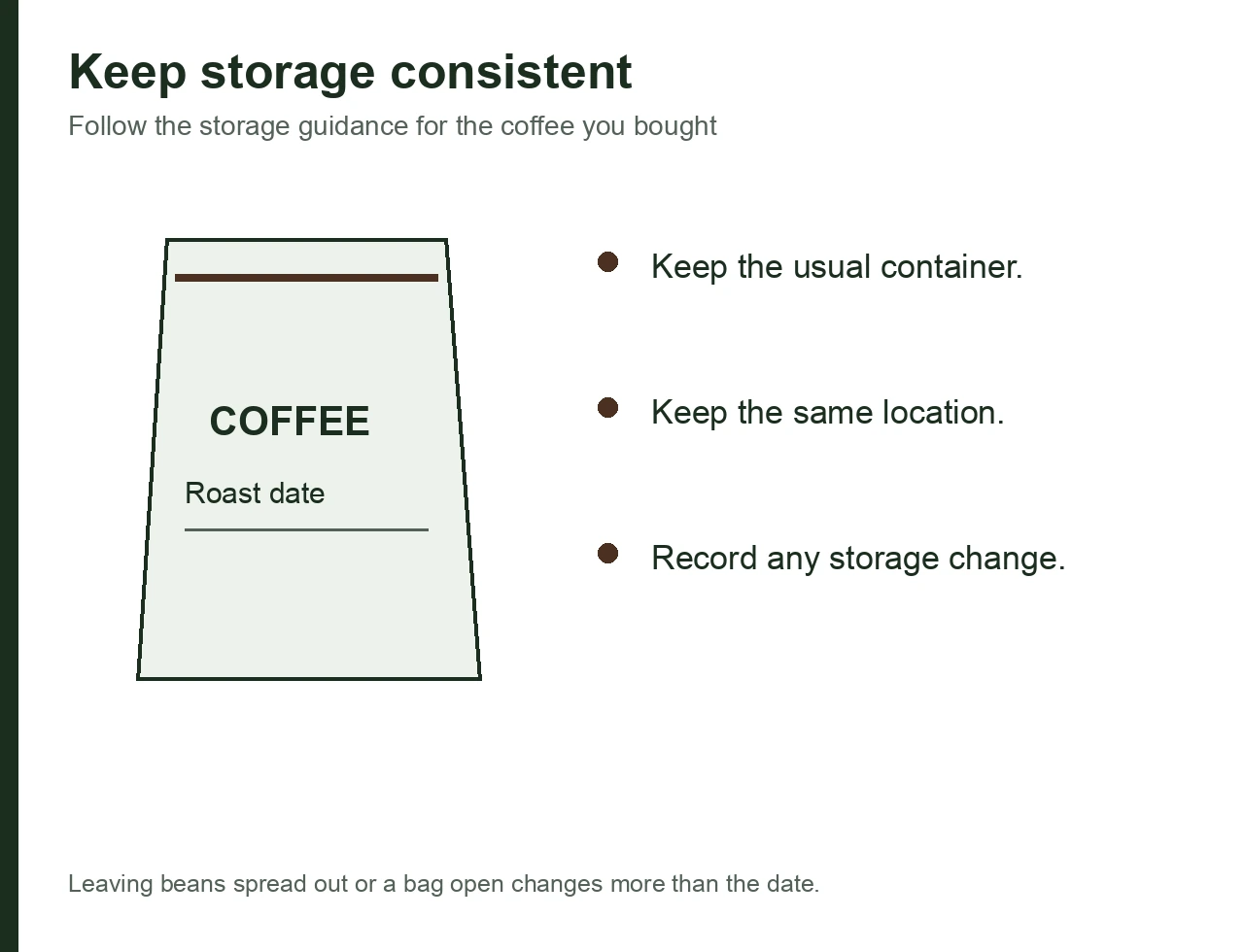
Keep the storage method consistent between observations and record a change if you make one. Freezer handling, a new canister and repeated exposure to a hot location belong in the notes; they should not disappear behind the single label “rested.” For storage choices, use the separate coffee storage guide.
Resting and useful life also answer different questions. This page helps choose a first brewing session and interpret later observations. It does not set a use-by deadline. For that broader question, see how long coffee beans last.
What should you do with the bag in front of you?
| Your situation | A useful next action |
|---|---|
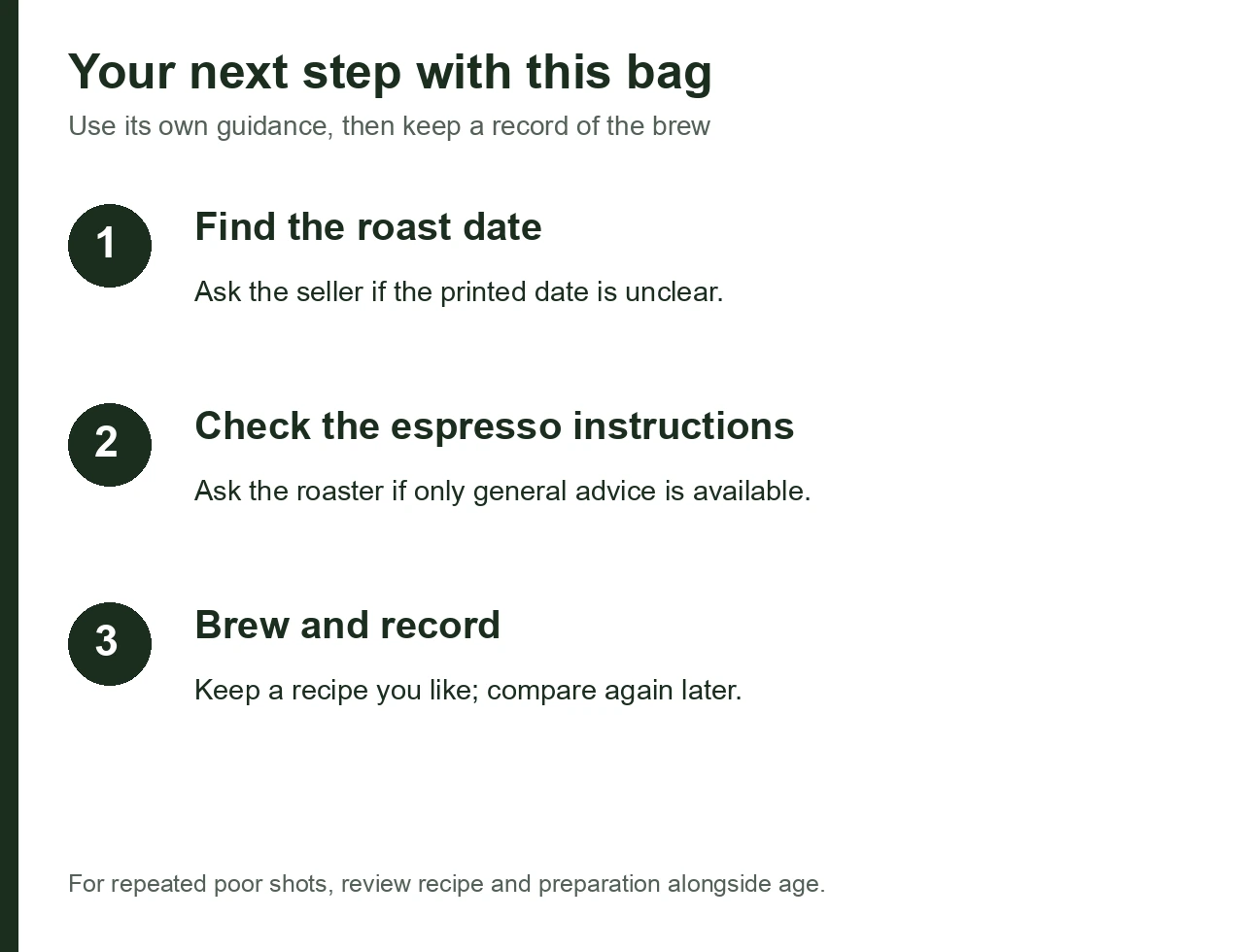
| The bag gives a rest interval and espresso recipe | Start with those instructions and record the first brew |
| The roaster has only a general FAQ | Ask whether the specific coffee has a different espresso recommendation |
| Delivery has already taken part of the stated rest period | Calculate roast age; do not automatically add the whole interval again |
| You brewed early and liked the cup | Keep the result, then compare later rather than discarding a successful recipe |
| Several attempts are unpleasant | Review preparation and recipe alongside age; contact the roaster with the actual numbers |
| You are about to run out of coffee | Plan the next bag’s first-use date using its own recommendation |
A useful question for the roaster is: “This coffee was roasted on this date, and I am using this machine and grinder. When do you recommend beginning espresso, and what dose and yield should I start from?” That gives them something more specific than “How fresh is too fresh?”
Questions about resting espresso beans
Must every light roast rest for two weeks?
The recommendations here do not establish that rule. April’s minimum of 14 days concerns its own coffee and practice. Use the recommendation attached to your actual bag, then judge your results rather than treating the roast-level label as a complete brewing instruction. [2]
Is coffee at its best the moment the rest period ends?
A suggested minimum tells you when a roaster recommends starting. It does not identify a single peak day for your equipment and taste. Keep a short record of the brews you enjoy so that the next order of the same coffee starts with evidence from your own setup.
Does opening the bag start the resting period?
Roast-age recommendations count from roasting. Opening is a separate event worth recording. A coffee roasted ten days ago does not become day zero again when the bag is opened.
Can waiting longer replace dialing in?
A longer wait does not set your dose, grind or yield. Use age as one part of the record, not the only adjustment. If you change the recipe while the coffee ages, write down the change so the next comparison remains understandable.
Record the roast date and the roaster’s recommendation now. After the first session, save one recipe you would willingly repeat. That gives the next bag a useful starting point.
Related HomeBaristaMods guides
References
- Tim Wendelboe — FAQ. Its own coffee’s rest and consumption guidance.
- April Coffee — FAQ. “Resting your coffee” section.
- La Cabra — Water and Resting Coffee. Roaster-specific recommendations; its detailed recipe examples are for V60.