

A milk pitcher should never be filled to its rated capacity before steaming. You need enough milk for the steam tip to work properly, but also enough empty space for the milk to expand as air is added.

Why does the pitcher need empty space?
Steaming does two things at once: it heats the milk and, during the aeration phase, adds air. That increases volume. If the pitcher starts too full, you have very little room for expansion and it becomes harder to create a controlled vortex without spilling.
Too little, workable starting point, too full
The wand may be difficult to position at the surface, and a small quantity of milk heats quickly.
Leave room for the milk to expand while meeting your machine’s starting fill instructions.
Not enough headroom. Expansion and vortex control become harder, and spills are more likely.
Is one-third full an official rule?
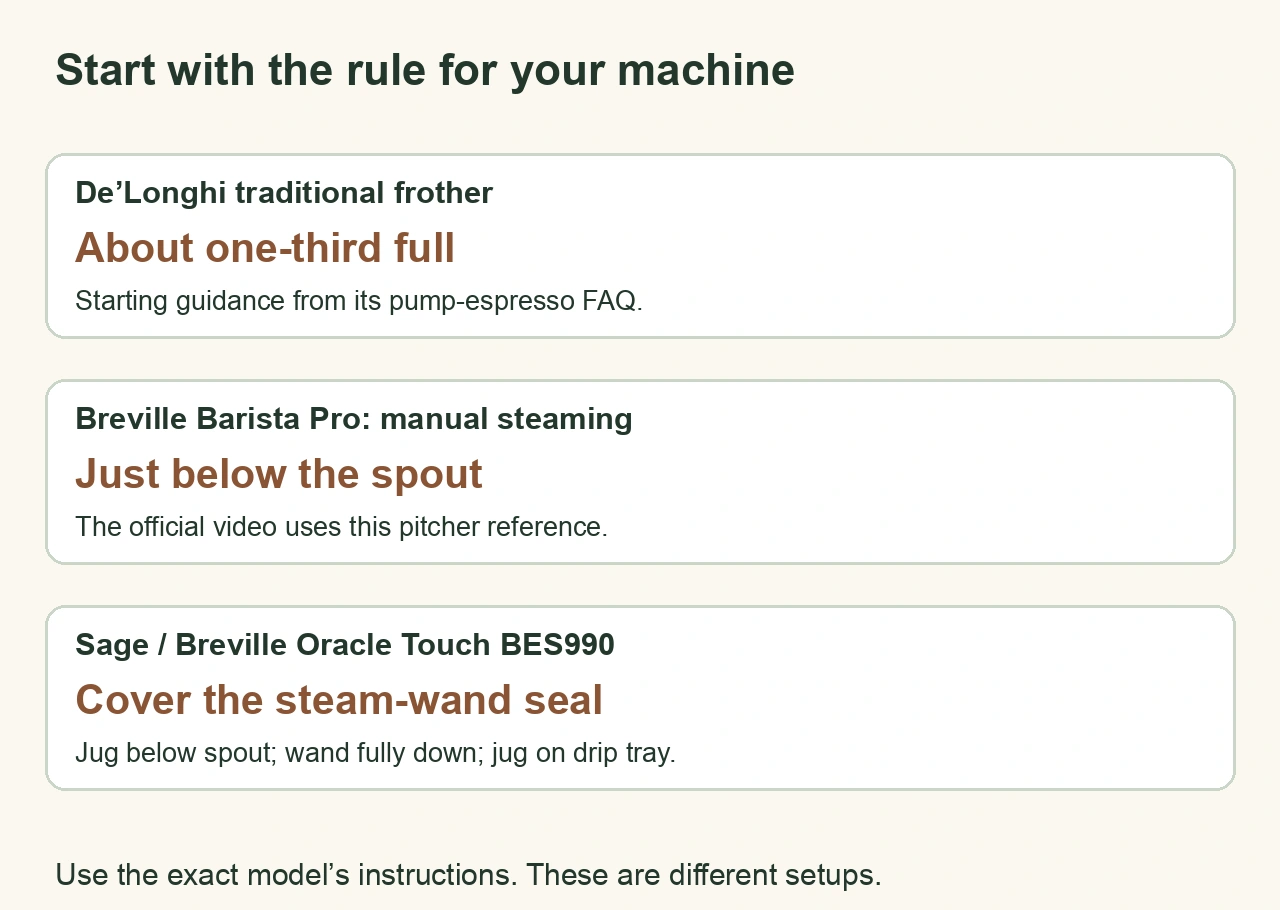
De’Longhi’s pump-espresso FAQ says to fill the jug up to one-third for its traditional-frother cappuccino method. The milk expands as air is added. That instruction belongs to that frothing setup; a manual steam wand or an automatic milk-texturing system may have a different starting level.
For automatic texturing on the Sage / Breville Oracle Touch BES990, the manual says to fill below the spout, lower the wand fully and place the jug on the drip tray. The milk must cover the steam-wand seal. Keep that model’s fill limits even if you only want a small drink; do not apply its seal rule to every Breville machine.
Does a 12 oz or 17 oz pitcher mean you should pour in 12 oz or 17 oz of milk?
No. Those are the labeled jug sizes: De’Longhi lists the DLSC060 at 12 oz / 350 ml and the DLSC069 at 17 oz / 500 ml. They are not instructions to start steaming with that much cold milk. Leave expansion room and follow the machine’s fill guidance.
Pitcher capacity ≠ starting milk volume
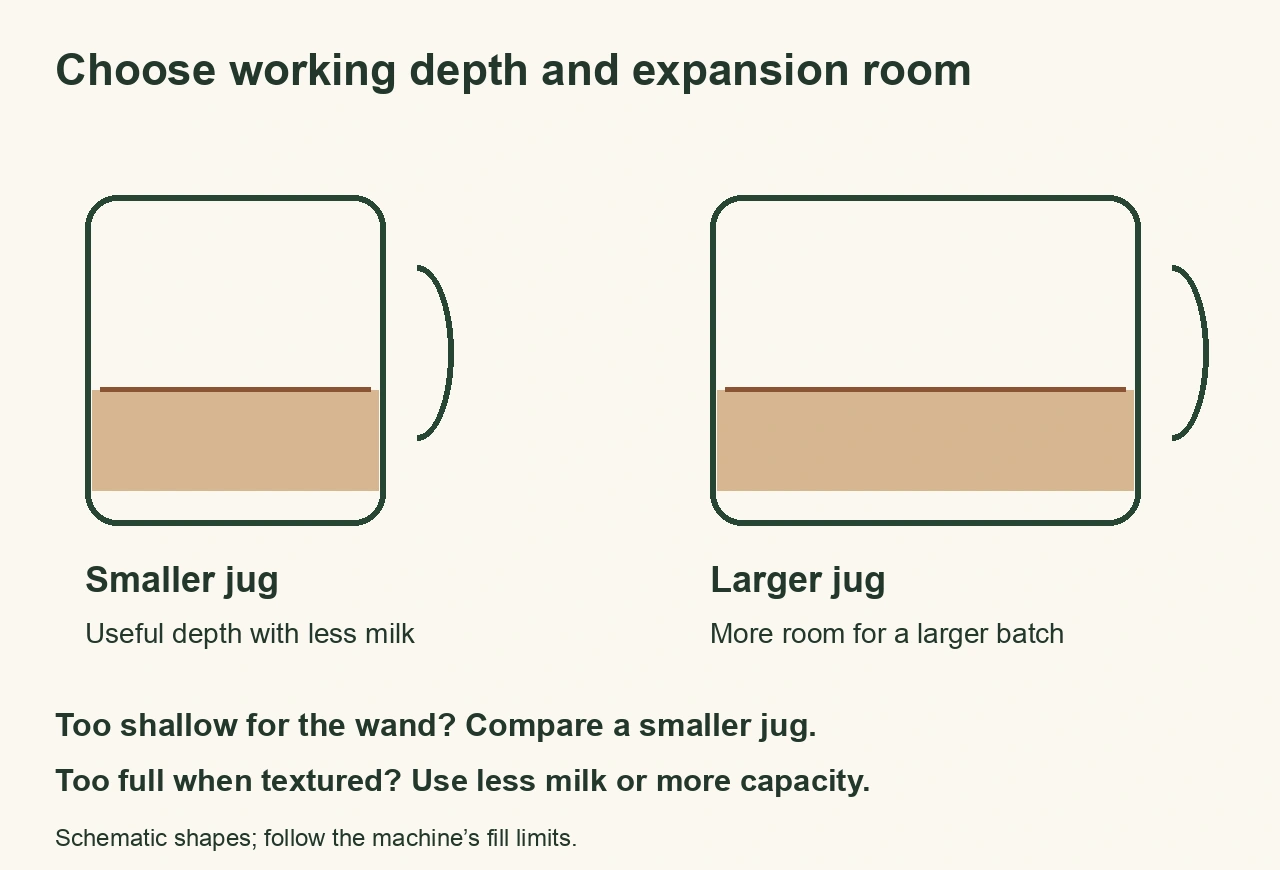
Smaller working space can suit one modest milk drink. Start below full capacity and leave room for expansion.
More headroom can help with larger drinks or more milk, but you still do not use the full 500 ml as the steaming fill.
Check your machine’s fill limits before choosing a starting quantity. These bars are not calibrated measuring marks.
How much milk should you use for one drink?
Start from the finished drink, then work backward. A smaller flat white needs less total milk than a large latte. You also need to account for expansion and a little milk left in the pitcher after pouring.
Do not use the cup volume as a one-to-one milk volume. The cup already contains espresso, and the milk changes volume when you add air.
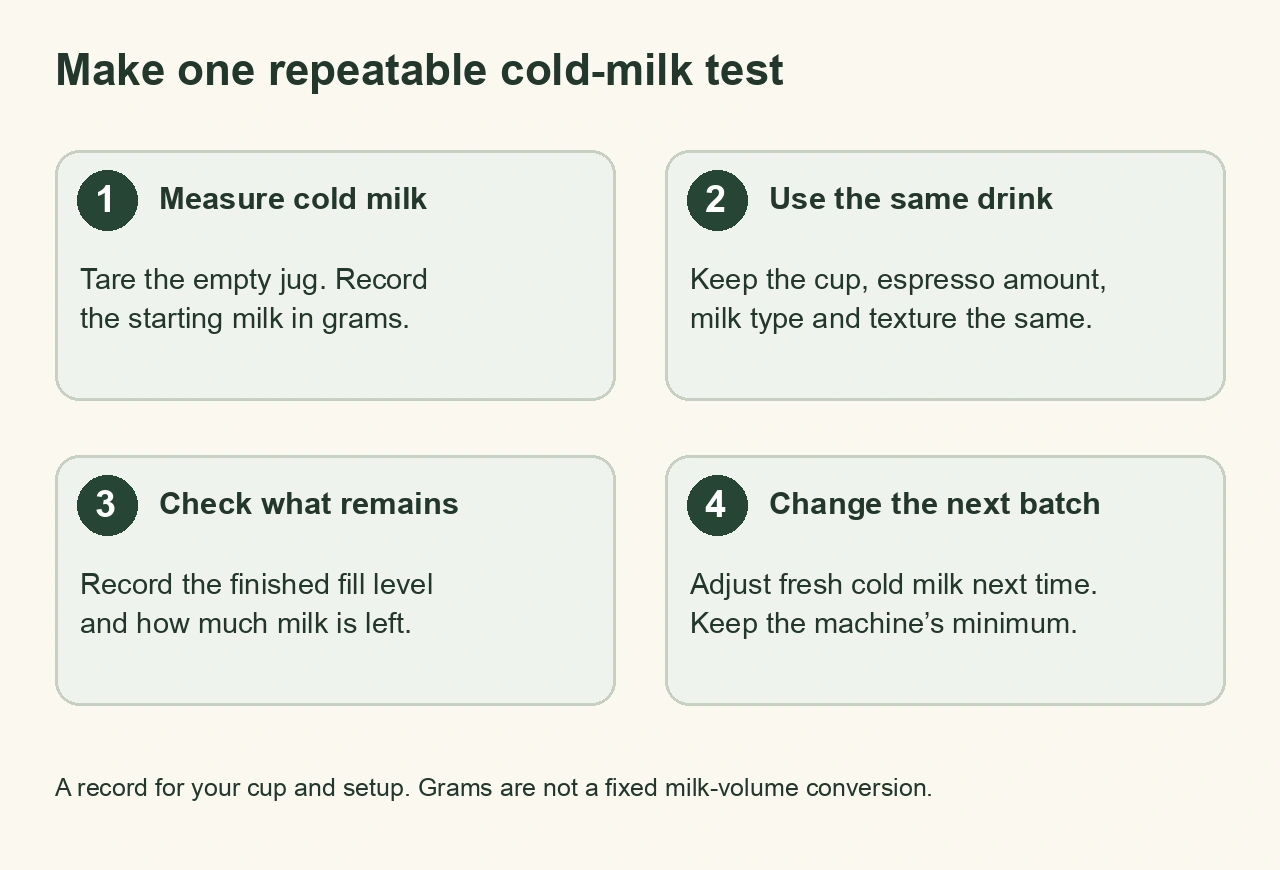
To find a repeatable quantity for your cup, keep the cup, espresso amount, milk type and foam texture the same for a few drinks:
- Put the empty jug on a scale and tare it. Add fresh cold milk within the machine’s fill limits, then record the weight in grams.
- Steam and pour your usual drink. Note whether you reached the desired cup level and how much milk remained.
- For the next drink, reduce the fresh cold-milk quantity if you had more left over than you needed, or increase it if the cup was short. Change only the starting quantity.
Use grams to repeat your own starting amount, without treating them as an exact conversion to milk volume or finished cup volume. A stable kitchen or coffee scale can help. If the automatic-steaming minimum leaves excess milk, check for a manufacturer-approved smaller jug or another supported steaming method before reducing the fill further.


What happens if there is too little milk?
Very low milk volume can make positioning awkward. Depending on the jug and wand geometry, the tip may be difficult to keep near the surface at a usable angle. The small milk mass can also heat very quickly, leaving less time to add air and create fine foam.
If you regularly make very small drinks, check whether a smaller pitcher fits your machine’s wand and steaming requirements. Follow the machine’s temperature instructions; the milk-temperature guide covers the separate question of when to stop heating.
For plant milk, keep the same carton type during this test. See the oat-milk frothing guide if the foam changes when you switch milk.
What happens if there is too much milk?
Overfilling causes the opposite problem. The milk has less room to expand, the vortex may be harder to establish, and the pitcher can overflow as the volume increases. A larger milk mass also asks more of a small single-boiler or thermoblock steam system.
If the pitcher is sensibly filled but the machine still cannot build a stable vortex, use the microfoam troubleshooting guide before buying a different pitcher.

How do you choose the right pitcher size?
Choose a pitcher that holds the milk you need with expansion room left over, while letting the wand reach the working depth. Check wand clearance, grip and any automatic-texturing requirements. If a wide jug leaves your usual quantity too shallow, a compatible smaller jug may be easier to use.
| Your normal use | What matters most | Practical direction |
|---|---|---|
| One small flat white / cappuccino | Enough depth without excess waste | A smaller pitcher is often easier to control |
| One larger latte | More liquid volume plus expansion room | Move up a pitcher size if the smaller jug crowds the milk |
| Two milk drinks at once | Steam power and vortex control | Use a larger pitcher only if the machine can texture that amount well |
| Very small milk quantity | Steam tip cannot sit correctly in a large jug | Use a smaller pitcher instead of underfilling a very large one |
Should the milk reach the bottom of the spout?
Breville’s official Barista Pro manual-steaming demonstration starts with fresh cold milk just below the spout. That is a useful reference for the demonstrated setup. Pitcher shapes vary, so the same height does not identify a fixed milk volume in every jug.
For machines with automatic milk texturing, follow the machine's marked MIN/MAX range or sensor/seal requirement instead of copying a manual-steaming rule.
For manual steaming, turn off the steam before withdrawing the tip. Wipe and purge the wand as directed by the manufacturer, and clean the jug before the next drink.

FAQ
Can I fill the pitcher halfway?
Follow the machine’s fill guidance first. Half-full can work on a manual setup when there is enough room for expansion and the wand can circulate the milk. De’Longhi’s one-third instruction applies to its traditional-frother method; automatic texturing may impose different minimum and maximum levels.
Why does my milk spill even though I did not fill to the top?
The milk expands during aeration. If you add a lot of air, a starting level that looked safe can still climb quickly. Within the machine’s fill limits, use less starting milk or add less air if the foam is thicker than your drink needs.
Why does a small amount of milk heat too fast?
There is less thermal mass. The same steam power raises the temperature faster, which gives you less time to create fine microfoam.
Should I buy a 12 oz or 17 oz pitcher?
Match the pitcher to your normal drink size and machine steam power. De'Longhi sells both 12 oz / 350 ml and 17 oz / 500 ml examples, and both require room for expansion during steaming.
Does pitcher size change latte art?
It can. A pitcher that is wildly too large or too small for the milk volume can make vortex control and pouring less comfortable. Spout design also affects pouring, but good microfoam matters more than the label on the pitcher.